
Academic Calendar of Events

https://undergradresearch.washu.edu/xml/events/13266/rss.xml
21643

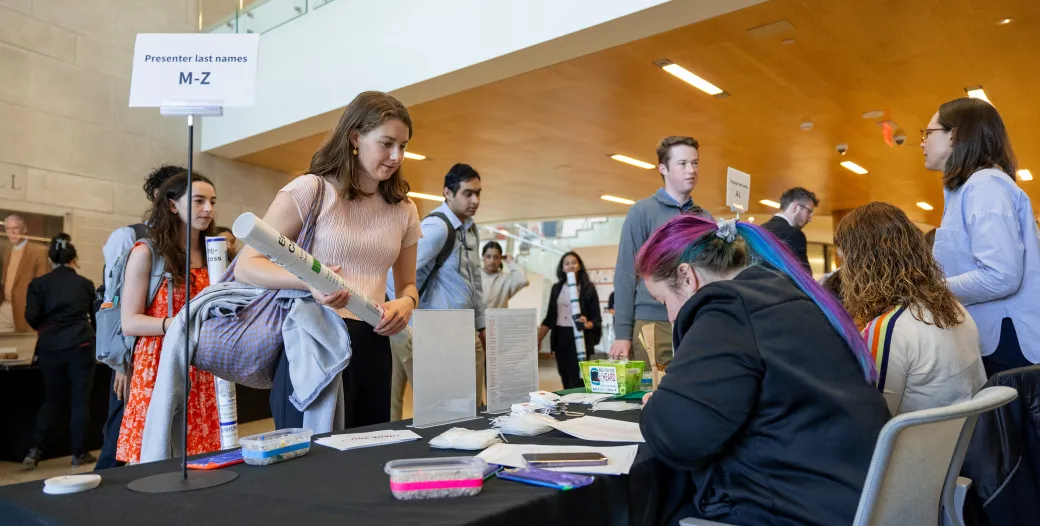
Spring 2026 Undergraduate Research Symposium

The Office of Undergraduate Research (OUR) hosts Undergraduate Research Symposia twice a year, showcasing the diverse range of research and creative inquiry conducted by WashU undergraduate students and mentored by WashU faculty. Visit the Spring 2026 Symposium webpage for more information. 

The symposia provide an opportunity for undergraduate students to share their work, engage in peer networking and cross-disciplinary conversations, and develop presentation skills. Any WashU student is welcome to present their project, including works in progress.

For students who are interested in getting started in research, the symposium is a great opportunity to learn about the process from your peers. All WashU community members are encouraged to attend! 

Key Dates

  • Wednesday, February 4: Registration opens. Registration is required for all symposium participants; no students are automatically registered. Registration includes a tentative title and abstract.
  • Wednesday, March 4: Registration closes
  • Wednesday, March 11: Presenters notified of session assignment
  • Wednesday, March 18: Deadline for presenters to confirm participation
  • Wednesday April 8: Submission deadline - final title, abstract, and presentation file for online program due*
  • Friday, April 17: Symposium from 10 am - 4:30 pm in Frick Forum (1st floor) and other locations in Bauer/Knight Halls

*All presenters must submit a presentation file (e.g., PDF of poster, slides, or exhibit) for the online program (see the Fall 2025 URS program). This file will be VISIBLE TO THE PUBLIC as submitted, so it is critical for students to discuss their submissions with their faculty mentors. If there are IP concerns and data cannot be publicly disclosed, students should coordinate with the OUR to protect sensitive information.

https://gradstudies.artsci.washu.edu/xml/events/16004/rss.xml
22056

Global Pathways: A&S Grad International Alumni Panel

Join the Office of Graduate Studies to hear from international alumni of A&S graduate programs! You will learn about panelists' pathways to their current careers, how they navigated the job market, and which opportunities or resources helped them feel most prepared.
 
We will then transition into breakout rooms for more nuanced discussions, which will give you a chance to expand your connections, share your own story and goals, and ask specific questions. We encourage you to come ready to engage!
 
Panelists will include:
  • David Balmaceda Marenco, PhD Education 2024, Visiting Lecturer of Spanish at University of Massachusetts Lowell
  • Xiannong Zhang, PhD Economics 2022, Data Scientist at Google
  • Yi-Ling Lin, PhD Anthropology 2021, Associate Director of Advancement at Indiana University
RSVP to receive the Zoom link. This event is designed for A&S graduate students, but all students are welcome if you feel the content might resonate with you. 
 
Special thanks to the Center for Career Engagement's PhD & Postdoc Career Community and Employer Engagement teams for their support of this event!
https://classics.washu.edu/xml/events/14813/rss.xml
22091

Lecture: Understanding Greek and Roman Manumission

Meyer headshot

Elizabeth A. Meyer, T. Cary Johnson, Jr. Professor of History at the University of Virginia, is a leading scholar of Greek and Roman history, specializing in legal epigraphy, documentary practices, and the social dimensions of law in antiquity. Her work has illuminated how inscriptions and legal texts shaped ancient societies, with particular focus on manumission and the transition from slavery to freedom.


Closing Lecture: “Understanding Greek and Roman Manumission”

Abstract 
This lecture will compare what we know about Greek practices of consecration, manumission, and inscribing with what is known of contemporary Roman practice. Did the Roman presence in Greece in the Second Macedonian War and after have any impact on the frequency or contents of the legal actions pursued?

https://classics.washu.edu/xml/events/14812/rss.xml
22092

Seminar: Reconstructing Monuments with the Help of Inscriptions

Meyer headshot

Elizabeth A. Meyer is the T. Cary Johnson, Jr. Professor of History at the University of Virginia. A specialist in Greek and Roman history, her research focuses on legal epigraphy, documentary practices, and the social dimensions of law in antiquity. She has published extensively on Greek manumission inscriptions, Roman legal documents, and the cultural significance of writing in the ancient world.


Seminar: “Reconstructing Monuments with the Help of Inscriptions”

Abstract
This seminar is designed as a practicum in understanding the relationship between the inscribed text and the stones on which these texts are inscribed—and what adding in the factor of 'where' and 'on what?' texts are inscribed can add to our understanding of the practices undertaken.

Recommended Reading

P. Funke, “Chaeronea,” in Brill’s New Pauly 

Sosin, J. D. (2023) "Manumission at Chaironeia," Zeitschrift für Papyrologie und Epigraphik 227: 81-96.

S, Peels-Matthey, Andrej Petrovic, Ivana Petrovic, “What is Sacred in the Sacred Regulations?” forthcoming in Meanings and Values of the Sacred in Greco-Roman Antiquity, Penn-Leiden Colloquium on Ancient Values XII.

https://classics.washu.edu/xml/events/14811/rss.xml
22093

Colloquium: Manumission in Hellenistic Greece

Elizabeth Meyer

Elizabeth A. Meyer is the T. Cary Johnson, Jr. Professor of History at the University of Virginia. She earned her A.B. (1979), M.A. (1982), and Ph.D. (1988) from Yale University, and specializes in Greek and Roman history with a focus on legal epigraphy, ancient law, and documentary practices. 

Her scholarship has significantly contributed to our understanding of social and legal phenomena in antiquity, particularly:

  • Ancient manumission and slavery, through her work on Greek manumission inscriptions and their social contexts.
  • The evolution of documentary practice in Roman law and Greek epigraphy.
  • Broader themes in Greek and Roman society, including literacy, political institutions, and regional histories (e.g., Molossia, Dodona). 

Meyer is the driving force behind an innovative electronic archive of Greek manumission inscriptions, designed to serve both specialists and general audiences. This archive features high-quality images, textual transcriptions (in both Greek and English), metadata, and tagging to facilitate comparative and interdisciplinary research. 


Colloquium: “Manumission in Hellenistic Greece"

Abstract
Slavery and the release from slavery has a long history in ancient Greece, but the evidence for it is very uneven and the status (and the lives) of the freed are difficult to determine. The later Hellenistic period, starting in around 205 BC, provides much more extensive evidence about legal actions involving the enslaved, all of it from inscriptions, and almost all of it from central and western Greece. This lecture provides an overview of these legal actions, which took different forms in different places with different legal results (not all resulting in freedom), and explores what all had in common and what might have provoked this explosion of inscribing in these places at this time.


https://classics.washu.edu/xml/events/14810/rss.xml
22094
-

2026 Biggs Family Residency in Classics

Elizabeth Meyer

The 2026 Biggs Family Resident in Classics will be Elizabeth Meyer of The University of Virginia. Professor Meyer specializes in Greek and Roman political and social history, particularly in relation to law. Her research explores the intersections of legal and documentary practices in the ancient world, with a focus on Roman law, literacy, manumission, and epigraphic traditions. Meyer's work sheds light on how legal and archival developments shaped broader societal structures in antiquity.

The Colloquium, Seminar, and Lecture will be followed by receptions.

Colloquium 

"Manumission in Hellenistic Greece"
Monday, March 23, 2026
4PM
Location: Umrath Lounge

Ancient Historian Panel

"Ancient Worlds: A Conversation with Leading Historians"

Roger Bagnall, WashU
Suzanne Marchand, Louisiana State University
Elizabeth Meyer, University of Virginia and the 2026 Biggs Family Resident in Classics
Jonathan Price, Tel Aviv University
Michael Scott, University of Warwick
 

Tuesday, March 24, 2026
4PM
Goldberg Formal Lounge | 2nd floor of the Danforth University Center

Seminar 

"Reconstructing Monuments with the Help of Inscriptions"
Wednesday, March 25, 2026
4PM
Danforth University Center (DUC) 276

Lecture 

"Understanding Greek and Roman Manumission"
Thursday, March 26, 2026
4PM
Holmes Lounge

22097

‘Unimaginable Atrocities’: The Neglected Catastrophe in Sudan and the History of Genocide in the Region

Please RSVP by following this link.

Political scientist and former international journalist Scott Straus will discuss the ongoing mass atrocities occurring in Sudan. He will place the atrocities in historical and regional context and explore the implications for contemporary policies of genocide prevention.

22098

Censoring Education and Policing Minds – A Global Trend

Higher education is under unprecedented attack, from large public universities to small liberal arts and community colleges. This talk discusses why this is happening and links events in the United States to similar attacks on higher education in countries around the world. What does this global trend signal in terms of building thriving and inclusive democratic societies?

Please RSVP by following this link.

https://afas.washu.edu/xml/events/14589/rss.xml
22105

The James Baldwin Lecture - Achieving Our Country: Baldwin and U.S. Politics Today

James Baldwin Review is proud to present The James Baldwin Lecture at Washington University in St. Louis. James Baldwin Review is an annual, open-source journal that brings together a wide array of peer‐reviewed critical essays and creative non-fiction on the life, writings, and legacy of the African American writer James Baldwin. The prevailing themes of honesty, responsibility, vulnerability, and justice in Baldwin’s works are vital for our current political moment. In this spirit, The James Baldwin Lecture invites WashU and the St. Louis community to connect with the journal as a forum for the vibrant, multidisciplinary, and international community of Baldwin scholars, students, and enthusiasts.  

The inaugural speaker for The James Baldwin Lecture will be Hortense J. Spillers, Professor Emeritus of English at Vanderbilt University. Her lecture is entitled "Achieving Our Country: Baldwin and U.S. Politics Today."

https://transdisciplinaryfutures.washu.edu/xml/events/13969/rss.xml
22106

mosAIcs & brAIns : the computational aesthetics of mosaic art

Symposium Schedule (please visit this link for abstracts and speakers' affiliations)

Monday, December 8th

08:30am: Coffee & light breakfast

08:50am: Opening remarks by Ralf Wessel, WashU Professor of Physics 

09:00am: Sue Giannotti, Contemporary Mosaics and the Artistic Process: Does AI Have a Place? 

09:30am: Kiyohito (Kyo) Iigaya, Neural and Computational Mechanisms of Subjective Aesthetic Valuation

10:00am: Sam Goree, Is There a Human-Centered Computational Aesthetics?

10:30am: Coffee & refreshments break

11:00am: Gabrielle Starr, Knowledge, Tools, and Art as Active Perception 

11:30am: David Crandall, Learning to See from Biased Experience

12:00pm: Group photo & poster session set-up

12:15pm: Lunch & poster presentations (please visit this link for poster abstracts) 

1:30pm: Karen Ami, Material Consciousness: Mosaic Art as Embodied Practice

2:00pm: Brady Roberts, Uncovering the Properties of Memorable Visual Designs

2:30pm: Ahmed Elgammal, AI Art from the Uncanny Valley to Prompting: Gains and Losses

3:00pm: Coffee & refreshments

3:30pm: Edward Vessel, Making Meaning from Art, and Getting Pleasure from Understanding

4:00pm: Brendan Weekes, Mosaic as Embodiment

4:30pm: Closing remarks

6:00pm: Dinner at Pastaria's deli & wine space (7734 Forsyth Blvd, Suite 2, Clayton, MO). Please email TheIncubator@wustl.edu to inquire, as space is limited.


Tuesday, December 9th 

10:00am: Join fellow attendees for a docent-led tour of the Cathedral Basilica of St. Louis, which houses one of the largest mosaic collections in the world. Please arrive early to the cathedral (located at 4431 Lindell Blvd), as the tour will start promptly at 10am. 

Please be advised that an RSVP is required to join us for meals, and symposium attendance may be capped. 

https://undergradresearch.washu.edu/xml/events/13319/rss.xml
22107

Fall 2026 Undergraduate Research Symposium

Hosted by the Office of Undergraduate Research, the Fall Undergraduate Research Symposium showcases the diverse range of faculty-mentored research and creative inquiry conducted by WashU undergraduate students. More details can be found on the Fall 2026 Symposium webpage. 

Undergraduate Research symposia provide an opportunity for undergraduate students to share their work, engage in peer networking and cross-disciplinary conversations, and develop presentation skills. Any WashU student is welcome to present their project, including works in progress.

For students who are interested in getting started in research, the symposium is a great opportunity to learn about the process from your peers. All WashU community members are encouraged to attend! 

22117

A Counter-Imaginary to Authoritarian Power: Gender, Passion and other Psychosocial Formations

In-person registrations have reached capacity. Please see event details below for livestream registration.

Keynote lecture

4 pm, February 3
Hillman Hall, Clark-Fox Forum

Livestream registration (lecture)

https://polisci.washu.edu/xml/events/15031/rss.xml
22120

Workshop on Politics, Ethics, and Society: The Ethics of Political Representation

The Workshop in Politics, Ethics, and Society (WPES) presents Alex Guerrero (Philosophy, Rutgers) on "The Ethics of Political Representation: Electoral v. Lottocratic".

Rachel Brown (Women, Gender, and Sexuality Studies, WashU) will serve as discussant. This read-ahead workshop takes place in the Weidenbaum Center seminar room (Seigle Hall, Suite 170, Room 152).

Email wupoliticaltheory@gmail.com to receive the paper and RSVP for lunch—all are welcome!

https://polisci.washu.edu/xml/events/15032/rss.xml
22121

Workshop on Politics, Ethics, and Society: Detention and the Limits of Vision in David Taylor’s COMPLEX

Join the Workshop in Politics, Ethics, and Society (WPES) for Ila Sheren (Art History and Archaeology, WashU)'s "Detention and the Limits of Vision in David Taylor's COMPLEX." 

Ben Levin (Law, WashU) will serve as discussant. This read-ahead workshop will be held in the Weidenbaum Center seminar room (Seigle Hall, Suite 170, Room 152).

Email wupoliticaltheory@gmail.com to receive the paper and RSVP for lunch—all are welcome!

https://polisci.washu.edu/xml/events/15033/rss.xml
22122

Workshop on Politics, Ethics, and Society: Measuring Belief Polarization

The Workshop in Politics, Ethics, and Society (WPES) presents Esther Ng (Philosophy, WashU) on "Measuring Belief Polarization." 

Taylor Carlson (Political Science, WashU) will serve as discussant. This read-ahead workshop takes place in the Weidenbaum Center seminar room (Seigle Hall, Suite 170, Room 152).

Email wupoliticaltheory@gmail.com to receive the paper and RSVP for lunch—all are welcome!

https://polisci.washu.edu/xml/events/15034/rss.xml
22123

Workshop on Politics, Ethics, and Society: The Erotic Interest in Privacy

Join the Workshop in Politics, Ethics, and Society (WPES) for Brenda Dvoskin (Law, WashU)'s "The Erotic Interest in Privacy." 

Lori Watson (Philosophy, WashU) will serve as discussant. This read-ahead workshop will be held in the Weidenbaum Center seminar room (Seigle Hall, Suite 170, Room 152).

Email wupoliticaltheory@gmail.com to receive the paper and RSVP for lunch—all are welcome!

https://polisci.washu.edu/xml/events/15035/rss.xml
22125

Workshop on Politics, Ethics, and Society: Eliminating the Engines of Gender

Join us for the final Workshop in Politics, Ethics, and Society (WPES) session this semester. We will discuss Ophelia Vedder (Political Science, WashU)'s "Gender Abolition and the Second Wave: Eliminating the Engines of Gender".

Alex Avery (Political Science, WashU) will serve as discussant. This read-ahead workshop takes place in the Weidenbaum Center seminar room (Seigle Hall, Suite 170, Room 152).

Email wupoliticaltheory@gmail.com to receive the paper and RSVP for lunch—all are welcome!

https://philosophy.washu.edu/xml/events/15116/rss.xml
22131

Civil Society Brunch: Sex, Gender, and Sports

A central issue in the “culture wars” that characterize contemporary American politics is how sports ought to be organized: whether and how sports should be sex-segregated and, in particular, who should be included in women's sports.  This invites further questions, including whether we ought to have a separate category of women's sports to begin with, what values competitive sports currently embody and advance and if we might have sports that aim at different values, and what kind of knowledge about women and their bodies is emerging (or not) from sport science and medicine.  The Civil Society Initiative at Washington University in St. Louis is pleased to present a public symposium featuring four WashU faculty: Zack Bowersox (Political Science), Marina DiMarco (Philosophy), Ophelia Vedder (Political Science), and Lucy Vollbrecht (Philosophy).  We’ll have lightning presentations from our four panelists about their research, followed by discussion with the audience.

This event is sponsored by the Frick Initiative and the Weidenbaum Center on the Economy, Government, and Public Policy.

https://philosophy.washu.edu/xml/events/15114/rss.xml
22132

Civil Society Brunch: Democracy without Elections?

portrait of a person

The Civil Society Initiative at Washington University in St. Louis is pleased to present a public talk by Alex Guerrero, Professor of Philosophy at Rutgers University and author of Lottocracy: Democracy without Elections.  Professor Guerrero is a leader scholar of "lottocracy" (also known as "sortition"), whereby public officials or political representatives are selected at random.  

All are welcome; RSVP below if you plan to attend.  

Abstract: Democracy is in trouble. What is going wrong? What should we do?  In this talk, I will suggest that perhaps surprisingly, the problem is with the heart of modern democracy: the election. Elections are failing as accountability mechanisms. Elections provide powerful short-term incentives, leading elected politicians to downplay long-term catastrophic concerns. Elections create division where none need exist. The most powerful among us take advantage of this to control who is elected, what policies are enacted, and which problems are ignored. Policy complexity, citizen ignorance, elite capture and manipulation, algorithmically reinforced echo chambers, intensifying partisan division and distrust, and the dissolution of political community combine to render modern electoral democracies incapable of helping us solve the urgent problems we face.  Although electoral democracy may have been better than all systems that have been tried, the basic mechanism at its core-the election-is broken, and unworkable under modern political conditions.  We should move past the Churchillian shrug ("the worst system, except for all the others") and consider a new form of democracy: lottocracy.  Lottocratic systems include many new elements, but the most striking is the shift from using elected representatives to using representatives selected through lottery.  The second half of the talk introduces and discusses lottocratic systems, their potential advantages, and potential concerns.

This event is sponsored by the Frick Initiative and the Weidenbaum Center on the Economy, Government, and Public Policy.

https://classics.washu.edu/xml/events/14885/rss.xml
22139

Resistance at the Crossroads: Heracles in German Postwar Literature

Abstract

In the long reception history of Greek mythology in the German literary and philosophical tradition, several canonical figures stand out for their political resistance, prominently among them Antigone, Prometheus, or Medea. Typically, Heracles has not served that function in the political aesthetics of German language authors. It is all the more surprising, then, how he emerges as an ambiguous figure of resistance in postwar German literature, when the persuasive power of mythology was met with skepticism on both sides of the iron curtain. In the works of Peter Weiss and Heiner Müller, Heracles is rather critically examined than posited as a model of heroic resistance. Against the historical backdrop of anti-fascist resistance against Nazism as well as in the political context of the Cold War and a divided Germany, both authors reflect their respective philosophies of history in an unlikely figure of resistance. The crossroads at which Heracles finds himself in their works is not that of vice and virtue, but that of oppression and liberation. 
 

André Fischer

Fischer headshot

André Fischer’s research focuses on 20th-century German literature, film, theater, and intellectual history.

Fischer’s scholarship is located at the intersection of aesthetics and politics, where he investigates practices of modern mythmaking, its aesthetics and political theologies, as well as associated concepts and strategies of resistance. In his monograph The Aesthetics of Mythmaking in German PostwarCulture (Northwestern University Press, 2024), he explores significant turns towards myth in German postwar literature, film, and conceptual art. He is currently working on a project on forms of aesthetic and political resistance in European modernism, as well as on Black Atlantic religious aesthetics. In 2022/23, Fischer was a BECHS-Africa fellow at the Institute of African Studies in Accra, Ghana. He has edited a special issue of Colloquia Germanica (55.3-4, 2023) on “Hubert Fichte and the Poetics of Syncretism” and published articles on Bertolt Brecht, Werner Herzog, Hans Henny Jahnn, Alexander Kluge, and Peter Weiss.

Besides teaching all levels of German language, Fischer offers courses on German and comparative literature, film, and theater, for example “Myth and Modernism” or “Queer German Cinema.” He received his PhD in German Studies from Stanford University and has taught at Auburn University, before joining the faculty at WashU. 

Co-sponsored by the John and Penelope Biggs Department of Classics, the Department of Comparative Literature and Thought, and the Program in Germanic Languages and Literature.

https://classics.washu.edu/xml/events/14884/rss.xml
22140

Entitled to write: Identity and Poetic Authority in the Titles of Early Roman Epic

Abstract

Titles identify and distinguish texts, making them referable in writing or in speech. But there's much more to titles than designation. These paratexts are advertisements and guides to our consumption of literature, sites of authorial commentary that have much to say about the works they preface as well as about the writers who coined them. Ancient titles are a particularly precious kind of evidence, for they can shed light on lost literary works and those preserved only in fragments. In my paper, I will explore what the titles of early Roman epic can tell us about this highly fragmentary genre and, more broadly, about the beginnings of Latin literature and its practitioners. I will argue that seemingly straightforward titles like Odusia and Bellum Punicum enact a strategy of authorial self-fashioning whereby poets negotiated their author-ity - that is, their ability to write literature at and about Rome.

Barbiero headsho

Emilia Barbiero

Barbiero is a philologist whose research interests focus on Roman republican literature and ancient epistolography. Her current project is a book on the letters in Plautus which seeks to discern how the playwright manipulates epistolary conventions to cause comic mischief and uses text as a prop in the oral medium of drama. It argues that the embedded letters in Plautus’ corpus represent the theatrical script, and therefore that they both demonstrate the textuality of the oeuvre and function metapoetically to cast an image of Plautus’ creativity within the play. Barbiero has published on various other Plautine topics besides letters, including the interaction of oratory and comedy, Plautus' conceptions of 'the new' and the mode of his translation. She has also written articles on Second Sophistic and late antique epistolography. Her future research plans revolve around the Catullan corpus and its ‘thingliness’.


Unable to attend in person?

Join via Zoom

Note: you will be admitted into the Zoom lecture when it begins.
Having tech issues?  Email gazzola@wustl.edu 

22146

Fall internal grants deadline

Washington University provides significant internal funding to support and encourage research and scholarship at the university. These programs are intended to enhance the ability of WashU faculty and students to compete for external funding for their research or creative work. A variety of internally funded opportunities are offered through the Center for the Humanities. 

Fall funding programs include Faculty Fellowships, Collaborative Research Grants, Grimm Travel Awards and Summer Faculty Research Grants. Small Grants for Publication are offered on a rolling basis. 

22147

Spring internal grants deadline

Washington University provides significant internal funding to support and encourage research and scholarship at the university. These programs are intended to enhance the ability of WashU faculty and students to compete for external funding for their research or creative work. A variety of internally funded opportunities are offered through the Center for the Humanities. 

https://pad.washu.edu/xml/events/15188/rss.xml
22160

Health as Performance: Hygienic Theater in Interwar Germany

This talk explores hygienic theater as a tool for motivating popular audiences, especially children and young adults, to shift from older beliefs and practices of health to new ones. It focuses on two plays from the mid-1930s, one devoted to toothbrushing and the other to eugenic marriage. The talk explores each play in the context of elaborate public relations campaigns organized during the rapid racialization of public health in Nazi Germany.
 
 
About Corinna Treitel:
 
Corinna Treitel is the William Eliot Smith professor of history at Washington University in St. Louis.
Her research focuses on science, medicine, and popular culture. She has published on everything from occultism and modernism to natural foods, organic farming, and biopolitics. Her current research investigates the puzzle of health consciousness. Health consciousness is that voice in your head that tells you to brush your teeth, exercise, and eat lots of fresh fruits and vegetables. How did it get there? Treitel’s book uses the German case to explore a group of movements—medical enlightenment, popular hygienic education, Lebensreform (life reform), health communication, and wellness—that worked hard over the past 200 years to put it there.
https://pad.washu.edu/xml/events/15187/rss.xml
22161

Colloquium - Audience Participation as Archetype

Elizabeth Hunter, Assistant Professor of Performing Arts

Elizabeth Hunter is a critical theorist and digital maker exploring the future of live performance and emergent technologies. Her research asks what happens when we inhabit the space of a famous story, and the story seeps into our own.

Her first monograph, Acting the Part: Audience Participation in Performance (University of Michigan Press 2025), offers a new paradigm for understanding how audiences participate in immersive theater, from physical spaces like the Globe in London to digital spaces like social virtual reality. She is currently working on her next book project, which mounts the first scholarly analysis of digital resurrection—the use of AI and spatial computing to bring back the dead—as performance. Titled, “Death Is Obsolete: Staging Resurrection in the Age of AI,” this project explores how a critical lens of performance theory can illuminate the user roles and production choices inherent in digitally resurrecting all manner of bodies, from the corporeal to the architectural.


Read Dr. Hunter's full bio here!

https://history.washu.edu/xml/events/15061/rss.xml
22162

Colloquium Series: Writing a Counter Narrative for Modern Korea: Borders, Borderlands, and Diasporas

This talk explores the possibilities of writing a counter narrative for Korea’s modern history—through borders, borderlands, and diasporas.  Korea’s history has often been told as a story of colonization/victimization on the one hand and freedom fighters/revolutionaries on the other, both perspectives emphasizing the power and gaze of an outside empire.  How do we invert this narrative to center native actors and the transregional dynamics in which they were situated?  I ruminate about reading against and with multiple imperial archives and the conundrum, for a time, of the lack of a Korean “archive.”  The talk offers a view of Korea’s northern borderlands at the turn of the 20th century, as well as the borders and migrants/refugees that suddenly came into being after decolonization (1945-50).

_____

Alyssa Park is the author of Sovereignty Experiments: Korean Migrants and the Building of Borders in Northeast Asia, 1860-1945 (Cornell University Press, 2019), which examines how questions of sovereignty—claims over land and subjects—became a central concern to multiple states as they confronted the unprecedented mobility of Koreans. Based on sources from Korea, the Russian Far East, St. Petersburg, and Manchuria, the book explores the history of the Korean community across Russia and China, illuminating the process by which this border region and people were claimed as belonging to surrounding states.

Dr. Park is currently working on a book about population displacement in the two Koreas. Through the lens of Korean “refugees,” it brings together the transnational histories of postcolonial Korea, nascent South Korean regime, and Soviet and U.S. occupations during the critical interregnum of 1945-50.

Dr. Park’s research has been supported by grants and fellowships from the Woodrow Wilson Center, Kennan Institute, Yale Council on East Asian Studies, Korea Foundation, American Council of Learned Societies / Mellon, International Research and Exchanges Board, and Fulbright-Hays. She earned an AB from Princeton University and a PhD in History from Columbia University. 

https://fms.washu.edu/xml/events/14320/rss.xml
22163

FMS Colloquium Lecture Series: Alice Lovejoy "Tales of Militant Chemistry: The Film Factory in a Century of War”

FMS Colloquium Lecture Series: Alice Lovejoy (University of Minnesota, Twin Cities, Cultural Studies & Comparative Literature)

"Tales of Militant Chemistry: The Film Factory in a Century of War”

Tales of militant chemistry: the film factory in a century of war

This talk traces the chemical and industrial histories that, beginning in the 1910s, made the Eastman Kodak Company  a major military contractor, ultimately bringing the company to the Manhattan Project, for which Kodak operated the Y-12 uranium separation plant at Oak Ridge. Considering the materials from which film was made; the factories in which these materials were transformed into film, weapons, and countless other chemical products; the scientists and workers who transformed them; and the corporate, military, geopolitical, and environmental questions that surrounded these materials and their transformation, the talk traces a history of safety and danger—one that entangled the twentieth century’s two quintessential technologies: film and the atomic bomb.

https://fms.washu.edu/xml/events/14319/rss.xml
22164

FMS Colloquium Lecture Series: Lea Jacobs "Ford at Work: Making Young Mr. Lincoln"

FMS Colloquium Lecture Series: Lea Jacobs (University of Wisconsin Madison, Professor Emerita of Communication Arts)

"Ford at Work: Making Young Mr. Lincoln"

From John Libbey Publishing & Indiana University Press

John Ford at Work


John Ford at Work explores the evolution of Ford’s career in the Hollywood studio system of the 1930s as the system itself changed in response to the coming of sound and the business downturn of the Depression. Based upon a decade of 
research utilizing the studio files of Twentieth Century-Fox, RKO and Samuel Goldwyn it delineates the director’s collaborations with the producers, screenwriters, actors and cinematographers that had the most impact on his production practices. It traces the major literary, cinematic and musical sources from which he drew. It considers relevant changes in film technology and seeks to explain how they were incorporated into his style. Films analyzed include 4 Sons, The Black Watch, Arrowsmith, Air Mail, The Lost Patrol, The Informer, Judge Priest, Steamboat Round the Bend, The Prisoner of Shark Island, Wee Willie Winkie, Stagecoach and Young Mr. Lincoln. The book is illustrated with 300 black 
and white photographs. 


Lea Jacobs specializes in the history of the Hollywood studio system to 1960. She is the author of The Wages of Sin: Censorship and the Fallen Woman Film, Theatre to Cinema, The Decline of Sentiment: American Film in the 1920s and Film Rhythm After Sound: Technology, Music and Performance. 


See leajacobs.net for more information.
eBook: 9780861969951, $31.99
Paperback: 9780861967575, $32.00
Available from Amazon and other booksellers and Indiana University Press, iupress.org


Lea Jacobs FMSCLS
https://fms.washu.edu/xml/events/14318/rss.xml
22165

FMS Colloquium Lecture Series: Mark Minett "Origins/Stories/Conventions: Towards a Poetics of the ‘Golden Age’ of the Superhero Genre”

FMS Colloquium Lecture Series: Mark Minett (University of South Carolina, Associate Professor of English Language and Literature)

"Origins/Stories/Conventions: Towards a Poetics of the ‘Golden Age’ of the Superhero Genre”

FMS Colloquium Lecture Series: Mark Minett
https://fms.washu.edu/xml/events/14317/rss.xml
22166

FMS Colloquium Lecture Series: Patrick Keating “Postwar Cinematography and the Idea of Italian Neorealism”

FMS Colloquium Lecture Series: Patrick Keating (Trinity University, Professor of Communication)

“Postwar Cinematography and the Idea of Italian Neorealism”


https://fms.washu.edu/xml/events/14316/rss.xml
22167

FMS Colloquium Lecture Series: Annie Sullivan "Broadcasting Resistance: A History of Black Media Activism and Civic Life in 1960s Detroit”

FMS Colloquium Lecture Series: Annie Sullivan (Oakland University, Assistant Professor of English, Creative Writing, and Film)

"Broadcasting Resistance: A History of Black Media Activism and Civic Life in 1960s Detroit”

Broadcasting Resistance: A History of Black Media Activism and Civic Life in 1960s Detroit examines how Black media producers mobilized local television to advance Black liberation struggles and challenge white dominance over communication infrastructure in the wake of Detroit’s 1967 Rebellion. Drawing on newsprint discourse, archival materials, oral histories, and close textual analysis, this research uncovers largely overlooked histories of community-based television production that sought to articulate Black cultural values and political objectives to local audiences. By tracing the material labor and creative strategies of media activists operating with scarce resources, the project positions local broadcasting as a critical platform through which Black civil rights activism played out and expands our understanding of Black contributions to media history.  

https://english.washu.edu/xml/events/16579/rss.xml
22173

A Conversation on Religion and the Environment: Academia, Community, Activism

This event is open to the general public and will be held on Wednesday, November 5, beginning at 5:30 PM, at the Ann W. Olin Women's Building Formal Lounge. A reception will follow at around 7 pm. To park on campus, we recommend either the Danforth University Center (DUC) Garage or the Millbrook Garage. Visitor parking is free after 5 pm. The Ann W. Olin Women's Building is a short walk from these parking garages; the Formal Lounge is on the first floor near the main building entrance. 

This event is organized by the Religion and Literature Writing Group (RLWG), which is housed in the Department of English. It is made possible by support from the Center for the Humanities, the Center for the Environment, the Danforth Center on Religion and Politics, and the Department of English. See below for information about our speakers! 
 
Collage of speaker headshots
Top Row: Beth Gutzler, Suzanne Loui, Bernadette Myers
Bottom Row: Rachel Penczykowski, Josh Richardson, Jay Turner
 
Beth Gutzler is the Lead Environmental Justice Organizer for Metropolitan Congregations United in St. Louis, Missouri. As a faith based community organizer for five years, she has been able to put her own faith into action working for justice in the Midwest. She has combined her Gamaliel organizing training and International Institute for Restorative Practices certification to align people around shared air, water, and land. As board Treasurer for SAVE Leadership, Beth continues to combine her psychology degree and Masters in Business Administration to develop non-profits in the St. Louis Region and bring about policy change in communities. 

Suzanne Loui began teaching at Washington University in 2004 and is now a senior lecturer in the Environmental Studies Program. Her field of study is environmental humanities. She has designed courses in keeping with her passion for bridging the humanities with scientific inquiry around topics and challenges of climate change. She has collaborated with colleagues in the fields of physics, ecology, biology, and engineering.

Bernadette Myers is an Assistant Professor of English at WashU, where she specializes in Shakespeare and early modern literature. Her research and teaching often explores how writers from Shakespeare's era understood and wrote about the natural world, and what their perspectives can teach us about our relationship with the environment today. Her current book project, The Nature of London: Urban Ecology and the Early Modern English Stage, argues that early modern plays portray cities not just as human-dominated domains, but as collaborative creations between human and nonhuman forces. Her articles and reviews have appeared in Shakespeare Quarterly, Journal of Contemporary Archival Studies, ISLE and MLQ. 

Rachel Penczykowski is an Associate Professor in the Department of Biology and Environmental Studies Program. Her lab studies the ecology and evolution of plant-pathogen interactions, including across gradients of climate and urbanization. She also has a special interest in collaborations around urban heat and its mitigation.

Josh Richardson is the Founder and Executive Director of Brugmansia Ministries, an interfaith nonprofit organization that works with faith communities, religious denominations, and other faith-based nonprofits to help prepare local faith organizations for the impacts of climate change and climate-induced migration through physical, emotional, and spiritual resilience. Josh holds a Master of Public Ministry from Garrett-Evangelical Theological Seminary at Northwestern University and a Master of Science in Geological Sciences from Ohio University. He also serves on the religious cabinet of the Interfaith Partnership of Greater St. Louis, the board of the Creation Justice Network, as pastor of St. Louis Mennonite Fellowship, and is a fellow with Invested Faith and a missional co-creator with the American Baptist Home Mission Society.

Jay Turner is a Professor of Energy, Environmental and Chemical Engineering at the McKelvey School of Engineering, Washington University in St. Louis. He also serves as the James McKelvey Professor of Engineering Education, Vice Dean for Education, and inaugural Head of the Division of Engineering Education. Jay’s research focuses on air quality characterization – including field measurements, lab analysis, and data analysis–for air quality planning and management and exposure studies. Jay is a past president of the American Association for Aerosol Research (AAAR) and served six years on the EPA’s Science Advisory Board (SAB).
https://rll.washu.edu/xml/events/14793/rss.xml
22177

St. Louis Reads Dante - Inferno 4

St. Louis Reads Dante invites readers of all backgrounds—curious newcomers and seasoned Dante enthusiasts alike—to join a monthly journey through Dante’s Comedy, one canto at a time. Held at Washington University in St. Louis, each session brings together undergraduates, scholars, and community members for a guided reading and discussion led by scholars from many different disciplines and research areas.

Whether you're discovering Dante’s epic poem for the first time or returning to it with fresh questions, this is a chance to engage deeply with a work that continues to inspire, provoke, and challenge across time.

The series concludes on Tuesday, December 2 with Professor Timothy Moore. Following the discussion, attendees will have the opportunity to explore a special showcase of manuscripts and rare objects related to Dante’s Comedy and medieval culture from WashU’s Special Collections.

https://rll.washu.edu/xml/events/14792/rss.xml
22178

St. Louis Reads Dante - Inferno 3

St. Louis Reads Dante invites readers of all backgrounds—curious newcomers and seasoned Dante enthusiasts alike—to join a monthly journey through Dante’s Comedy, one canto at a time. Held at Washington University in St. Louis, each session brings together undergraduates, scholars, and community members for a guided reading and discussion led by scholars from many different disciplines and research areas.

Whether you're discovering Dante’s epic poem for the first time or returning to it with fresh questions, this is a chance to engage deeply with a work that continues to inspire, provoke, and challenge across time.

The series continues on Tuesday, November 11, with Professor Nicolo Sassi. Following the discussion, attendees will have the opportunity to explore a special showcase of manuscripts and rare objects related to Dante’s Comedy and medieval culture from WashU’s Special Collections.

https://gradstudies.artsci.washu.edu/xml/events/16053/rss.xml
22180

A&S Grad Fall Research Roundtable

Join English Language Programs and the Office of Graduate Studies for the Fall Research Roundtable, a space to learn more about graduate student research across disciplines, in a supportive and welcoming environment. Attendees will hear presentations from different fields and will have a chance to discuss and share feedback.
 
Lunch provided. RSVP to attend.
https://gradstudies.artsci.washu.edu/xml/events/16052/rss.xml
22181

Stop, Drop (In), and Write Fall Mini-Conference

Join English Language Programs and the Office of Graduate Studies for a half-day writing conference for A&S graduate students! Graduate students can benefit from dedicated time to focus on writing while getting support from their peers, discussing the writing process, and engaging in peer review. Note that ELP offers significant expertise in serving international students.
 
Morning blocks will consist of writing time, and afternoon blocks will consist of interdisciplinary peer review and editing. Bring your questions, your laptop, and be ready to stop, drop (in), and write!
 
Lunch will be provided.
 
https://afas.washu.edu/xml/events/14609/rss.xml
22191

Anti-Haitianism, Statelessness, and Religious Practice in The Bahamas

This talk explores how Haitian Protestant hymnody, liturgical dance, and prayer constitute embodied practices through which stateless Bahamian-born people of Haitian descent negotiate anti-Haitianism, remake selfhood, and cultivate a hybrid Christian habitus in The Bahamas.


Learn more about Dr. Louis Here


Bert Louis Talk


https://ealc.washu.edu/xml/events/15187/rss.xml
22192

A House Divided: Translation, National Identity, and the Rise of Pluricentric Korean

The geopolitical division of the Korean Peninsula in 1945 also resulted in the rupture of many colonial-era (1910-1945) cultural movements, among them the Korean language reform movement headed by the Han’gŭl Society (Han’gŭl hakhoe). Many of the members of this influential society “went North” after 1945, contributing to an emergent North Korean language policy and planning regime that increasingly diverged from its South Korean counterpart. In this talk, I will demonstrate how the bifurcation of the Korean language movement and the development of disparate state ideologies in the Koreas eventually became established approaches to not only language and literature, but also the interpretation of pre-modern Korean history and its relationship to contemporary politics and national legitimacy. As a case study to demonstrate this divergence in the realm of literature, I examine two translations of The Tale of Unyŏng (Unyŏng chŏn 雲英傳, early seventeenth century) into vernacular Korean in South Korea (1960) and North Korea (1966). Looking beyond the classical paradigm of interlingual and intralingual translation as “translation proper” and “rewording,” respectively, I argue that translations of classical Korean fiction from Literary Sinitic (Hanmun) into vernacular Korean represented a form of transitional intralingual translation as each nation navigated away from active membership in the Sinographic Cosmopolis (Hanchakwŏn 漢字圈) and attempted to establish a new national literature and cultural identity.

Bio: Daniel Pieper is the Korea Foundation Lecturer in Korean Studies and the Director of Korean Studies in the School of Languages, Literatures, Cultures and Linguistics at Monash University in Melbourne, Australia. He specializes in modern Korean language and literary history. His current research focuses on the emergence of vernacular Korean as a discrete subject in the modern school, the textual differentiation process of cosmopolitan Hanmun and vernacular Korean, and the role of language ideology in directing language standardization in late-nineteenth and twentieth-century Korea. His forthcoming book (University of Toronto Press) is titled Cosmopolitan Memories, Vernacular Visions: The Roots of Modern Korea.

https://jimes.washu.edu/xml/events/16955/rss.xml
22193

The Stern Family Lecture - Songs for the Brokenhearted: A Reading and Conversation with Award-Winning Israeli Author, Ayelet Tsabari

On Monday, October 27th at 6:00 p.m., Jewish, Islamic, and Middle Eastern Studies (JIMES) at Washington University in St. Louis will host award-winning writer Ayelet Tsabari for a reading and discussion of her debut novel, Songs for the Brokenhearted (Random House, 2024).

Tsabari will introduce her novel, which was the winner of the 2024 National Jewish Book. Building on the success of her memoir The Art of Leaving and her story collection The Best Place on Earth, Tsabari’s novel explores the experiences of Yemini immigrants in Israel from its founding through the backlash to the Oslo Peace Accords. These episodes in Israeli politics and culture continue to reverberate today.

Tsabari will also speak about growing up Yemeni in Israel, about re-finding and reclaiming that identity through writing and through extensive research into Yemeni culture and traditions. She will share audio and images from her research into the Yemeni women’s songs that are a leitmotiv in the novel, and speak of some of the unique challenges she has faced writing about Israel in English, her second language. This lecture will explore the many ways in which a writer’s cultural background, mother tongue, and origins influence and inform her writing, in terms of both content and style.

The event is free and open to the public and will be held in Umrath Lounge on the Danforth campus of Washington University in St. Louis. A reception will begin at 5:30 p.m., followed by the main program at 6:00 p.m.


About the Book: Songs for the Brokenhearted traces intertwined stories of love, loss, and discovery spanning two transformative moments in Israeli history. One storyline begins in the early years of Israeli statehood in the squalor of an immigrant camp, where a forbidden love unfolds between the young Yaqub and the married Saida. The second, set in the volatile summer of 1995, follows Zohara, a disillusioned graduate student in New York, who returns to Israel after her mother’s death and uncovers startling family secrets hidden in recordings of her mother’s singing. Tacking back and forth between the early years of Israeli statehood and the mid-1990s, the novel explores intergenerational memory, the legacies of migration and displacement, and the complex bonds between mothers and daughters.

Critics have hailed the book as “a gorgeous, gripping novel filled with unforgettable characters” (Elizabeth Graver), and “an unparalleled triumph” in its portrayal of Israel’s marginalized communities (Ranen Omer-Sherman). With agile prose and unforgettable characters, Tsabari gives voice to experiences too often silenced, weaving together personal stories and broader histories of upheaval and survival.


Find more JIMES events at https://jimes.washu.edu/events.
Those with specific inquiries about this event can contact Julia Clay at jclay@wustl.edu.

https://afas.washu.edu/xml/events/14613/rss.xml
22194

Critical Race Theory at the Bottom of the Well: Derrick Bell’s ‘Grandchildren’ Reflect on the Future of CRT

This roundtable will bring together Adrienne Davis and two leading figures in Critical Race Theory, Robert Chang and Anthony Farley, for a powerful discussion on the future of CRT.

At the heart of the conversation is the ongoing work of articulating frameworks for understanding the complex intersections of Blackness, law, and American democracy.

  • Anthony Farley is widely recognized in both law and the humanities for his groundbreaking article, The Black Body as Fetish Object, which engages Frantz Fanon to examine the sexual and other desiring pleasures that underlie anti-Blackness in the West.

  • Robert Chang has written and litigated extensively on the ways law operationalizes anti-Black racism, and he and Adrienne Davis have co-authored works exploring intersectional frameworks that contrast their positionalities as a Black woman and an Asian American man.

Together, these scholars will reflect on Derrick Bell’s legacy and consider the path forward for Critical Race Theory in contemporary society.

Critical Race Theory Event
https://sociology.washu.edu/xml/events/14646/rss.xml
22200

WashU Sociology's Fall 2025 Colloquium Series: Youngjoo Cha

Join the WashU Department of Sociology for our third installment of the Fall 2025 Colloquium Series, featuring Prof. Youngjoo Cha. 

Presentation Title: "How does parental leave shape perceptions of women and men as parents and workers? Survey-experimental evidence from South Korea, the US, and Germany"

Youngjoo Cha is an Associate Professor of Sociology at Indiana University - Bloomington. Her main research investigates how the trend toward long work hours and workplace norms prescribing long hours reinforce gender inequality, and under what conditions flexible work policies (e.g., flexible schedules, remote working, paid time off) can help to change these patterns. Her other research investigates how parenthood is associated with the gender pay gaps in various settings; the patterns and heterogeneity of hiring, promotion, wage outcomes of Asian-origin workers, particularly focusing on the role of stereotypes; the organizational, institutional, and market conditions that drive changes in organizational diversity; and how the pandemic has changed employees’ and employers’ perspectives on work. 

More about our guest: https://sociology.indiana.edu/about/faculty/cha-youngjoo.html 


Colloquia are open to a broader WashU audience; however, space is limited. 
Students who are interested in more advanced sociological inquiry are strongly encouraged to attend.

https://complitandthought.washu.edu/xml/events/15515/rss.xml
22201

AFAS 5500: Global Black Studies: Approaches, Theories, and Methods - A Student Symposium

https://globalstudies.washu.edu/xml/events/15840/rss.xml
22203

People1st: Civil Society Call to Release Civilian Prisoners Related to the War in Ukraine

Join us for a public lecture with Denis Shedov, a human rights activist and doctoral researcher at the University of Helsinki. 

At the start of 2025, Nobel Peace Prize laureates, human rights defenders, and civic activists from Ukraine, Russia, and around the world joined forces under one message: put people first. The People1st campaign calls for any peace negotiations around Russia’s war against Ukraine to prioritize the release of war captives — including unlawfully detained Ukrainian civilians, prisoners of war on both sides, Ukrainian children forcibly taken to Russia, and Russian political prisoners jailed for opposing the war.
Denis Shedov, board member of the Human Rights Defense Center Memorial, will present the campaign’s goals and findings, shedding light on the thousands of people whose freedom and return home depend on this effort. He will also share reflections on the campaign’s first year — its achievements, challenges, and plans ahead — and explain how anyone who shares its humanitarian mission can get involved.
 

In the midst of Russia’s ongoing full-scale war against Ukraine, People1st stands as the first public campaign uniting Ukrainian and Russian human rights defenders to pursue shared humanitarian goals.
 

A reception will follow. 

https://globalstudies.washu.edu/xml/events/15842/rss.xml
22206

Weaving “Brocades”: Rules, Textuality, and Games of Reading

This talk centers on a set of word puzzles known as “brocades” to demonstrate how gaming, especially through its rules (dufa), expanded and reimagined the act of reading wen in early modern China. “Jin,” or “brocade,” as an umbrella term, refers to a series of creative applications of the Chinese writing system that mimic everyday objects, in which readers were required to follow a specific trajectory that imitated the process of weaving a piece of brocade. I trace the intricate transformation of the “brocade” puzzles from a hands-on game played across social echelons that required one to see the words and touch them with fingers; to a word diagram, whose animation mimics cosmological movement; and finally, to a word-only notational system encoding coordinates for chess pieces on a Go board. I argue that reading emerges as both material (engaging tactility) and algorithmic (encoding and decoding coordinates), ontological (reflecting on the act of reading itself) and epistemological (reading as a means of knowing the order and movement of the phenomenal world), simultaneously engaging with both the visible textual surface and the underlying structure. These puzzles complicate our understanding of literacy and reading, anticipating aspects of digital textuality in their emphasis on fragmentation, tactile interface, and structural coding.

Biography: Jiayi Chen is an assistant professor of East Asian Languages and Cultures at Washington University in St. Louis. Her research focuses on early modern Chinese literature and culture, particularly their intersections with games, theater, visual and material culture, and the history of books and reading. Her current book project, tentatively titled Game On: Epistemic Play in Early Modern China, studies how the critical potential of games to model reading, learning, and thinking, thereby cultivating new epistemological perspectives for navigating reality. Her other research interests include early modern Chinese discourses on immersion, magic, and cultural exchanges in East Asia.

https://english.washu.edu/xml/events/16569/rss.xml
22209

CANCELLED- Visiting Writer Mary Ruefle Reading from Essays and Poetry

Visiting Writer Mary Ruefle is the author of many books, including, most recently, The Book along with Dunce, which was a finalist for the 2020 Pulitzer Prize, longlisted for the National Book Award and the National Book Critics’ Circle Award, as well as a finalist for the LA Times Book Prize. She is also the author of My Private Property, Trances of the Blast, Madness, Rack, and Honey: Collected Lectures, a finalist for the National Book Critics Circle Award in Criticism, and Selected Poems, winner of the WilliamCarlos Williams Award from the Poetry Society of America. She has also published a comic book, Go Home and Go to Bed!

Books available for purchase through Subterranean Books.

Reading followed by reception and book sale.


https://english.washu.edu/xml/events/16575/rss.xml
22213

Visiting Hurst Professor Rosa Alcalá Reading

Visiting Hurst Professor Rosa Alcalá has published several books of her own poems as well as translations of poetry by Latin American writers. YOU, her fourth poetry collection, was published by Coffee House Press in 2024. She has received a Foundation for Contemporary Arts Grant to Artists Award, a Woodberry Poetry Room Creative Fellowship from Harvard, and a National Endowment for the Arts Fellowship in Translation. Her book Spit Temple: The Selected Performances of Cecilia Vicuña was runner-up for the PEN Translation Award. She holds the DeWetter Endowed Chair in Poetry at the University of Texas at El Paso’s Department of Creative Writing and Bilingual MFA Program.

Books available for purchase courtesy of Subterranean Books.

Reading followed by reception and book sale. 
 

https://english.washu.edu/xml/events/16576/rss.xml
22214

Visiting Hurst Professor Rosa Alcalá Craft Lecture

Visiting Hurst Professor Rosa Alcalá has published several books of her own poems as well as translations of poetry by Latin American writers. YOU, her fourth poetry collection, was published by Coffee House Press in 2024. She has received a Foundation for Contemporary Arts Grant to Artists Award, a Woodberry Poetry Room Creative Fellowship from Harvard, and a National Endowment for the Arts Fellowship in Translation. Her book Spit Temple: The Selected Performances of Cecilia Vicuña was runner-up for the PEN Translation Award. She holds the DeWetter Endowed Chair in Poetry at the University of Texas at El Paso’s Department of Creative Writing and Bilingual MFA Program.
 

22219

POSTPONED: Humanities Career Spotlight: Panel on High School and Intermediate Teaching

Join us for a 90-minute conversation exploring the pathways from doctoral studies to careers in intermediate and secondary education. Our panel features three educators who will share how they prepared for roles in these settings — whether during or after completing their doctoral degrees — and offer insights into their current work.

22223

Graduate Writing Commons

The Graduate Writing Commons is a weekly writing group is open to graduate students from all schools and departments who want to concentrate on a writing project. (All projects are welcome, from novel manuscripts, to articles, to dissertation chapters, etc.) Since many struggle to reserve time in our busy schedules for a focused writing session, this space is meant to build the structure and the community needed to come back to our own writing projects again and again. The bulk of each session will be devoted to giving writers a quiet, focused space to co-work.

22224

Graduate Writing Commons

The Graduate Writing Commons is a weekly writing group is open to graduate students from all schools and departments who want to concentrate on a writing project. (All projects are welcome, from novel manuscripts, to articles, to dissertation chapters, etc.) Since many struggle to reserve time in our busy schedules for a focused writing session, this space is meant to build the structure and the community needed to come back to our own writing projects again and again. The bulk of each session will be devoted to giving writers a quiet, focused space to co-work.

22225

Graduate Writing Commons

The Graduate Writing Commons is a weekly writing group is open to graduate students from all schools and departments who want to concentrate on a writing project. (All projects are welcome, from novel manuscripts, to articles, to dissertation chapters, etc.) Since many struggle to reserve time in our busy schedules for a focused writing session, this space is meant to build the structure and the community needed to come back to our own writing projects again and again. The bulk of each session will be devoted to giving writers a quiet, focused space to co-work.

22227

Graduate Writing Commons

The Graduate Writing Commons is a weekly writing group is open to graduate students from all schools and departments who want to concentrate on a writing project. (All projects are welcome, from novel manuscripts, to articles, to dissertation chapters, etc.) Since many struggle to reserve time in our busy schedules for a focused writing session, this space is meant to build the structure and the community needed to come back to our own writing projects again and again. The bulk of each session will be devoted to giving writers a quiet, focused space to co-work.

22228

Graduate Writing Commons

The Graduate Writing Commons is a weekly writing group is open to graduate students from all schools and departments who want to concentrate on a writing project. (All projects are welcome, from novel manuscripts, to articles, to dissertation chapters, etc.) Since many struggle to reserve time in our busy schedules for a focused writing session, this space is meant to build the structure and the community needed to come back to our own writing projects again and again. The bulk of each session will be devoted to giving writers a quiet, focused space to co-work.

https://globalstudies.washu.edu/xml/events/15844/rss.xml
22229

Sin Fronteras: Mapping and Writing on Labor, Immigration, and Revolution in Southern California

Dr. Aguilar will be presenting on a new digital humanities archive, the Sin Fronteras (Borderless) Project, the first multimedia repository and public history resource to document and map the histories of labor and social movements in the US-Mexico borderlands from 1848 to the present. Using archival documents from his new book project, Inland Against Empire: Class Solidarity, Racial Terror, and the Mexican Revolution in Southern California, Dr. Aguilar will discuss the historical legacies of multiracial labor movements in the Inland Empire region of Southern California and its broader impact on global history. Dr. Aguilar’s research highlights the important role that public history can play in contemporary labor and social movements in the region and offer insights on how such resources can mitigate political polarization locally and globally.

https://anthropology.washu.edu/xml/events/16338/rss.xml
22230

Imaginative Fieldnotes: A Strictly No-Writing-Allowed Workshop

Curious to explore anticolonial methods for community-engaged research? Seeking new forms of inspiration that challenge academic norms? Wanting to connect with other faculty and students in a creative atmosphere off campus? The Department of Anthropology's Experiential Ethnography Studio (EES) is thrilled to welcome Dr. Elizabeth Chin for a hands-on, no-writing-allowed workshop that will inspire you to unleash your imagination and play with the boundaries of form and design in humanistic research practice. Join us with our partners at St. Louis ArtWorks to craft, learn multimodal app-based tools, and practice ethical and experiential methods for recording fieldnotes in the Delmar Loop neighborhood. 

Lunch is provided. RSVP here. 

The EES is generously funded by grants from the Center for the Humanities and the Center for the Study of Race, Ethnicity, and Equity.

https://jimes.washu.edu/xml/events/16960/rss.xml
22233

Middle East / North Africa Film Series - Session Two: Captain Abu Raed

Join us for the second session of the Fall 2025 Middle East / North Africa (MENA) Film Series.

Captain Abu Raed (2007 / 102 min.) - Directed by Amin Matalqa

"When an old airport janitor finds a captain's hat in the trash, he gets pulled into the lives of children in his poor neighborhood. He weaves imaginary stories of his world adventures to offer hope in the face of their harsh reality."

The viewing will be facilitated by Dr. Younasse Tarbouni of the Jewish, Islamic, and Middle Eastern Studies department.

https://jimes.washu.edu/xml/events/16959/rss.xml
22234

Middle East / North Africa Film Series - Session One: Wadjda

Join us for the first session of the Fall 2025 Middle East / North Africa (MENA) Film Series.

Wadjda (2012 / 98 min.) - Directed by Haifaa Al-Mansour

"An enterprising Saudi girl signs on for her school's Koran recitation competition as a way to raise the remaining funds she needs in order to buy the green bicycle that has captured her interest."

The viewing will be facilitated by Dr. Younasse Tarbouni of the Jewish, Islamic, and Middle Eastern Studies department.

https://anthropology.washu.edu/xml/events/16328/rss.xml
22235

The Fire of Life: Energy, Ecology, and Evolution in Humans and Other Animals

Join us as we welcome Dr. Herman Pontzer,  Professor of Evolutionary Anthropology and Global Health, Duke University Global Health Institute to campus! Dr. Pontzer is an American evolutionary anthropologist and author best known for his work on human metabolism, energetics, and evolution. 

Calories are the currency of life, needed to fuel everything from growth to immune function, movement to reproduction. In this talk, we'll discuss recent advances in our understanding of energy use in humans and other species. Metabolic adaptations have played a critical yet underappreciated role in the evolution of primates, including our own species. Comparisons of energy expenditure across populations have challenged traditional models, indicating that variation in lifestyle and daily physical activity do not necessarily correspond to differences in caloric needs. Measurements across the lifespan show distinct metabolic phases as we grow up and grow old. These advances in metabolic research provide a framework for future research in ecology, evolution, and health.

This event is free and open to all! A light reception will follow.

https://anthropology.washu.edu/xml/events/16327/rss.xml
22236

Autogestion in Motion: University Insurgents, Anarchist Ethics, and Mexico City Punk

Join us as we welcome Dr. Liv Stone, Associate Professor, Department of Sociology and Anthropology, Illinois State University to campus!

Autogestión (self-management in English) is an ethical and political principle associated with radical horizontality. In most of the world it is associated with anarchist unions that operate workplaces without bosses. In Mexico City however, the term became attached to Zapatismo and was popularized in the 1990s as a means to bring the principles of indigenous governance to the urban context. Today, autogestión flourishes in the quiet radicality of Mexico City’s autogestive collectives, many of which are dedicated to art, music, zines, and urban autonomy, but reject the idea they are anarchist. Autogestión in Motion uncovers the true history of autogestión in Mexico City, involving the punk scene, Zapatista benefit concerts, and a massive student strike.

This event is free and open to all! A light reception will follow. 

https://english.washu.edu/xml/events/16606/rss.xml
22239

Hurst Lecture - Good Uses for ‘Bad’ Literature: Genre and Criticism in Context

Hurst Lecture

Good Uses for ‘Bad’ Literature: Genre and Criticism in Context

Monday, October 27

4:00 PM

Hurst Lounge, Duncker Hall

 Workshop

Serious on All Sides: Working on a Creative-Critical Continuum

Wednesday, October 29

11:00 a.m.

Hurst Lounge Duncker Hall

Critical and creative writer and performer Rosamond S. King’s work is centered on the sexualities, celebrations, and protests of Caribbean and African peoples. Her monograph Island Bodies: Transgressive Sexualities in the Caribbean Imagination was named “Best Book” by the Caribbean Studies Association in 2015 and will be reissued in a new edition in 2026. King’s poetry collections include All the Rage and the Lambda Award-winning Rock | Salt | Stone. Her essays have appeared in LitHub, the Ms. blog, Sargasso, The Progressive, The Caribbean Review of Gender Studies, and elsewhere. Her readings and performances have been curated in theatres, festivals, and nontraditional venues around the world. King is the Carol L. Zicklin Endowed Chair to the Honors Academy at Brooklyn College, part of the City University of New York. www.rosamondSking.black


https://english.washu.edu/xml/events/16607/rss.xml
22240

Workshop - Serious on All Sides: Working on a Creative-Critical Continuum

Workshop

Serious on All Sides: Working on a Creative-Critical Continuum

Wednesday, October 29

11:00 a.m.

Hurst Lounge Duncker Hall

Critical and creative writer and performer Rosamond S. King’s work is centered on the sexualities, celebrations, and protests of Caribbean and African peoples. Her monograph Island Bodies: Transgressive Sexualities in the Caribbean Imagination was named “Best Book” by the Caribbean Studies Association in 2015 and will be reissued in a new edition in 2026. King’s poetry collections include All the Rage and the Lambda Award-winning Rock | Salt | Stone. Her essays have appeared in LitHub, the Ms. blog, Sargasso, The Progressive, The Caribbean Review of Gender Studies, and elsewhere. Her readings and performances have been curated in theatres, festivals, and nontraditional venues around the world. King is the Carol L. Zicklin Endowed Chair to the Honors Academy at Brooklyn College, part of the City University of New York. www.rosamondSking.black


https://complitandthought.washu.edu/xml/events/15528/rss.xml
22241

International Writers Series: Dabin Jeong and Safa Khatib in Conversation

22245

Engaged City Community Fellows Introduction

Join us for a special lunchtime session where our three inaugural Engaged City Community Fellows will introduce themselves and share more about their work, creative practices, and visions for the Engaged City project.
 
This is an opportunity to get to know the fellows, hear about the questions and ideas driving their work, and learn how they plan to engage with our communities in the months ahead.
 
The 2025-2026 Fellows are: 
https://undergradresearch.washu.edu/xml/events/13362/rss.xml
22246

Peer Research Writing Group (1 of 4)

Are you working on graduate school applications, research papers, or fellowship proposals? The Office of Undergraduate Research (OUR) is hosting a Peer Research Writing Group this fall – a supportive space to work alongside fellow students tackling similar projects.

Come with whatever you are working on — grad school applications, fellowship proposals, research papers, your thesis, or any other writing project. We will have a focused work environment, snacks, and peers going through the same processes!

Schedule (Wednesdays, 4:30-6:30 PM):

  • October 29 – Eads 203
  • November 5 – Lopata House 21
  • November 12 – Eads 203
  • November 19 – Eads 203

See you there!

https://undergradresearch.washu.edu/xml/events/13363/rss.xml
22247

Peer Research Writing Group (2 of 4)

Are you working on graduate school applications, research papers, or fellowship proposals? The Office of Undergraduate Research (OUR) is hosting a Peer Research Writing Group this fall – a supportive space to work alongside fellow students tackling similar projects.

Come with whatever you are working on — grad school applications, fellowship proposals, research papers, your thesis, or any other writing project. We will have a focused work environment, snacks, and peers going through the same processes!

Schedule (Wednesdays, 4:30-6:30 PM):

  • October 29 – Eads 203
  • November 5 – Lopata House 21
  • November 12 – Eads 203
  • November 19 – Eads 203

See you there!

https://undergradresearch.washu.edu/xml/events/13365/rss.xml
22248

Peer Research Writing Group (4 of 4)

Are you working on graduate school applications, research papers, or fellowship proposals? The Office of Undergraduate Research (OUR) is hosting a Peer Research Writing Group this fall – a supportive space to work alongside fellow students tackling similar projects.

Come with whatever you are working on — grad school applications, fellowship proposals, research papers, your thesis, or any other writing project. We will have a focused work environment, snacks, and peers going through the same processes!

Schedule (Wednesdays, 4:30-6:30 PM):

  • October 29 – Eads 203
  • November 5 – Lopata House 21
  • November 12 – Eads 203
  • November 19 – Eads 203

See you there!

https://undergradresearch.washu.edu/xml/events/13364/rss.xml
22249

Peer Research Writing Group (3 of 4)

Are you working on graduate school applications, research papers, or fellowship proposals? The Office of Undergraduate Research (OUR) is hosting a Peer Research Writing Group this fall – a supportive space to work alongside fellow students tackling similar projects.

Come with whatever you are working on — grad school applications, fellowship proposals, research papers, your thesis, or any other writing project. We will have a focused work environment, snacks, and peers going through the same processes!

Schedule (Wednesdays, 4:30-6:30 PM):

  • October 29 – Eads 203
  • November 5 – Lopata House 21
  • November 12 – Eads 203
  • November 19 – Eads 203

See you there!

https://pad.washu.edu/xml/events/15207/rss.xml
22250

From Variable Stars to Dark Matter – The Expanding Legacy of Henrietta Leavitt

Henrietta Swan Leavitt’s early twentieth-century discovery of a relationship between the brightness of certain stars named "Cepheid variables” and the duration of their brightness cycles transformed astronomy. By showing that a star’s intrinsic luminosity could be inferred from its variation period, Leavitt provided the first reliable method for measuring astronomical distances beyond our galaxy and established the foundation for what became known as the cosmic distance ladder. Her work made it possible to determine the accurate scale of the Milky Way, identify other galaxies beyond it, and eventually measure the expansion of the Universe itself. In this colloquium, Dr. Tansu Daylan and several members of the AstroMusers research group in the Department of Physics will follow the developments stemming from her discovery, beginning with her meticulous analysis of variable stars and tracing how precise photometric measurements enabled a deeper understanding of stellar evolution, including the formation and cooling of white dwarfs. The discussion will then move outward to the galactic scale, where Leavitt’s relation revealed the immensity of space and led to the recognition of galaxies as dynamic, independent systems. Finally, the colloquium will examine one of the most significant frontiers of modern astrophysics—the detection of dark matter—whose gravitational effects determine the rotation of galaxies, the binding of clusters, and the growth of large-scale cosmic filaments, even though it emits no light of its own. Across these themes runs a single unifying idea: careful observation and the disciplined use of light as data remain central to how astronomers uncover both the visible and hidden structure of the Universe.

 This event will take place in Seigle Hall, Room 206. Download a campus map here.

Dr. Tansu Daylan is an assistant professor in the Department of Physics and leads a research program focused on atmospheric characterization of exoplanets and the astrophysical signatures of dark matter. He is the Principal Investigator for one of the Wide Field Science Programs of NASA's upcoming Roman Space Telescope. Members of his AstroMusers research group, Aavik Wadivkar, Bryce Wedig, and Dr. Chris Cappiello, work on contemporary astrophysical problems. Aavik is an undergraduate majoring in astrophysics, doing a research project on planets transiting white dwarfs. Bryce is a fourth-year PhD student in physics working on cosmic gravitational lenses, and Chris is an Ed Jaynes postdoctoral fellow in the Department of Physics focusing on particle properties of dark matter. 

Dr. Chris Cappiello is an Edwin Thompson Jaynes Postdoctoral Fellow in the Department of Physics. He received his PhD in 2021 from Ohio State, after which he was a postdoctoral fellow at Queen's University in Kingston, Canada, before joining the Department at WashU in 2024. His research focuses on dark matter theory, finding new ways to use particle detectors, telescopes, and astrophysics generally to search for dark matter.  Although he is a theorist, Chris has collaborated with experimental groups in the past, identifying new models of dark matter that their detectors could search for.


Bryce Wedig is a fourth-year PhD candidate in Physics studying dark matter using space telescopes. He studied physics and philosophy at Kenyon College and philosophy of physics at the University of Cambridge.


Aavik Wadivkar is a sophomore undergraduate student studying Astrophysics and Philosophy. He's involved in exoplanet research, searching for planets orbiting around White Dwarfs and contributing to ExoCore, a NASA-funded curriculum of open science for the field of exoplanets. He also acts as President of WashU Satellite, an undergrad-led engineering design team that develops and builds satellites and space-ready science missions for WashU research. He's passionate about the intersection of science and philosophy and how we understand the world around us.

Learn more about the upcoming Performing Arts Department production of Silent Sky and get tickets here!

22257

Kling Undergraduate Honors Fellowship information session

WashU sophomores in the humanities and humanistic social sciences are invited to apply for the Center for the Humanities Merle Kling Undergraduate Honors Fellowship Program. This 20-year-old program selects a cohort of five to seven ArtSci sophomores who want to conduct independent research in the humanities or humanistic social sciences. The humanities center provides a significant stipend each semester as well as a weekly writing-intensive seminar here at the center. 

22259

Roundtable on Tyson’s Military History

Breakfast provided!

22260

Restricted Reading: What Book Bans Mean for Health and Justice

22262
-

Faculty works in progress survey

Looking for feedback and a forum to meet new colleagues?

Inspired by faculty interest in sharing work in progress, the Center for the Humanities is piloting a new opportunity in spring 2026 for humanities and humanistic social sciences faculty in Arts & Sciences. Small groups of faculty across disciplines will meet regularly during the spring semester to engage with one another’s work.

22266

International Humanities Prize nomination deadline

The Center for the Humanities invites nominations for the 2027 Washington University International Humanities Prize from WashU departments and programs in the humanities and humanistic social sciences.

The prize is awarded biennially to a person who has contributed significantly to the humanities through a body of work that has dramatically impacted how we understand the human condition. Past recipients have included internationally recognized scholars, essayists and public intellectuals.

Click on the button below for more details and to access the nomination form.

https://classics.washu.edu/xml/events/14949/rss.xml
22267

St. Louis Ancient Philosophy Workshop

Thanks to the generous support of the Classics Department, the Philosophy Department, and the Center for the Humanities, Washington University in St. Louis is pleased to present the St. Louis Ancient Philosophy Workshop featuring scholar Vivian Feldblyum (Auburn University).


Text-Based Discussion: Texts to be posted

  • Time: 1:30–3:30 pm
  • Location: McDonnell 212

Bring your copy of the text and join this in-depth examination.


Work-in-Progress Workshop

  • Title: From the Cradle to the End” (no Greek or Latin required)
  • Abstract: Is pleasure intrinsically good? This was a central question and topic of debate in 
    ancient ethics, and the most common ancient arguments given in favor of the intrinsic value of 
    pleasure were conative arguments, according to which we know that pleasure is intrinsically 
    good because all seek or desire it for its own sake. Traditionally, the Epicureans are understood 
    to have two arguments which they take to establish the intrinsic value of pleasure: the empiricist 
    “argument from immediate experience” and the conative “cradle argument”. In this paper, I 
    argue against the prevailing view that the Epicurean empiricist and conative arguments are 
    distinct. Rather, I propose that the cradle argument’s role in Epicureanism is therapeutic, and 
    meant simply to direct one’s attention to the empiricist argument, which stands alone.
  • Time: 4:00–6:00 pm
  • Location: McDonnell 212

Who Should Attend

  • Graduate students and faculty in classics, philosophy, and related fields
  • Anyone interested in ancient ethics, Platonic dialogues, and Epicurean thought

Why Attend

  • Attend a dynamic, text-driven workshop and contribute to an active scholarly community
  • Participate in a work-in-progress session, witnessing research in transformation

RSVP & Inquiries

No registration is required—just drop by!

You are welcome to join us for dinner afterwards, but to confirm a spot, please reply to us by February 25.
For questions, contact Eric Brown eabrown@wustl.edu or Luis Salas luis.salas@wustl.edu.


Join us for an afternoon of vibrant discussion, engaged scholarship, and meaningful connection with peers—right in the heart of ancient philosophical inquiry.

https://classics.washu.edu/xml/events/14943/rss.xml
22268

Ancient Worlds: A Conversation with Leading Historians

Co-sponsored by the John and Penelope Biggs Department of Classics, the Department of History, and WashU Global, Office of the Provost

Join us for an extraordinary discussion with five internationally renowned historians of the ancient world. WashU’s own William Bubelis (Associate Professor of Classics) and Chris Erdman (Assistant Professor of Classics) will facilitate a lively conversation with our distinguished panel:


Panelists

Roger Bagnall (Washington University in St. Louis)
Roger Bagnall is one of the world’s foremost experts on papyrology and the social and economic history of the Hellenistic, Roman, and Late Antique East. Formerly Jay Professor of Greek and Latin at Columbia University and founding director of NYU’s Institute for the Study of the Ancient World, Bagnall has authored seminal works including Egypt in Late Antiquity and The Demography of Roman Egypt. His research has transformed our understanding of everyday life in antiquity. 

Suzanne Marchand (Louisiana State University)
Suzanne Marchand is Boyd Professor of European Intellectual History at LSU and a leading scholar of modern European cultural and intellectual history. Her acclaimed books—such as Down from Olympus and German Orientalism in the Age of Empire—explore the reception of antiquity and the history of the humanities. A Guggenheim Fellow and past president of the German Studies Association, Marchand’s current work examines the long afterlife of Herodotus. 

Elizabeth Meyer (University of Virginia; 2026 Biggs Family Resident in Classics)
Elizabeth Meyer, T. Cary Johnson Jr. Professor of History at UVA, specializes in Greek and Roman political and social history, ancient law, and epigraphy. Her influential books include Legitimacy and Law in the Roman World and The Inscriptions of Dodona. Meyer’s research illuminates documentary practices and legal culture in antiquity, bridging material and intellectual history. 

Jonathan Price (Tel Aviv University)
Jonathan Price is the Fred and Helen Lessing Professor of Ancient History at Tel Aviv University. His scholarship spans Greek and Roman historiography, Jewish history under Rome, and epigraphy. Author of Jerusalem under Siege and numerous studies on Josephus and internal conflict in antiquity, Price brings a global perspective to the study of ancient societies and their texts. 

Michael Scott (University of Warwick)
Michael Scott is Professor of Classics and Ancient History and Pro-Vice-Chancellor (International) at Warwick. A prolific author and broadcaster, Scott has written widely on ancient Greece and Rome, including Delphi: Centre of the Ancient World and Ancient Worlds: An Epic History of East and West. He is well known for his BBC documentaries and his commitment to making the ancient world accessible to all.


Why Attend?

This unique event brings together leading voices in ancient history to explore how the ancient world continues to shape our understanding of culture, politics, and society. Don’t miss the chance to engage with scholars whose work spans continents and millennia.

flyer for Ancient Worlds
https://history.washu.edu/xml/events/15098/rss.xml
22269

Refusing Sustainability - Race, Health, and Environmentalism

Event generously sponsored by the Transatlantic Forum, the Department of Anthropology, the Center for the Study of Race, Ethncity, and Equity CRE2, and the Department of History.

This event will take place in McMillan Hall (Room G052) at 4:00pm on Tuesday, January 13, 2026.

https://afas.washu.edu/xml/events/14621/rss.xml
22270
-

2026 African Film Festival

Save the Date!
 
The 20th Annual African Film Festival at Washington University will take place March 27–29, 2026. This milestone year celebrates two decades of bringing outstanding African cinema to the St. Louis region.
 
Each year, the Department of African & African American Studies, Film & Media Studies, and the African Students Association partner to present a vibrant weekend of film screenings. The festival highlights recent works from across the African continent, many of which have received recognition at major international film festivals.
 
Join us for a special 20th anniversary celebration of African storytelling, creativity, and cinema.
 

All screenings are free and open to the public.

https://religiousstudies.washu.edu/xml/events/15414/rss.xml
22271

2026 Morrell Lecture in Asian Religions: Conflict over the Identity and Future of Korean Buddhism: The Buddhist Purification Movement, 1954–1970

Immediately after liberation from Japanese colonial rule in 1945, celibate Korean Buddhist monks sought to abolish the Temple Ordinance instituted by the Japanese Governor-General’s Office in 1911 by rejecting the practice of clerical marriage and reinstituting celibate monasticism, repealing the Japanese-style system of control over monasteries and temples, and reorienting the Korean Buddhist Order towards the propagation of Sŏn Buddhism. Their attempts were unsuccessful until, on May 20, 1954, the celibate monks Ha Tongsan 河東山 (1890–1965) and Yi Ch’ŏngdam 李靑潭 (1902–1971) appealed to President Syngman Rhee 李承晚 (1875–1965), whose regime had stabilized with the cease fire in the Korean War and who heartily assented to the “de-Japanification” of Korean Buddhism. This became known as the “Buddhist Purification Movement” (Pulgyo chŏnghwa undong 佛敎淨化運動). Refusing any compromise with the married majority of Korean monks, the celibate minority used connections to the presidency, government organs, and the media to advance their case. From the mid-1950s to the early 1960s, the married and celibate monks were grid-locked in fierce litigation in South Korean courts. Because the succeeding regime of Park Chung Hee 朴正熙 (1917–1979), the judicial courts, and the Korean population on the whole were sympathetic to the cause of the celibate monks, ultimately the married monks willfully separated themselves from the celibate monks and organized the T’aego Order 太古宗 of Korean Buddhism on May 8, 1970. The celibate monks’ unrelenting emphasis on reestablishing celibate monasticism, their unyielding tenacity in assuming administrative control over the Chogye Order’s 曹溪宗 major monastic complexes, and their persistent championing of Chinul 知訥 (1158–1210) as the founder of the Korean Sŏn tradition functioned as immovable ideological pillars enabling the ultimate success of the celibate monks.

This event is free and open to the public. A reception with light refreshments will follow. 

Richard was raised in Los Angeles, California, and served a mission for The Church of Jesus Christ of Latter-day Saints in the Korea Pusan Mission from 1988 to 1990. He double majored in Asian Studies and Korean at BYU, graduating in 1993, and later earned a Ph.D. in East Asian Languages and Cultures (with emphasis on Korean and Chinese Buddhism and early Korean History) at UCLA in 2001. He was a Fulbright Senior Researcher at Dongguk University in Korea from 2007 to 2008, He taught in the History Department at BYU-Hawaii from 2008 to 2018. His wife of 17 years, Younghee Yeon McBride, passed away from pancreatic cancer in February 2018. They are the parents of two sons, David and Sean. 

22273

Introducing: Affect Theory

NEW DATE

Are you interested in learning about affect theory and would you benefit from a beginner friendly introduction? Join the Center for the Humanities for an introductory workshop led by Rebecca Lester, professor of sociocultural anthropology and assistant vice provost of faculty affairs and diversity. 

“Introducing: Affect Theory” is the latest installment in a series of workshops meant to help faculty, graduate students and postdocs explore ideas and approaches. Your ideas are welcome — see registration page!

22275

The Task of a Comparatist

COMPARATIVE METHODS LECTURE SERIES

22276

Tagore’s Concept of World Literature: A Comparatist Genealogy

In a talk he gave in 1907, five years before he won the Nobel Prize in Literature, Rabindranath Tagore famously said: “In Bangla I shall call it Visva Sahitya (World Literature).” What are the afterlives of this statement in the history of comparative literature? What role does translation play here? In what relation is Tagore’s concept of world literature to other comparatist genealogies? How did Tagore conceive of world literature in relation to his own work, for example The Home and the World?

https://publichealthandsociety.washu.edu/xml/events/425/rss.xml
22277

ONLINE ONLY- The Resilience & Recovery of Former Child Soldiers

The Resilience & Recovery of Former Child Soldiers

What happens to children who experience the unimaginable? How do they build lives after war? And what can their stories teach us about resilience, recovery, and the power of human connection? Through a decades-long longitudinal study following former child soldiers in Sierra Leone from adolescence into adulthood, Dr. Theresa S. Betancourt has demonstrated how rigorous, ethically grounded research can illuminate pathways to resilience and inform interventions that honor cultural contexts while achieving meaningful impact. This event explores the long-term impact of war on child development, the ethics of cross-cultural trauma research, and how evidence-based interventions can support recovery in the most challenging circumstances.

This event is co-sponsored by the School of Public Health and Program in Public Health & Society. It is part of the WashU Ideas, Discourse, and Exploration (WIDE) Speaker Series.

RSVP

Zoom link

https://afas.washu.edu/xml/events/14628/rss.xml
22278

Book Talk with Karma Frierson: Local Color and Blackness in Veracruz, Mexico

The African & African American Studies Department invites you to a book talk with Dr. Karma Frierson on Thursday, March 19, 2026, at 5:00 PM. 

In this talk, Dr. Frierson will discuss her forthcoming book, Local Color, an ethnographic exploration of how Blackness is culturally expressed and understood in the Gulf Coast port city of Veracruz, Mexico. Drawing on research that centers music, dance, and cultural programming, she examines how Afro-Caribbean heritage is understood as collective and deeply rooted, yet not always tied to formal racial identification within Mexico’s broader discourse of mestizaje.

This event offers an opportunity to engage with questions of race, culture, identity, and belonging across national and diasporic contexts, and to reflect on how Blackness is lived and articulated beyond dominant racial frameworks.

This event is sponsored by the African & African American Studies Department, Romance, Languages and Literatures, Center for the Study of Race, Ethnicity & Equity,  and Center for Humanities

22280

Crafting Your Humanities Resume

You’ve diligently put together your academic CV throughout your time as a humanities graduate student, but now you realize this format won’t work for most jobs beyond the professoriate. Join this session to gain tips and insights on how to translate your research activities, teaching and other traditional academic labors into skills and assets visible to a broader range of employers.

It’s never too early to plan your next move, so this session is open to grad students at any level.

22282

Humanities Undergrad Mixer

Join us for our first-ever Humanities Undergrad Mixer! Hang out with other undergrads interested in humanities, eat good food, win a limited edition hat, and design your own buttons with our Center for the Humanities staff. We’ll also have information about how the Center can support you as well as about upcoming events of interest. (For example: Did you know that we are hosting Judith Butler on February 3?)

https://history.washu.edu/xml/events/15105/rss.xml
22286

CCHP: Trump, Venezuela, and the Return of the Monroe Doctrine

"Trump, Venezuela, and the Return of the Monroe Doctrine"

Americans were shocked by the Jan. 3 raid on Venezuela and by the arrest of President Nicolas Maduro and his wife Cilia Flores. But the incident represents the return of something very old to U.S. foreign policy. Read more: "The Return of the Monroe Doctrine"

This lecture is free and open to the public; light refreshments will be provided. More information to come!

The location will be in Hurst Lounge (located on the second floor of Duncker Hall). Visit our interactive map and look for "Duncker Hall", which is adjacent to Ridgely Hall and the Beaumont Pavillion.

_______________________________________________

For more information, please contact Professor Krister Knapp via email at kknapp@wustl.edu, or via phone at 314-935-6838.


https://anthropology.washu.edu/xml/events/16354/rss.xml
22287

Refusing Sustainability - Race, Health, and Environmentalism

A conversation with  Dr. Elana Resnick, Assistant Professor in the Department of Anthropology at the University of California - Santa Barbara, about her new book Refusing Sustainability, the connection between racialized labor and waste in Eastern Europe, and the future of environmentalism and health. 

Event generously sponsored by the Transatlantic Forum, the Department of Anthropology, the Center for the Study of Race, Ethnicity, and Equity CRE2, and the Department of History. 

https://history.washu.edu/xml/events/15099/rss.xml
22288

Ancient Historian Panel

WashU's two ancient historians, William Bubelis, Associate Professor of Classics, and Chris Erdman, Assistant Professor of Classics, will facilitate a discussion with this panel of visiting ancient historians.

https://music.washu.edu/xml/events/16930/rss.xml
22290

Artist Talk: Ballaké Sissoko, kora

Master kora virtuoso Ballaké Sissoko will be joined by Professor of Music Patrick Burke and Senior Lecturer in African and African American Studies El Hadji Samba Amadou Diallo in a conversation about the kora and its significance in West African musical traditions.

Biographies

Ballaké Sissoko

After the success of Djourou, the Malian virtuoso returns for an intimate tête à tête with his kora – intimate yet simple and majestic.

On his last album Djourou, Ballaké Sissoko explored new horizons by inviting musicians as varied as Salif Keita, Arthur Teboul (Feu! Chatterton), Camille, Oxmo Puccino, Vincent Segal and Patrick Messina, Piers Faccini to collaborate with him. The highly praised release was a demonstration of the art of musical conversation, Ballaké style, that plaited new strands into the long cord or ‘djourou’ that links him to other musicians and to the history of the kora. There’s no doubt that Ballaké owes his taste and talent for the musical encounter to his consummate listening skills. But they’re also the fruit of the long conservations he never tires of having with his own instrument.

During these strange and paradoxical ‘solitary dialogues’, he makes his kora speak and reacts to the emotions it arouses in him, letting his imagination and his fingers fly off to landscapes that are both magnificent and unknown. It’s there that his qualities as an improviser can be accurately measured, qualities that he began cultivating long ago in the shadow of the venerable elders of the Instrumental Ensemble of Mali, when he was still a young boy. Taking time off from the Djourou sessions, Ballaké recorded these eight instrumental pieces in the intimate confines of the Chapelle Sainte-Apolline in Belgium. Together they proclaim, without need for further evidence, the heights of mastery and freedom that this discreet giant of global music has scaled in his forty-year-long career.

Though two of the pieces also feature on Djourou, the new album gathers together all eight of them in a musical conversation between a master, made of flesh and spirit, and his ‘double’, made of string and wood. It’s a captivating, intimate and authentic testament, recorded in one afternoon, in which Ballaké takes us on a journey, a meandering trip full of majesty that borders on the sacred and touches serene meditative uplands as well as plains criss-crossed by Manding warriors straight out of the epics of a country of whom they are the pride. Ballaké is that country’s best ambassador. He was recently invited by the famous COLORS studio in Berlin to play ‘Nan Sira Madi’, the song that opens the new album. As for the title ‘A Touma’, take it to mean ‘this is the moment’: the moment for Ballaké to share the fruits of his maturity, and for us to discover and be blown away.

The CD and vinyl editions of ‘A Touma’ will be available exclusively to Nø Førmat! subscribers.

Patrick Burke

Patrick Burke received his B.A. in music at the University of Pennsylvania (1996) and his Ph.D. in ethnomusicology at the University of Wisconsin-Madison (2003). Since 2004, he has been a professor of music at Washington University in St. Louis, where he teaches undergraduate and graduate courses on such topics as the history of jazz and popular music, music of the African diaspora, and the methods and theories of ethnomusicology.  In 2013-14, he was a Guest Scholar at the University of Oslo, Norway, and he served on the editorial board of the Journal of the American Musicological Society from 2013 to 2018.  In past years, Prof. Burke has served as Director of Undergraduate Studies and Head of Musicology in the Department of Music.

Prof. Burke's research centers on jazz and popular music in the United States, with a focus on the relationship between music's performance and reception and the formation of racial ideology.  His work has been supported by fellowships from the American Musicological Society, the American-Scandinavian Foundation, the National Endowment for the Humanities, the Rock and Roll Hall of Fame, the Social Science Research Council, and the Center for the Humanities at WashU.  Prof. Burke is the author of Come In and Hear the Truth: Jazz and Race on 52nd Street (University of Chicago Press, 2008) and Tear Down the Walls: White Radicalism and Black Power in 1960s Rock (University of Chicago Press, 2021). He was also project director, researcher, and writer for the digital humanities project Music and Racial Segregation in Twentieth-Century St. Louis: Uncovering the Sources (link below).  Prof. Burke’s current research addresses the role of the Norwegian shipping industry in establishing Western ideas and stereotypes about music of the global South during the Age of Empire. In addition to his academic work, Prof. Burke is a guitarist and composer.  He has also performed in a Javanese gamelan and on the amadinda, a Ugandan xylophone.

El Hadji Samba Amadou Diallo

El Hadji Samba Diallo joined African and African American Studies in 2011 to expand the language offerings by teaching Wolof. Since joining, he expanded his course offerings to include classes on Islam, Sufism, and Francophone Africa.

His research explores the ways religious institutions reproduce themselves and how adherents accept as natural, the interpretation of those institutions by their leaders. Diallo uses a variety of international archives in France and Senegal as well as ethnographic research. His first book was entitled La Tijāniyya sénégalaise: Les métamorphoses des modèles de succession (Paris: Publisud, 2010). In addition to the book, he has published several articles on the expansion of the Tijāniyya brotherhood in French Colonial History, Africa Zamani, Incursions, and Social Compass. His most recent publications have examined the dissemination of Sufism and Islam as well as democratization processes in Africa.

His current research project explores musical influences between Africa and its diaspora. Inspired by his popular freshman seminar, Youth in Africa, the research looks to newer diasporic connections taking place via dance and the movement of Hip-Hop. The connections include a variety of music such as Zouk, Cabo Love, and Kizomba, stretching from Cape Verde, Angola, the Netherlands, France, and Portugal to Brazil and the Antilles.

In addition to his teaching and research commitments, Diallo continues to work with graduate and undergraduate students while fostering connections with African communities in St. Louis. To this end, he organizes many events on campus, including the annual Ñiari Ràkka conference with African Islamic leaders and scholars of Islam.

Before coming to Washington University, Samba taught courses at Southern Illinois University at Edwardsville. He received his doctorate in History and Social Anthropology from the École des Hautes Études en Sciences Sociales (EHESS) in Paris, France in July 2005.

Support

In collaboration with St. Louis Classical Guitar
 

WashU Department of African & African American Studies

Financial assistance for this project has been provided by the the Regional Arts Commission and the Missouri Arts Council, a state agency.  


22294

Livestream Gathering: Judith Butler Lecture

https://english.washu.edu/xml/events/16661/rss.xml
22297

Panel Discussion: The Political Economy of Translation

What is the place of translation in the contemporary literary system? In what relation is the funding and publication of translation to contemporary geopolitical events? How do literary institutions, including universities, value the labor of translation? How do we conceive of translation as a mode of authorship? We asked our three panelists—acclaimed translators who translate from/into Bosnian, Farsi and Arabic—to answer these questions and others and engage in conversation with each other and the audience.

Panelists

Mona Kareem (left) is an assistant professor of Arabic literature at Washington University in St Louis. She is the author of four poetry collections and the translator of Ra'ad Abdul Qadir, Octavia Butler, and Ashraf Fayadh. 

AJ Javaheri (center) is an Iranian born and raised literary translator, translating to and from English, Farsi and Kurdish. She holds an MFA in Literary Translation from the university of Iowa and she is currently a second year PhD student in Comparative Literature, International Writers Track, at WashU. Her focus is translating contemporary Iranian literature, mainly fiction and poetry, from Farsi.

Ena Selimović (right) is a writer and translator. She received her PhD in Comparative Literature from WashU in 2020. Her work has appeared in Words Without Borders, The Los Angeles Review of Books, and The Paris Review. She has been awarded fellowships from the American Literary Translators Association, the American Council of Learned Societies, and the National Endowment for the Arts. Her most recent translation is Maša Kolanović's Underground Barbie (Sandorf Passage, 2025).


https://music.washu.edu/xml/events/16956/rss.xml
22298

Department of Music Lecture: Brian Wright, Associate Professor of Music History at University of North Texas

Title

Paul McCartney’s Evolution as a Bass Player: From Emulation to Innovation  

Abstract

The Beatles’ global popularity was the single most significant development in popular music of the mid-to-late 1960s, so much so that it is difficult to fully convey the immensity of their impact. Over the course of their short career, they had seventeen No. 1 hits in the UK and twenty in the US. Millions and millions of young people bought their records, and their commercial success was so vast and unprecedented that it fundamentally altered the direction of both the British and American music industries. To this day, fans and historians continue to obsess over the trajectory and significance of the Beatles’ career. Yet relatively few have specifically explored Paul McCartney’s development as a bass player. 

Building on the work of Jack Hamilton and Andy Babiuk, this presentation chronicles the wider cultural, social, and technological factors that shaped McCartney’s bass playing across the Beatles’ recorded output, from their early days in Hamburg up through Sgt. Pepper’s Lonely Hearts Club Band (1967). It contextualizes McCartney as part of a wider generation of young British musicians who were drawn to the perceived rebelliousness of American popular music, especially African American music. It then charts how McCartney evolved from imitating American pop styles to developing his own melodic approach to bass playing—a process that Andrew Kellett describes as “adoption, emulation, creativity.” Ultimately, this presentation highlights both McCartney’s musical ingenuity and the inherent complexities of his cross-cultural borrowings, revealing the process through which he became the most famous bass player of the 1960s.

Biography

Brian F. Wright is Associate Professor of Music History at the University of North Texas, where he specializes in the history of American popular music. He holds a Ph.D. in historical musicology from Case Western Reserve University and is a former research assistant for the Rock & Roll Hall of Fame Library and Archive. His book-length history of the electric bass, The Bastard Instrument, received the 2025 ASCAP Deems Taylor / Virgil Thomson Book Award, and his work has appeared in the Journal of the Society for American Music and the Journal of Popular Music Studies, as well as in Vintage Guitar and Bass Player Magazine.

https://music.washu.edu/xml/events/16949/rss.xml
22299

Department of Music Lecture: Walter Parks, guitarist, composer, storyteller based in St Louis

Title

"The Story of Finding Style by Honoring Roots– An Art's Journey From Hometown to The World Stage"
 

About

Performer, historian and writer Walter Parks shares the bounty of his Library of Congress-archived research on three genres of music from Southeast Georgia’s Okefinokee Swamp – hymns, hollers and reels. This entertaining and educational workshop with performance examples and relevant stories also encompasses originals, reimagined Southern U.S. spirituals and Richie Havens classics.  Walter will discuss how researching the art, music, and culture of the area from which an artist comes can inform the artist's style.

Walter toured and recorded the world over with Woodstock legend Richie Havens – performing at New York’s Carnegie Hall and Madison Square Garden and at The Glastonbury Festival in England.  In 2014, Walter was the sole accompanist of Judy Collins at her Lincoln Center tribute to Pete Seeger. Walter is the leader of two Americana roots groups – Swamp Cabbage (electric-folk/rock) and The Unlawful Assembly (reimagined spirituals).
 

Biography

Walter Parks is both entertaining and educational, presenting historic music, original music, and stories that preface songs in a contemporary way. Walter toggles between hollers, spirituals, Appalachian reels, Delta blues, work songs, swamp jazz, and even bits of opera, all delivered with Walter’s northeast Florida swampy feel. At every show, Walter tributes Woodstock legend Richie Havens, with whom he served as sideman for 10 years, performing worldwide in Madison Square Garden, The Glastonbury Festival, and Carnegie Hall, amongst other prestigious venues. Walter was recently invited by The Library of Congress/American Folklife Collection to archive his research work on the music made in southeast Georgia’s Okefinokee Swamp. Now based out of St. Louis, Walter has recently co-written with Stan Lynch, former Tom Petty drummer, and has performed at various venues with R&B drum legend Bernard Purdie and at Lincoln Center with Judy Collins. Walter tours solo, with his trio Swamp Cabbage and with The Unlawful Assembly, a group that reimagines historic spirituals, propelled by drummer Steven Williams and female vocalist Ada Dyer, who’s currently on the Bruce Springsteen world tour. Walter was a founding member of The Nudes, a popular folk duo, with cellist Stephanie Winters.  


https://music.washu.edu/xml/events/16951/rss.xml
22300

Department of Music Lecture: Mvstermind, Damon Davis, and Blvck Spvde

Title

"Music in St. Louis"

About

Associate Professor Christopher Stark moderates a panel discussion on St. Louis Music with musicians Damon Davis, Blvck Spvde, and Mvstermind.

Biographies

Damon Davis

Damon Davis is a post-disciplinary, Emmy Award-winning artist who works and resides in St. Louis, Missouri. In a practice that is part therapy, part social commentary, his work spans a spectrum of creative mediums to tell stories exploring how identity is informed by power and mythology. He is well known for his solo exhibition, Darker Gods in The Garden of Low Hanging Heavens, which premiered in St. Louis in 2018 and went to Art Basel Miami later that year. The exhibit explored the surrealist manifestations of Black culture by constructing new mythologies in response to tropes of Blackness.

Davis is the founder and creative director of music collective/ label FarFetched. Filmmaker Magazine selected him and Sabaah Folayan as part of the “25 New Faces of Independent Film 2016” for their work co-directing the critically acclaimed documentary Whose Streets? chronicling the Ferguson uprising of 2014. In 2020, critic Ben Davis cited his project All Hands On Deck, which captured the hands of people who shaped and upheld the Ferguson movement, as one of the “100 Works of Art That Defined the Decade.” He is a Firelight Media, Sundance Labs, TED, and Kennedy Center Citizen Artist Fellow.

Blvck Spvde

Blvck Spvde stands as a multi-talented artist with a storied career spanning decades in both the realms of music and fashion, earning him a profound level of recognition within underground circles. Notably, he has received accolades and admiration from some of your beloved artists.

Mvstermind

Muhammad “Mvstermind” Austin challenges the box of being a successful “Independent Music Artist” and opens up a world of creative storytelling. Through the power of music, voice, and experiences he leaves an intentional mark of community. His work has impacted MLS Franchises, as seen in RollingStones, as he is cemented in stone in his hometown as an entrepreneurial hero. Born and bred in Saint Louis, Missouri. Muhammad “Mvstermind” Austin is the new proof of concept of what is possible in your own “backyard” as a musical entrepreneur. Inspired by possibility, his distinctive approach and sound leave the fingerprints of a true “Mastermind.” As an artist, Muhammad creates music under the moniker “Mvstermind” writing, recording & producing music for the soul’s ignite with his collaborators & friends. Born in the midst of diverse musical tastes, Mvstermind fuses sounds from all genres, paying homage to his musical memories. Age 12 is when he first began to produce music. “I selfishly create music for me, FIRST” he states, music is his therapy & motivation to be GREATER, sharing his creative expressions with the world with an intention for it to serve as the same. From streaming services to Apple TV web series “City Flavor” and national stages across the country, Mvstermind’s music has the likes of NPR, Complex, & the world buzzing for more. His touring and performances have had him share stages with the greats, such as Snoop Dogg, Chance The Rapper, Lupe Fiasco, Travis Scott & more. As a producer Mvstermind has been catching the wind in the film/media world. Received recognition from the likes of the Berlin Film Festival for his involvement with “Summer in Saint Louis”. Working with collaborators such as “My friends and I” Mvstermind produces music, scores, and voiceovers, for artists, films & commercials that have touched the globe. Mvstermind’s dedicated music hustle evolved over the years and helped him develop a keen sense of business acumen. His impact along with partnerships has served as an essential component of the Saint Louis ecosystem. For instance, his partnership with Dr. Scholl’s resulted in a custom-designed “Mvstermind” eco-friendly tennis shoe, which was available in Zappos and Kole’s and is now currently sold out worldwide. Being a creative visionary and a man of his word, his business approach grew his name and impact over the years, resulting in him being able to create a 1 of its kind moment. In 2022 he was appointed The Director of Musical Experience for MLS’s new expansion team “Saint Louis City SC”. A role in which he created and pitched to the owners himself. As stated by the team’s CXO - Mat Sebek “There’s nobody better than Mvstermind,” he says. “We could have done a nationwide casting call, but he’s right here.” Here Muhammad “Mvstermind” Austin curated the franchise's first-ever musical philosophy to represent its CITY on a global scale. Muhammad “Mvstermind” Austin is a true product of his community, therefore his urge to build platforms to assist and inspire others is purely innate. His platform “Mvstercamp” was created to enrich the artist community across the globe with programming designed to discover themselves spiritually & creatively, all while building up business acumen to be discovered. This past fall they incubated 95 in total performance artists through a six-day artist boot camp that resulted in a performance at the nationally recognized “Music at the Intersection” music festival. As much as Muhammad “Mvstermind” Austin believes in Saint Louis, so does Saint Louis. In 2022, Mayor Tishaura Jones appointed October 2nd to be the official “Mvstermind Day” in the City of St. Louis… Giving proof of what we are all witnessing. - “May we all strive to be GREATER” - Muhammad “Mvstermind” Austin

Christopher Stark

Christopher Stark, whose music The New York Times has called, "fetching and colorful," has been awarded prizes from the Guggenheim Foundation, Chamber Music America, the Barlow Endowment, and the Fromm Foundation at Harvard. Named a "Rising Star" by the St. Louis Post-Dispatch, his music and arrangements have been performed by ensembles such as the Detroit Symphony, Los Angeles Philharmonic, Toronto Symphony, and members of the St. Louis Symphony. In 2012, he was in residence at Civitella Ranieri, a fifteenth-century castle in Italy, and in June of 2016, he was in residence at the Copland House. Recent highlights included performances at the 2016 Santa Fe Chamber Music Festival and at the Whitney Museum of American Art as part of the 2016 NY Phil Biennial. In 2018, he lived in Bergen, Norway, where he worked with musicians from the BIT20 Ensemble, and in 2020, he was a resident artist at the Bogliasco Foundation in Italy as the Aaron Copland Fellow in Music. His film score for the feature-length film Novitiate premiered at Sundance in January 2017 and was theatrically released by Sony Pictures Classics. His debut CD, Seasonal Music, was released in 2019 on Bridge Records.


https://music.washu.edu/xml/events/16952/rss.xml
22301

Department of Music Lecture: Varun Chandrasekhar & Bryce Noe

Varun Chandrasekhar, PhD student in Music Theory

(Conference: International Association for the Study of Popular Music-U.S. Chapter)

Title

“CAN I STILL GET INTO HEAVEN IF I KILL MYSELF”:
La Dispute and Emo’s Suburban Whiteness

Abstract

Michigan-based emo band La Dispute “King Park” chronicles the death of an unintended teenage victim of a drive-by shooting. The song, narrated by a ghost who follows the shooter as he attempts to flee the police, climaxes with the murderer screaming, “Can I still get into Heaven if I kill myself” as a way to avoid his oncoming punishment. Shockingly, the song ends abruptly, offering no resolution to the story’s tragedy. Although the song does not explicitly state that the shooter was Black, the lyrical reference to endemic gang violence in a city with a relatively large Black population signals Blackness, which contrasts against La Dispute’s generally white performance style (Kajikawa 2023).
 
I argue that the song should be read as an exemplar of emo’s complex relationship to its own whiteness. I argue that emo reflects the contradictions that emerge out of white flight to the suburbs. La Dispute’s treatment of the narrator, a literal ghost, symbolizes the white desire to be aware of, but safely distanced from, Black culture. If the suburbs used whiteness to implicitly confirm their “homogeneity, containment, and predictability” (Avila 2006, 6), then La Dispute, through making their whiteness hypervisible (Dyer 1997, Yancy 2012), notes how such suburban flight (which gave birth to emo) constructs an urban Other. I provide a hermeneutic reading of the song’s incomplete ending, noting how the song ends without a clear conclusion, arguing the incompleteness expresses a racialized understanding of Carillo-Vincent’s (2013, 38) claim that emo is a “normative critique of normativity.”
 

Biography

Varun's research reframes discussions of "freedom" in jazz cultures through a lens of Sartrean existentialism. Building upon Sartre's claim that freedom is the anxious reality of being forced to take action in an objectively meaningless world, Varun argues that jazz represents the freedom of enduring the absurdities of the racialized existence of its musicians. Varun then applies these insights to explicate the life and music of the jazz bassist and composer Charles Mingus, arguing that Mingus's eccentric, exaggerated, and enigmatic actions demonstrate the anxious existence of the jazz musician.

In addition to his work on jazz, Varun also studies pop-punk and emo music, highlighting the ways the genres respond to the depressing state of neoliberal decay. In the Spring of 2026, Varun will host "A Conference...But It's Midwestern Emo," the first conference dedicated to the study of emo music.

Varun has had articles published in the journals Jazz and Culture, The Journal of Popular Music Studies, and Musicology Now, and reviews published in The Journal for the Society of American Music, The Journal of Jazz Studies, and The Journal of Musicological Research. Varun has presented his research at a litany of national and international conferences, including all three major music conferences (AMS, SMT, SEM), Cultural Studies Conferences, Jazz Studies Conferences, and Popular Music Studies Conferences. Varun's research has been supported by WashU's Center for the Humanities Graduate Student Fellowship and WashU's American Cultural Studies Department's Lynne Cooper Harvey Fellow. He is also an affiliate of WashU's Center for the Study of Race, Equity, and Ethnicity.

Bryce Noe, PhD student in Musicology

Title

"The 'Death' and Revival of Freestyle Skateboarding"

Abstract

Freestyle—the earliest subdiscipline of skating whereby practitioners perform choreographed routines to self-selected music on open, flat terrain—has become a taboo topic of inquiry in dominant skateboard circles. Dominant skateboarding media represent freestyle as an old-school form of skateboarding that died in the early 1990s and remains dead. Additionally, publications in skateboard studies either overlook freestyle or describe the subdiscipline as constituting an early stage of skateboarding’s evolution (i.e., the 1960s–1980s) (Borden, 2019; O’Connor, 2018). And yet, 2025 was one of the most eventful years in freestyle history with 19 contests happening in seven countries, a World Championships that garnered 108 competitors, and the revival of the World Freestyle Skateboard Association. Freestyle, which experienced a hiatus in the 1990s, is now a thriving pocket of skateboard culture. But why is freestyle misrepresented as “dead” or a topic avoided altogether (i.e., the secret past of skating) within the mainstream skateboard industry? This paper illustrates (1) how the hypermasculinity of street skateboarding and its homophobia in the late 1980s contributed to the “death” and discursive suppression of freestyle and (2) the ways in which the modern-day freestyle scene leverages its mainstream image as “dead” to stay alive. Freestyle’s supposed death-knell can be attributed to Steve Rocco’s efforts to amplify the machismo image of skateboarding through his company World Industries (1987–) and magazine Big Brother (1992–2004). These two business ventures promulgated skateboarding as a gritty and degenerative street culture whereby engaging in dangerous acts on urban structures—street skating—and demonstrating pain tolerance and aggression when falling were markers of an unruly and stoic masculinity that became riders’ currency for magazine coverage and credibility.
 
This shift in skateboarding’s mainstream values not only subordinated freestyle as effeminate or “gay” due to its emphasis on mostly male bodies enacting refined, graceful routines to music for “safe” contest environments; it also catapulted the subdiscipline into its “dark age” (1992–2000) when brands stopped manufacturing freestyle boards and no one organized freestyle contests. Practitioners, fortunately, resuscitated their subpractice in the early 2000s through organizing low-budget and grassroots “reunion” contests as well as creating internet forums that fostered a tight-knit global community. Keeping their scene relatively small and developing an insular subculture that operates in resistance to the hegemonic skateboard industry are also ways freestylers yield their collective friendship. As professional rider Tony Gale (2021) states, “[W]ith freestyle being so marginalized for so long, we became this tight-knit tribe that was very self-policing because we were protecting it.” Freestylers fear that they might lose control over and access to their community if it becomes too widespread. As such, freestyle companies like Moonshine and Decomposed denounce any involvement from the mainstream skateboard world and screenprint “Keeping Freestyle Dead” on their product. Freestylers are abhorrent toward being “revived” and embrace performing within skateboarding’s oft-neglected and feminized subpractice. This paper is not meant to “revive” freestyle but rather revise erroneous discourse on the subdiscipline and shed light on how these practitioners are navigating the margins of skateboarding.
 

Biography

Bryce studies choreography and sound in sport settings. In particular, he examines sporting spaces and events as sites whereby knowledge—both semantic and somatic—is transmitted sonically. Additional research interests include disability studies, popular music, and urban musicology. Prior to graduate study at Washington University in St. Louis, Bryce earned his Master of Music degree in Musicology at the University of Miami’s Frost School of Music. His master’s thesis, “Freestyle Soundscapes: An Acoustemology of Freestyle Skateboarding Contests,” is an exploration of freestyle skateboarders’ engagement with music and sound during contests as well as the (sub)cultural and gender politics embedded within such sporting spaces.

https://music.washu.edu/xml/events/16953/rss.xml
22302

Department of Music Lecture: Naomi André, Professor of Music at UNC Chapel Hill

Title

"Engaging Opera: Stories from Black experiences and Spanish Language Latin Diasporic Opera"
 

Abstract

This presentation explores how leading artists are centering new voices and stories on the operatic stage. Inside and outside of the opera house, living creatives (composers, librettists, singers, and administrators) are shaping how culture can articulate and represent lived experiences. They bring to life experiences from the past that provide a deeper context for how we think about the present. Belonging to a shadow culture of artistic activity that has been hidden from mainstream view, in this paper I examine operas that had Black composers, librettists, and singers involved with the compositional process. (Denyce Graves, Nkeiru Okoye, Sandra Seaton, and Damien Geter). A portion of this talk will also explore another operatic shadow culture of Spanish-language works from the Latin Diaspora by Manuel de Falla, Daniel Catán, Osvaldo Golijov, and Gabriela Lena Frank. Seen together, operas involving interracial compositional teams from a wide range of racial, ethnic, and cultural experiences animate histories from the past and shape a new vanguard in opera for an artistic vision that has a new relevance for the present.

Biography

Naomi André is the David G. Frey Distinguished Professor in the Department of Music at the University of North Carolina at Chapel Hill and Professor Emerita at the University of Michigan in Afroamerican and African Studies, Women’s and Gender Studies, and the Residential College.

Her publications include the books Black Opera: History, Power, Engagement and Voicing Gender: Castrati, Travesti, and the Second Woman in Early Nineteenth-Century Italian Opera and co-edited collections Blackness in Opera; African Performance Arts and Political Acts; and The Music of Mzilikazi Khumalo: Language, Culture, and Song in South Africa. Actively engaged with performance today, she has worked with opera companies, symphonies, and is a founding member of the Black Opera Research Network (BORN). She was the inaugural Scholar in Residence at the Seattle Opera (2019-2024) and has served on the Boards of the American Musicological Society, the Kurt Weill Foundation, and Detroit Opera.

https://music.washu.edu/xml/events/16955/rss.xml
22304

Department of Music Lecture: Steve Lamos, Associate Professor in the Program for Writing and Rhetoric and English Department at UC Boulder

Title

“Writing With Emo Nostalgia: Navigating Pasts, Presents, and Futures”
 

Abstract

This talk explores how researchers, teachers, and students can “write with” the unfolding embodied experience of nostalgic music, especially emo music, as a means to navigate past experience, present feeling, and future challenge.   It combines insights from musicology (e.g., Robinson; Brett) with insights from rhetoric and composition (e.g., Adams; Ceraso) to analyze two case studies of such writing: first, a personal example exploring how writing with a live drumming performance can generate a particular kind of presence and mindfulness; second, an example from a student writer highlighting how writing with a studio recording can help to navigate both past trauma and present-day healing.  Finally, the talk explores the potential benefits of writing with emo in a world critical of the value of a college education in general and of education in humanistic endeavors in particular.

Biography

Steve Lamos is an Associate Professor in the Program for Writing and Rhetoric and English Department at the University of Colorado-Boulder. His publications include the book Interests and Opportunities: Race, Racism, and University Writing Instruction in the Post-Civil Rights Era (Pitt UP), winner of a 2013 “Special Commendation” from the Conference on College Composition and Communication; the essay “Toward Job Security for Teaching-Track Composition Faculty: Recognizing and Rewarding Affective-Labor-in-Space,” winner of the 2016 Richard C. Ohmann prize from College English; and work in College Composition and Communication, College English, Journal of Basic Writing, Writing Program Administration, Composition Studies, The CEA Critic, and elsewhere.

Lamos’ current book project is tentatively titled Resonant Rhythms: Drumming, Writing, and Professing a Literate Life.  It explores intersections between his academic work and his work as the drummer and trumpet player for the indie / emo band American Football.  American Football has been lauded as a particularly influential “Midwest Emo” artist by Rolling Stone, Spin, New Music Express, The Guardian, Alternative Press, Pitchfork, NPR, and many others.


https://anthropology.washu.edu/xml/events/16360/rss.xml
22305

The Transatlantic Forum Presents: Dr. Perig Pitrou

Join the Transatlantic Forum as they welcome Dr. Perig Pitrou to campus! Dr. Pitrou will be giving a talk on his work The Anthropology of Life. His project of “Anthropology of Life” involves an epistemological endeavour which articulates the different approaches used to tackle the topic of life (Ecologies of Life, Science and Technology Studies, Anthropology of Biopolitics and Forms of Life). 

https://anthropology.washu.edu/xml/events/16359/rss.xml
22306

The Transatlantic Forum Presents: Roundtable on the Book "A Matter of Detail": Anthropology, Philosophy, and Aesthetics

Join the Transatlantic Forum for a roundtable discussion on the book A Matter of Detail: Anthropology, Philosophy, and Aesthetics featuring Dr. Perig Pitrou (EHESS, Paris), Dr. Sandra Laugier (Paris | Panthéon-Sorbonne), and Dr. Andrew Brandel (University of Chicago). 

A Matter of Detail inspires new ways of thinking about detail by bringing anthropology, philosophy, art history, and aesthetics into direct conversation. Co-editors Brandel, Das, Laugier, and Pitrou challenge a long-standing assumption that the history of detail begins with European modernity and follows a teleological course from an object of scorn to a sign of the good. In its place, they offer a history of attention to detail that draws on classical and vernacular histories and traditions found in grammar, ritual, and poetics around the world. Emphasizing detail as a method and moving between its usage as a noun (detail) and a verb (detailing) enables them to tell stories about the reassembly of detail across accidents, contingencies, and unintended consequences.
From this vantage, the book argues that details are not always small and insignificant. Rather, there is a dynamic relationship between the minute and the grand, detail and surface, which makes the proliferation of details threatening to the idea of an authoritative and integrated imagination of the whole. This expanded context generates ways of conceiving detail as a conceptual and moral mode of self-formation and being toward others, both human and non-human.

https://publichealthandsociety.washu.edu/xml/events/459/rss.xml
22307

Empire of Madness: Reimagining Western Mental Healthcare for Everyone

Empire of Madness flyer

Dr. Khameer Kidia: Division of Global Health Equity, Department of Medicine, Brigham and Women’s Hospital, Harvard Medical School

Co-Sponsored by The Department of Women, Gender, & Sexuality Studies; Public Health and Society; Center for the Study of Race, Ethnicity & Equity; and the Center for the Humanities.

https://rll.washu.edu/xml/events/14840/rss.xml
22308

Pelagie X

Friday, February 20th, 2026

4:00 pm 

Umrath Lounge

https://rll.washu.edu/xml/events/14839/rss.xml
22309

St. Louis Reads Dante - Inferno 8

St. Louis Reads Dante invites readers of all backgrounds—curious newcomers and seasoned Dante enthusiasts alike—to join a monthly journey through Dante’s Comedy, one canto at a time. Held at Washington University in St. Louis, each session brings together undergraduates, scholars, and community members for a guided reading and discussion led by scholars from many different disciplines and research areas.

Whether you're discovering Dante’s epic poem for the first time or returning to it with fresh questions, this is a chance to engage deeply with a work that continues to inspire, provoke, and challenge across time.

The series concludes on Tuesday, April 21 with Professor Robert Henke. 

https://rll.washu.edu/xml/events/14838/rss.xml
22310

St. Louis Reads Dante - Inferno 7

St. Louis Reads Dante invites readers of all backgrounds—curious newcomers and seasoned Dante enthusiasts alike—to join a monthly journey through Dante’s Comedy, one canto at a time. Held at Washington University in St. Louis, each session brings together undergraduates, scholars, and community members for a guided reading and discussion led by scholars from many different disciplines and research areas.

Whether you're discovering Dante’s epic poem for the first time or returning to it with fresh questions, this is a chance to engage deeply with a work that continues to inspire, provoke, and challenge across time.

The series concludes on Tuesday, March 17 with Professor Eric Brown.

https://rll.washu.edu/xml/events/14837/rss.xml
22311

St. Louis Reads Dante - Inferno 6

St. Louis Reads Dante invites readers of all backgrounds—curious newcomers and seasoned Dante enthusiasts alike—to join a monthly journey through Dante’s Comedy, one canto at a time. Held at Washington University in St. Louis, each session brings together undergraduates, scholars, and community members for a guided reading and discussion led by scholars from many different disciplines and research areas.

Whether you're discovering Dante’s epic poem for the first time or returning to it with fresh questions, this is a chance to engage deeply with a work that continues to inspire, provoke, and challenge across time.

The series continues on Tuesday, February 17 from 5 PM - 6 PM with Professor Julie Singer.

https://rll.washu.edu/xml/events/14835/rss.xml
22312

The 1776–1789 Connection: Transatlantic Revolutions and the Birth of Human Rights

The French Connexions center will host an exceptional afternoon of programming in the presence of His Excellency Laurent Bili, Ambassador of France to the United States.

3:00 PM: Exhibition "1776-1789" and guided visit at Olin Library, featuring WashU’s original copy of the U.S. Declaration of Independence and a selection of French Enlightenment-era materials that shaped the revolutionary rights tradition. (Reserved to French Embassy Delegation and WashU students in French studies, then open to the public).

4:00 PM: Opening remarks by the Ambassador of France to the United States.

Keynote lecture and roundtable in CLARK FOX FORUM, featuring professor Vivian Curran, Vice President of the International Academy of Comparative Law and Distinguished Professor of Law at the University of Pittsburgh : “Revolutions of Rights: The U.S. Declaration and the French Declaration in Conversation.”

Professor Curran will deliver a keynote on comparative law and the transatlantic rights tradition

Followed by a round-table conversation with Professors Leila Sadat, James Carr Professor of International Criminal Law, WashU School of Law and Iver Bernstein, Professor of History, African and African-American Studies, and American Culture Studies,WashU. Moderated by Lionel Cuillé (director of the French Connexions center).

The discussion will examine how the American and French revolutionary moments continue to shape contemporary understandings of human rights and constitutionalism.

5:30 PM: Reception to follow in Clark-Fox Forum.

With the support of the Cultural Services of the French Embassy in the United States, WashU Law School, Whitney R. Harris World Law Institute, the Center for Human Rights, the Gephardt Institute, Global Studies, Center for the Study of Race, Ethnicity & Equity, the Weidenbaum Center, Les Amis, and the Foyer Foundation.

https://rll.washu.edu/xml/events/14834/rss.xml
22313

Colonial Incarceration and its Legacies in the Philippines

Drawing on the administrative archive of San Ramón Penal Colony (Zamboanga, 1869), this talk explores how the Spanish Empire’s penal colonies project in Mindanao disciplined and archived indigenous bodies through the colonial gaze. It considers how these forms of carceral governance persisted after 1898 and continue to shape institutions such as the Manila City Jail and the Iwahig penal farm in Puerto Princesa (Palawan).

Guest Speaker: Aurélie Vialette, Associate Professor at Yale University


https://rll.washu.edu/xml/events/14804/rss.xml
22314

2026 Rava Lecture Series Presents: Patrick Bringley

22315

‘Sweet Willie Rollbar’s Orientation’ Screening and Talk with Brent Hayes Edwards

Sweet Willie Rollbar’s Orientation is an experimental film shot in 1972 by the saxophonist Julius Hemphill, the poet K. Curtis Lyle, the actor Malinke Elliott and other members of the Black Artists’ Group of St. Louis. Made in part with funding from WashU, the film is an astonishing document of the post-Black Arts moment, a series of fragmented, surreal “trickster tale” vignettes set in the detritus of the St. Louis ghetto.

https://english.washu.edu/xml/events/16663/rss.xml
22345

RHINO 50th Anniversary Reading

Half a century of voices, stories, and verse—RHINO Poetry is celebrating 50 years! Join us at Bel Air Social in the Central West End for an afternoon reading with poets Apollo Chastain, Joanne Diaz, Kristin Emanuel, and Alex Mouw. Whether you’re a longtime fan of the journal or just enjoy a good party, all are welcome to come celebrate five decades of poetry with four fabulous poets. Questions? Please reach out to Laura Evers at e.laura@wustl.edu.

Books for purchase provided by Left Bank Books. 

Photo credit: Naoko Fujimoto

https://polisci.washu.edu/xml/events/15125/rss.xml
22346

Workshop on Politics, Ethics, and Society: Revisiting Enclaves of Resistance

Join us for the final Workshop in Politics, Ethics, and Society (WPES) session this semester. We will discuss Clarissa Rile Hayward (Political Science, WashU)'s “Revisiting Enclaves of Resistance: A Constructivist Account of Deliberation’s Epistemic Value”.

Chad Flanders (Law, St. Louis University) will serve as discussant. This read-ahead workshop takes place in the Weidenbaum Center seminar room (Seigle Hall, Suite 170, Room 152).

Email wupoliticaltheory@gmail.com to receive the paper and RSVP for lunch—all are welcome!

https://polisci.washu.edu/xml/events/15133/rss.xml
22347

Workshop on Politics, Ethics, and Society: Who's Afraid of Imprecise Sexes?

Join us for the final Workshop in Politics, Ethics, and Society (WPES) session this semester. We will discuss Marina DiMarco (Philosophy, WashU)'s “Who's Afraid of Imprecise Sexes?”

Anya Plutynski (Philosophy, WashU) will serve as discussant. This read-ahead workshop takes place in the Weidenbaum Center seminar room (Seigle Hall, Suite 170, Room 152).

Email wupoliticaltheory@gmail.com to receive the paper and RSVP for lunch—all are welcome!

https://polisci.washu.edu/xml/events/15132/rss.xml
22348

Workshop on Politics, Ethics, and Society: Black Feminist Prosecutions: Linguistic Violence and Grammatical Justice

Join us for the final Workshop in Politics, Ethics, and Society (WPES) session this semester. We will discuss Adrienne Davis (Law, WashU)'s “Black Feminist Prosecutions: Linguistic Violence and Grammatical Justice.”

Rachel Greenwald Smith (English, St. Louis University) will serve as discussant. This read-ahead workshop takes place in the Weidenbaum Center seminar room (Seigle Hall, Suite 170, Room 152).

Email wupoliticaltheory@gmail.com to receive the paper and RSVP for lunch—all are welcome!

https://polisci.washu.edu/xml/events/15131/rss.xml
22349

Workshop on Politics, Ethics, and Society: Legislative Vetoes as Political Theater in Late Roman Republican Lawmaking

Join us for the final Workshop in Politics, Ethics, and Society (WPES) session this semester. We will discuss Chris Erdman (Classics, WashU)'s “Legislative Vetoes as Political Theater in Late Roman Republican Lawmaking.”

Randy Calvert (Political Science, WashU) will serve as discussant. This read-ahead workshop takes place in Seigle Hall 103.

Email wupoliticaltheory@gmail.com to receive the paper and RSVP for lunch—all are welcome!

https://polisci.washu.edu/xml/events/15130/rss.xml
22350

Workshop on Politics, Ethics, and Society: On Vegetables and Vermin: The Politics of Insect-Plant Encounters from the Early Modern to the Anthropocene

Join us for the final Workshop in Politics, Ethics, and Society (WPES) session this semester. We will discuss Daisy Reid (Center for the Humanities Post-Doc, WashU)'s “On Vegetables and Vermin: The Politics of Insect-Plant Encounters from the Early Modern to the Anthropocene.”

Bernadette Myers (English, WashU) will serve as discussant. This read-ahead workshop takes place in the Weidenbaum Center seminar room (Seigle Hall, Suite 170, Room 152).

Email wupoliticaltheory@gmail.com to receive the paper and RSVP for lunch—all are welcome!

https://polisci.washu.edu/xml/events/15129/rss.xml
22351

Workshop on Politics, Ethics, and Society: Domination and Dehumanization

Join us for the final Workshop in Politics, Ethics, and Society (WPES) session this semester. We will discuss Lori Watson (Philosophy, WashU)'s “Domination and Dehumanization.”

John Lawless (Philosophy, Illinois State University) will serve as discussant. This read-ahead workshop takes place in the Weidenbaum Center seminar room (Seigle Hall, Suite 170, Room 152).

Email wupoliticaltheory@gmail.com to receive the paper and RSVP for lunch—all are welcome!

https://afas.washu.edu/xml/events/14640/rss.xml
22352

The Black Rep Show: The Black Feminist Guide to the Human Body

Join Lisa B. Thompson, acclaimed playwright and author of The Black Feminist Guide to the Human Body, and Adrienne Davis, William M. Van Vleck Professor at Washington University in St. Louis School of Law, for a post-show discussion reflecting on this powerful new work.

Hailed as a joyous, raucous, and spiritual experience, The Black Feminist Guide to the Human Body is also a deeply moving love letter to Black women and their families. Together, Thompson and Davis will explore the themes of the performance, including embodiment, care, survival, and the ways Black women continue to create meaning, joy, and connection in the face of ongoing challenges.

This conversation invites audiences to think critically and tenderly about Black feminist thought, performance, and the enduring truth that—despite it all—we are still here.


https://ealc.washu.edu/xml/events/15196/rss.xml
22353

Annual Stanley Spector Lecture: Democratizing Railroads and the Cultivation of a New Postwar Japan

Democracy was not the inevitable outcome for Japan after World War II. The new constitution set up a legal framework for a democratic system, but after years of authoritarian rule, changing people's attitudes and daily practices to match legal transformations was a major challenge for the builders of democracy in 1945. By training workers and revising labor management structures for changed social conditions, institutions of everyday life like the national railway agency contributed to the popular mindset deemed essential to democracy. Because these institutions were present in people’s daily lives all across Japan, the ideas they championed —which often focused on their own institutional interests—helped shape the resulting system that emerged.

Reception to follow.

Professor Abel is a historian of modern Japan with interests in democratization, technology, infrastructure, sports, and international relations. Her current research focuses on postwar Japan to examine the ways in which institutions of daily life (such as the national railway, the public broadcaster, the police, and Parent-Teacher Associations) work to instill democratic practices and attitudes in a population. Her latest book, Dream Super-Express (winner of the 2024 Modern Japan History Association Book Prize), views 1960s Japan through the window of the bullet train, showing how infrastructure operates beyond its intended use to perform cultural and sociological functions. 

https://rll.washu.edu/xml/events/14842/rss.xml
22354

2026 Grigsby Lecture Series Presents: Turks, Ottomans, and World Conquest in the Medieval French Imagination

Wednesday, February 18, 2026

5:30 PM (refreshments beginning at 5:00)

Umrath Lounge

Dr. Markus Cruse is a scholar exploring the relationship between writing, performance, travel, and material culture in the Global Middle Ages and early modern period. He is the author of Illuminating the Roman d'Alexandre (Oxford, Bodleian Library, MS Bodley 264): The Manuscript as Monument, as well as the forthcoming monograph The Mongol Archive in Late Medieval France: Texts, Objects, Encounters, 1221-1422, which is the first comprehensive history of contact between France and the Mongols.

Please join us on this journey through the world of medieval intercultural communication. All are welcome!

https://history.washu.edu/xml/events/15060/rss.xml
22355

Herodotus and the ‘Clash of Civilizations’ in the Nineteenth Century

Recent discussions about the great battles of the Persian Wars presume that the idea that ‘despotic’ Eastern and ‘free’ Western civilization are destined to clash was born 2500 years ago, in Herodotus’ Histories.  This paper rejects any such claims to continuity in European thinking about these Wars, and shows that for centuries, readers of The Histories were quite unconcerned with this line of thought.  Even in the nineteenth century, when a ‘Whiggish’ reading of the Wars came to the fore, many continued to find other aspects of Herodotus’ work more interesting, and contested the Whiggish view.  The paper concludes with a discussion of the myriad audiences for ancient history in the nineteenth century, and the legacy of diverse orientations and fascinations they left behind. 


Suzanne L. Marchand is the Boyd Professor of History at Louisiana State University. Now writing a book about the history of Herodotus’ many readers, 1700 to the present, tentatively titled Herodotus and the Instabilities of Western Civilization, Suzanne Marchand continues to be interested in the history of the humanities, especially classical studies, art history, anthropology, history, and theology in modern Europe, as well as in the history of porcelain and related topics in the history of material culture and consumption in Central Europe. 


Sponsored by History, The Classics Department, and the Department of Philosophy

https://afas.washu.edu/xml/events/14650/rss.xml
22356

Baldwin-Buckley Debate at Cambridge Union, 1965

To commemorate the five-year anniversary of Belonging in Opera, CRE2 and the James Baldwin Review will host a screening of the historic 1965 Cambridge Union debate over the motion “Is the American Dream at the Expense of the American Negro?” Though their debate took place over sixty years ago, its themes remain relevant today and animate the March 19th performance The Tongue and the Lash.

A discussion with Nicholas Buccola, Ph.D., author of The Fire Is Upon Us: James Baldwin, William F. Buckley Jr., and the Debate Over Race in America, will follow.  

The debate is 60 minutes in length and there will be a Q&A Section following the screening. Lunch is provided. Please RSVP below.


https://undergradresearch.washu.edu/xml/events/13232/rss.xml
22357

Symposium Poster Design Workshop

Join us for an interactive poster design workshop where you'll explore content and design principles using examples from different disciplines. We’ll review practical strategies that illustrate how a well-designed poster can make presenting your research easier. You'll have the opportunity to ask questions and receive tips to help you craft a clear, engaging research poster for the symposium. Plus, enjoy some snacks and connect with fellow students.

Please RSVP to help us plan.

https://afas.washu.edu/xml/events/14654/rss.xml
22358

Critical Perspectives on Minneapolis and the Current Moment

22360

Tyson History Project Roundtable

Explore the complex history of the land on which Tyson Research Center sits, and the humans who have made use of its terrain and ecological features over thousands of years.

Join this roundtable discussion featuring a team of researchers, including archivists, historians, and undergraduate students, studying the history of this site through Indigenous presence, extractive practices, and military occupation.

22361

Humanities Career Spotlight on Grant Writing and Research Development

Join us for a 90-minute conversation exploring the pathways from doctoral studies to careers in grant-making and research development. Our virtual panel features three humanities/social science PhDs who will share how they prepared for roles in these settings — whether during or after completing their doctoral degrees — and offer insights into their current work.

https://history.washu.edu/xml/events/15122/rss.xml
22364

The 1776–1789 Connection: Transatlantic Revolutions and the Birth of Human Rights

Our French Connexions Center of Excellence will host an exceptional afternoon of programming in the presence of His Excellency Laurent Bili, Ambassador of France to the United States, and a delegation from the Consulat de France in Chicago

Sumers Welcome Center

4:00 PM: Opening and introductions
Opening remarks by Lionel Cuillé, Director, French Connexions Center, introducing His Excellency Laurent Bili, Ambassador of France to the United States, and the Consulat de France delegation.

Address by Ambassador Laurent Bili

Keynote lecture: “Revolutions of Rights: The U.S. Declaration and the French Declaration in Conversation.”
Vivian Curran, Distinguished Professor of Law, University of Pittsburgh School of Law, introduced by Leila Nadya Sadat, James Carr Professor of International Criminal Law, Washington University School of Law.

4:40 PM: Roundtable discussion
Roundtable with:
Iver Bernstein, Professor of History, African and African-American Studies, and American Culture Studies, Washington University in St. Louis
Leila Nadya Sadat, James Carr Professor of International Criminal Law, Washington University School of Law

5:00 PM: Public Q et A
Questions and answers with the audience.

5:30 PM: Clark-Fox Forum: Reception
Reception to follow.

With the support of: the Cultural Services of the French Embassy in the United States, WashU Law School, the Center for Human Rights, the Gephardt Institute, Global Studies, the Weidenbaum Center, Les Amis, and the Foyer Foundation.

https://pnp.washu.edu/xml/events/14051/rss.xml
22365

2026 STL Undergraduate Philosophy Conference

2026 St. Louis Undergraduate Philosophy Conference

Conference Date:  April 18, 2026

Venue:
Washington University in St. Louis
Wilson Hall, room 214
​
RSVP 
​to receive updates, provide headcount for our food/drink order, and for requesting accommodations
: https://forms.gle/rqDnDmtpzt2Qrcey8
 
Parking:
Wilson Hall is about midway between two parking garages (I think they run around $6 for the whole day, unless they've gone up). The garages are under the Danforth University Center to the west and the word 'Kemper' to the east. There is also free parking in the park on Lagoon and on Skinker south of Forsyth if anyone would rather walk 1/2 a mile than pay $6. It's very easy (no stairs, short distance) to walk from the faculty parking/uber dropoff on Forsyth to Wilson.

​Organizer: Sahar Joakim Resch, Ph.D. [sjoakim@stlcc.edu]
Assistant Organizer: Jason Gardner, Ph.D.
Funding Coordinator: Marina DiMarco, Ph.D.
​Keynote: Liz Jackson, Ph.D.
 

More information can be found here
 

https://wgss.washu.edu/xml/events/15548/rss.xml
22366

Christina Carney - Disreputable Women: Black Sex Economies and the Making of San Diego

Please join us for a book lecture by Christina Carney for her book Disreputable Women: Black Sex Economies and the Making of San Diego.
 
Christina Carney is an Associate Professor at the University of Missouri - Columbia, teaching courses in Women's and Gender Studies and Black Studies. Her areas of research specialization include black feminisms, global black sexualities, sex work, critical trafficking and carceral studies. 
 
Date: Monday, April 6th
Time: 4-5:30 pm
Location: January Hall 110
 
This event is co-sponsored by the Department of African & African American Studies. 
https://wgss.washu.edu/xml/events/15547/rss.xml
22367

McKenzie Wark - The Cis Gaze and Its Others

Please join us for a talk by McKenzie Wark, "The Cis Gaze and Its Others"
 
McKenzie Wark is best known for a series of books of twenty-first century critical theory, including A Hacker Manifesto, Gamer Theory, and Capital is Dead. She has also written works that contribute to an alternate history of Marxism, including Leaving the Twentieth Century and Molecular Red. Her survey books on contemporary theory and problems in collaborative knowledge production are General Intellects and Sensoria. She also writes in an autotheoretical style in books such as Dispositions, Philosophy for Spiders, Raving and Love and Money, Sex and Death. She is a professor of media and cultural studies at a university in New York.
 
Date: Thursday, March 19
Time: 2-3:30 pm
Location: Busch Hall 202
https://anthropology.washu.edu/xml/events/16377/rss.xml
22368

Performing Community: A Roundtable on the Transformational Potential of Theatre

The Department of Anthropology's Experiential Ethnography Studio (EES) and the Performing Arts Department are delighted to welcome Dean E. Patrick Johnson (Northwestern University), Dr. D. Soyini Madison (Northwestern University, emerita), Dr. Judith Hamera (Princeton University), and Dr. Renée Alexander Craft (University of North Carolina at Chapel Hill) in conversation with Ron Himes of The Black Rep for a roundtable discussion on performance as a bridge between scholarship, community, and social justice. In celebration of the prolific scholarly and creative works of our panelists and in anticipation of The Black Rep's 50 season, we will discuss: How does performance structure our identities, social lives, cultural attitudes, and the circulation of power? What imaginative and transformational potential does theatre, dance, and other forms of performance unleash? How might we center performance, its histories, and its lessons in our scholarly, activist, and community-driven practice? Dr. AJ Jones, Director of the EES, will moderate the discussion and Q&A.

*with support from the Center for the Study for Race, Ethnicity, and Equity (CRE^2).

https://anthropology.washu.edu/xml/events/16374/rss.xml
22369

Experiential Ethnography Studio Open Studio Hours

The Experiential Ethnography Studio is excited to announce its Open Studio Hours for Spring 2026 on the second and fourth Friday of every month from 12:00-1:00 in the EES (McMillan 348). The schedule for the semester will be as follows:
 
February 27th
March 27th
April 10th
April 24th
 
We'll be holding these bi-monthly for anyone (faculty, graduate students, undergrads) interested in learning about or incorporating multimodal, sensory, creative, and collaborative methods into their research projects. This might look like poetry writing, zine making, photography, film, sonic ethnography, drawing, performance, digital forms, etc. In the spirit of studio culture, we envision this as an open time to gather with others to work on projects, share progress or questions, and test out methods—we are stocked with all kinds of art, tech, and software supplies, which we'd love to continue building with your input!
 
To learn more about the EES, check out our website. We hope to see many of you there!
https://anthropology.washu.edu/xml/events/16373/rss.xml
22370

Experiential Ethnography Studio Open Studio Hours

The Experiential Ethnography Studio is excited to announce its Open Studio Hours for Spring 2026 on the second and fourth Friday of every month from 12:00-1:00 in the EES (McMillan 348). The schedule for the semester will be as follows:
 
February 27th
March 27th
April 10th
April 24th
 
We'll be holding these bi-monthly for anyone (faculty, graduate students, undergrads) interested in learning about or incorporating multimodal, sensory, creative, and collaborative methods into their research projects. This might look like poetry writing, zine making, photography, film, sonic ethnography, drawing, performance, digital forms, etc. In the spirit of studio culture, we envision this as an open time to gather with others to work on projects, share progress or questions, and test out methods—we are stocked with all kinds of art, tech, and software supplies, which we'd love to continue building with your input!
 
To learn more about the EES, check out our website. We hope to see many of you there!
https://anthropology.washu.edu/xml/events/16372/rss.xml
22371

Experiential Ethnography Studio Open Studio Hours

The Experiential Ethnography Studio is excited to announce its Open Studio Hours for Spring 2026 on the second and fourth Friday of every month from 12:00-1:00 in the EES (McMillan 348). The schedule for the semester will be as follows:
 
February 27th
March 27th
April 10th
April 24th
 
We'll be holding these bi-monthly for anyone (faculty, graduate students, undergrads) interested in learning about or incorporating multimodal, sensory, creative, and collaborative methods into their research projects. This might look like poetry writing, zine making, photography, film, sonic ethnography, drawing, performance, digital forms, etc. In the spirit of studio culture, we envision this as an open time to gather with others to work on projects, share progress or questions, and test out methods—we are stocked with all kinds of art, tech, and software supplies, which we'd love to continue building with your input!
 
To learn more about the EES, check out our website. We hope to see many of you there!
https://anthropology.washu.edu/xml/events/16371/rss.xml
22372

Experiential Ethnography Studio Open Studio Hours

The Experiential Ethnography Studio is excited to announce its Open Studio Hours for Spring 2026 on the second and fourth Friday of every month from 12:00-1:00 in the EES (McMillan 348). The schedule for the semester will be as follows:
 
February 27th
March 27th
April 10th
April 24th
 
We'll be holding these bi-monthly for anyone (faculty, graduate students, undergrads) interested in learning about or incorporating multimodal, sensory, creative, and collaborative methods into their research projects. This might look like poetry writing, zine making, photography, film, sonic ethnography, drawing, performance, digital forms, etc. In the spirit of studio culture, we envision this as an open time to gather with others to work on projects, share progress or questions, and test out methods—we are stocked with all kinds of art, tech, and software supplies, which we'd love to continue building with your input!
 
To learn more about the EES, check out our website. We hope to see many of you there!
https://jimes.washu.edu/xml/events/16980/rss.xml
22373

Building Bridges Speakers' Series - Tenimbè Ouattara

Tenimbè Ouattara is known as Coach T in the area. He was born and raised in Ivory Coast CI (Côte d’Ivoire). Outtara moved to the US in 2015 and went through all the migration journeys from having a Visa to being a Temporary resident, then Permanent resident to US citizenship. Coach T shares his story and experience as a first generation of youth immigrant in the United States, building US-African bridges through Soccer. This is a Real-life Story of Courage, Perseverance and Building Bridges.

Organized by: Dr. Tarbouni, Director of the Safe Asylum Politics and Pathways Program

Facilitated by the Team of TAs and Undergraduate Internship Course: Ale Santana, Riya Pant, Nyrah Dhariwal, Mazie Drummond

Sponsored by JIMES Dept. & A&S First-Year Programs.

Contact Hanah Ryan rhannah@wustl.edu or jimes@wustl.edu 

https://anthropology.washu.edu/xml/events/16369/rss.xml
22374

Medicine & Society Keynote Address: Dr. Tanya Luhrmann

Join us as we welcome Tanya Luhrmann, Ph.D. (Albert Ray Lang Professor in Anthropology, Anthropology Department, Stanford University) to campus to deliver the Medicine & Society keynote address titled "Voices". 

How do we know what is real? Voices (auditory hallucinations) are experiences in which someone has a thought that they feel is not their thought but a “real” voice from outside. This work draws on data from extensive fieldwork and from hundreds of interviews conducted across multiple countries to examine the prevalence and variability of these experiences. Dr. Luhrmann will discuss what we know about the difference between the voices found in psychosis and in the general population, and the evidence that three factors (trait, practice, culture) facilitate voices in the general population. Most fundamentally, Dr. Luhrmann will argue that voices teach us something about consciousness more generally: that we have contradictory intuitions about our own thoughts which are elaborated or ignored by local culture, and that these intuitions facilitate this felt sense that a mental event has qualities of something real in the world.

Tanya Marie Luhrmann is the Albert Ray Lang Professor in the Stanford Anthropology Department, with a courtesy appointment in Psychology. Her recent work has been on voices, visions, felt presence and other remarkable events in psychiatric illness and in religious experience. She has done ethnography on the streets of Chicago with homeless and psychotic women, and worked with people who hear voices in Chennai, Accra and the South Bay. She has also done fieldwork with evangelical Christians who seek to hear God speak back, with Zoroastrians who set out to create a more mystical faith, and with people who practice magic. She has written about psychiatry.

She was elected to the American Academy of Arts and Sciences in 2003, received a John Guggenheim Fellowship award in 2007, and was elected to the American Philosophical Society in 2022. In 2027 Norton will publish Voices.

https://anthropology.washu.edu/xml/events/16368/rss.xml
22375

Distinguished Visiting Scholar: Dr. David Tumusiime - "Protected Areas and People in Uganda: Moving Towards Win-Win?"

Join us as we welcome David Tumusiime, Ph.D. (Professor and Director, Makerere University) to campus to deliver a Distinguished Visiting Scholar address titled "Protected Areas and People in Uganda: Moving Towards Win-Win?"

Winston Churchill referred to Uganda as “The Pearl of Africa” in 1907. Reasons for this reference included the wide array of beautiful and unique life forms – including birds, insects, reptiles, and primates. In contemporary Uganda, most of these life forms are protected and conserved in the country’s chain of Protected Areas (PAs). These constitute an important natural heritage, but also increasingly identified as a vital resource for local and national development for example through the associated tourism activities as is identified in Uganda’s national development plan and Vision 2040. However, impacts of establishing and maintaining these areas has for long been a contentious issue and a recognizable threat to conservation efforts. Over the years, several efforts have been made at many a Ugandan PAs to deliver win-win outcomes for conservation and local people. This talk will examine the extent to which this outcome has been achieved.

*Supported in part through funding from the office of the Provost: Distinguished Visiting Scholar Program

https://rll.washu.edu/xml/events/14849/rss.xml
22376

Book Talk with Gabriela Wiener: Reading Beyond Desire and Revolution

Gabriela Wiener, a Peruvian writer, poet, and journalist, will virtually join the Gender and Sexuality in Contemporary Latin American Literature Reading Group for a thought-provoking discussion of her most recent publication, Atusparia (2024). Described as "exquisite," "satirical," and "lightly futuristic," Atusparia forces us to come face-to-face with the interwoven complexities of neoliberalism, unsatiable extractivism, indigenous revolts, and what it means to desire and love against this background. Having received the Premio Ciutat de Barcelona de Literatura en Lengua Castellana, for this publication, Gabriela Wiener continues to solidify her standing as one of the most influential Peruvian writers of contemporary times. 

This hybrid event is free and open to all (WashU community members and local, national, and international audiences). Please R.S.V.P. here. 

This event is sponsor by Revista de Estudios Hispánicos and the Center for the Humanities at WashU. 


Book Description:

“Keeping up with Wiener is one of the few luxuries we have left.” - Alejandro Zambra

A left-wing politician and victim of lawfare finds herself behind bars in a high-security prison deep in the Amazon. She calls herself Atusparia, after a nineteenth-century Peruvian indigenous leader and the staunchly communist school where she studied during the waning days of the Cold War. But love in the times of capitalism devolved into a spiral of drugs and frenzied sexual encounters that led her astray from her ideals, until she felt called back to her roots. A pilgrimage on foot to Lake Titicaca inspired her to rename herself after the revolutionary heroine of her youth.

No precedents come to mind for Gabriela Wiener’s latest novel. Atusparia is sui generis: satirical, auto-fictional and vaguely futuristic. Somewhere between social realism and poetic fantasy, Wiener takes her craft to new heights and shows us, in this post-indigenist “great Russian novel,” how hierarchies and power struggles can corrode freedom movements from the inside.


Source: Penguin Random House

https://anthropology.washu.edu/xml/events/16365/rss.xml
22377

A Difficult Language: Aymara Media, Linguistic Labor, and Urban Indigeneity in Bolivia

Join us as we welcome Karl Swinehart. Ph.D. (Associate Professor of Anthropology, UCLA) to campus! 

Aymara is a difficult language in more ways than one. The language’s difficulty is sometimes embraced by Aymaras themselves. Its cultivation affords forms of expertise and authority for language professionals and diverse Aymara cultural interventions foreground its difference from Spanish and other European languages. Bolivian Aymaras’ insistence on keeping the language in the public sphere poses difficulties to a colonial status-quo and to those who would rather not accommodate, much less learn, this or any other Indigenous language. Drawing on analyses of Bolivian media and research among Bolivian Aymara-language educators and media professionals, this talk examines these dynamics and their impact, both on the Aymara language itself and on the unequal terrain of Bolivia’s plurinational, multilingual society.

https://transdisciplinaryfutures.washu.edu/xml/events/13991/rss.xml
22379

The Incubator Unbound: Storytelling

Event Panelists:

Salma Abdalla, Assistant Professor of Public Health and Co-Director of the Global Health Futures Innovation Research Network, WashU

Cat Allman, Vice President, Open Source at Digital Science and Co-Organizer of Sci Foo Camp

Christopher Schaberg, Director of Public Scholarship and Professor of Practice in English, WashU

Betsy Sinclair, Assistant Vice Provost of Digital Transformation and Professor of Political Science, WashU

Focusing on broad themes and contemporary challenges, The Incubator Unbound brings together experts from diverse fields for an unscripted, public conversation that explores wildly divergent approaches and perspectives, sparks new intellectual connections, and inspires bold collaborations among all in attendance. We are grateful to the staff and educators at the Mildred Lane Kemper Art Museum for their collaboration on The Incubator Unbound event series. Questions? Please reach out to us at TheIncubator@wustl.edu

4:00pm- Doors open to the Kemper Museum (Please be aware that the museum is closed on Tuesdays, but will be open for this event.)

4:10-5:00pm- Introductions and discussion, followed by Q&A

Please stay afterwards for snacks and libations, conversation with The Incubator, panelists, and fellow attendees, as well as viewing art relevant to the event's theme. 

The Incubator for Transdisciplinary Futures (The Incubator) is a signature initiative of the Arts & Sciences Strategic Plan and was created to catalyze and support bold collaborations that foster the future of scholarly inquiry.

https://rll.washu.edu/xml/events/14851/rss.xml
22380

The Changing Hats of Teaching: How AI Can Support a Very Complicated Job

Dr. Gabriel Guillén

Middlebury Institute of International Studies at Monterey, California

Workshop:  Friday, April 3, 2026, at 1 pm in Eads 103

The Changing Hats of Teaching: How AI Can Support a Very Complicated Job

This workshop introduces Brisk Teaching and other AI tools through the lens of the “three teaching hats”: curriculum developer, classroom performer, and assessment mentor. Participants will explore how AI can support intentional lesson design, enhance student tasks and real time classroom improvisation, and provide meaningful formative feedback. Attendees will experiment with concrete language activities, reflect on benefits and limitations, and leave with practical strategies to use AI as a thinking partner across planning, teaching, and assessment.

*************************************************


*The Ginger Marcus Foreign Language Learning Speaker Series at Washington University in St. Louis is sponsored by the Department of Comparative Literature and Thought; the Department of Romance Languages and Literatures, the Department of East Asian Languages and Cultures; the Department of Jewish, Islamic, and Middle Eastern Studies; the Department of Romance Languages and Literatures, and the Dean of the Faculty of Arts and Sciences. 

22382

Workshop on Grant Writing Essentials for Humanities Graduate Students

Lunch provided; please RSVP below

22385

Roundtable: Queering Reproductive Justice

Please RSVP by clicking on the button below.

Join the Reproductive Justice Graduate Student Working Group for a roundtable discussion on queering reproductive justice through an interdisciplinary approach. Speakers will include Tamara Lea Spira, author of Queering Families; Carly Thomsen, author of forthcoming book Reproductive Justice, Queerly; co-creator of the Queer Birth Project Katherine Sobering; obstetrician-gynecologist Aileen Portugal; and feminist health communication scholar Robyn Adams. 

https://anthropology.washu.edu/xml/events/16388/rss.xml
22386

Transduction Workshop: From Graphics to Poetry

Transduction is the conversion of ethnographic insights from one genre into another genre (Marcus 2017).
 
In this workshop, brought to you by the Department of Anthropology's Experiential Ethnography Studio (EES), participants will transduct ethnographic materials (transcriptions of interviews, ethnographic notes, videos, or audio recordings, etc.) into a different mode of expression (poem, graphic, reel) to explore how we can convey meaning differently. By moving insights across modes, we not only understand and apply concepts of genre, affordances, and form-meaning relations, but also evaluate the affordances of form; in other words, learn which medium is better suited for specific content and why (Spitulnik 2025). 
 
While this workshop event is directed to students who have ethnographic materials, those who want to learn and experience with other materials are welcome to join as we will have some available during workshop.
22387

Modernism and Home, with Notes on Method

GLOBAL HUMANITIES LECTURE

The exploration of home is one of the most attractive, exciting and challenging investigations for a comparative scholar: It necessitates bridging spaces, disciplines and methodologies. In this talk, Sanja Bahun will discuss the ways in which a range of modernist artists and thinkers both nourished and responded to significant paradigm shifts in our thinking about home at the beginning of the 20th century and reflect on the opportunities and challenges of using comparative methods to discuss them.

22388

Time in Literary Studies

GLOBAL HUMANITIES LECTURE SERIES

In this workshop, we will discuss Sanja Bahun’s article “On Transience, Presence and Anticipation: Notes Towards a Palimpsestic Approach to Temporal Literary Study, with Reference to 1915.” This article concentrates on issues arising from our engagement with synchrony and diachrony in global literary and art scholarship, and on the use of anniversaries as purported ‘points of puncture’ that may bridge these two modes of scholarly enquiry. 

https://slavery.washu.edu/xml/events/13834/rss.xml
22390

WashU & Slavery Edit-a-Thon!

The St. Louis Integrated Database of Enslavement (SLIDE) enables you to search many different historical records about enslavement, enslaved people, and enslavers in greater St. Louis, Missouri that are physically scattered across different archives at once. 

The SLIDE team is working on developing an interactive map of slavery in St. Louis. This edit-a-thon invites WashU students, staff and faculty to participate in the creation of this map by helping trace the parcels of all property holders identified on a highly detailed 1857 map. This will make it possible to link information from SLIDE and other sources to the landscape of greater St. Louis, historically and today. No experience required. Free pizza and snacks.  

RSVP requested for planning and walk-ins are welcome. 

https://classics.washu.edu/xml/events/14993/rss.xml
22391

The Dead of Chaeronea: Unearthing a Lost Battlefield

Join us for the George E. Mylonas Lecture in Classical Art and Archaeology with Maria Liston, professor emerita, Anthropology and Classics Departments, University of Waterloo, Ontario.

In 338 BCE, the ancient Greek world changed forever when Battle of Chaeronea pitted the forces of Philip II of Macedon and his young son Alexander the Great against a powerful alliance of Greek city-states. This lecture will uncover the human cost of the battle by examining the skeletal remains of two elite forces: the legendary Sacred Band of Thebes and the Macedonian cavalry. Through their injuries, we gain a vivid, almost forensic glimpse into how these warriors fought, suffered, and died on one of history’s most decisive battlefields.

This lecture is presented in partnership with the St. Louis Art Museum; the Hellenic Government–Karakas Family Foundation Professorship in Greek Studies at the University of Missouri–St. Louis; the Departments of Classics and Art History and Archaeology, Washington University in St. Louis; and the Classical Club of St. Louis. The Mylonas Lecture is made possible by the generosity of the William Tragos family.


Maria Liston

Liston studying a skull

Professor Maria Liston recently retired from the Anthropology and Classics Departments at the University of Waterloo, Ontario. She is a bioarchaologist who studies human remains from Greek archaeological sites including Kavousi, Crete, the Athenian Agora, ancient Corinth, Thebes, and the UMSL excavations at Iklaina in the Peloponnese. Professor Liston specializes in the study of infectious diseases and battle trauma.

22393

Zine Your Research - Part 1

What would your research look like as a zine? In this two-part workshop, humanities graduate students will explore zines as a hands-on, analog medium for reaching audiences beyond the academy — learning their history, aesthetics, and DIY ethos before applying those tools to their own research. In the second of two sessions, participants will produce their own zine that translates a piece of their dissertation into something visual, tactile, and genuinely accessible to new readers.

22394

Zine Your Research - Part 2

What would your research look like as a zine? In this two-part workshop, humanities graduate students will explore zines as a hands-on, analog medium for reaching audiences beyond the academy — learning their history, aesthetics, and DIY ethos before applying those tools to their own research. In the second of two sessions, participants will produce their own zine that translates a piece of their dissertation into something visual, tactile, and genuinely accessible to new readers.

https://amcs.washu.edu/xml/events/15025/rss.xml
22395

Indigenous Health Summit

We are excited to announce an indigenous health summit hosted at the Washington University Medical School campus. The aim of this symposium is to bring together students and faculty members with dedicated interests in improving health outcomes in indigenous communities.

Highlights of the event will include student poster presentations, selected student oral presentations, a faculty panel and group discussion, and a plenary speaker session. 

Please fill out this Google form to indicate interest in attending and to be added to future e-mails regarding this event: Interest Form Link

Please direct any questions to Meagan Chriswell at cmeagan@wustl.edu and Mansi Garneni at g.mansi@wustl.edu

https://rll.washu.edu/xml/events/14856/rss.xml
22396

The Struggle of Visibility: Black Activism and Citizenship in Current Italy

Join us for a talk with Black Italian activist, Kwanza Musi Dos Santos. Her talk, titled "The Struggle of Visibility: Black Activism and Citizenship in Current Italy," will explore the intricate networks of activism that work towards disarming and erasing racial discrimination in Italy. This event is free and open to all. You can join us either in-person at Ridgley 122 or virtually via Zoom. 

Please RSVP via email to obtain the zoom link (elenad@wustl.edu). 


On Kwanza Musi Dos Santos 

Kwansa Musi Dos Santos is an Italian and afrobrazilian expert of DEI, trainer, and consultant. She is specialized on antiracism, environmental justice and intersectionality, and currently works with profit and non-profit organizations all over Europe.  

After a bachelor's degree in political science and international relations at Roma Tre University, an Erasmus exchange experience in Jena University (Germany), she attended a master's in management of cultural diversity at Tilburg University in the Netherlands.  

She is a member of the Advisory Board at the European organization "Union of Justice," an independent, people of color (POC) led organization dedicated to racial justice and
climate justice. 

She is also co-founder of the inter-cultural Association "QuestaèRoma", created in 2013 and led by a group of young Italians of color aimed to erase any form of discrimination through culture, politics, social awareness and art. 

Recently, she has been teaching with doc Camilla Hawthorne and Angelica Pesarini about Black Italy at the previous three editions of the Black Europe Summer School in Amsterdam and she was featured on Vice News Documentary about “Black Lives Matter in Italy”.

https://rll.washu.edu/xml/events/14854/rss.xml
22397

"Sade’s legacies in the 20th century: The Marquis, feminism, and comics"

You are invited to a lecture by Dr. Valentina Denzel (Michigan State University) "Sade’s legacies in the 20th century: The Marquis, feminism, and comics".

When? Monday, March 30th, 2026, 4:00-5:30 PM

Where? Whitaker Hall 218

RSVP: Dr. Andi Ghaderi: ghaderi@wustl.edu

Valentina Denzel is an Associate Professor of French Literature (17th and 18th century) at the Department of Romance and Classical Studies at Michigan State University. Her fields of interest are Italian and French Literatures (15th – 18th century), Queer and Gender Studies, Querelle des femmes, the libertine novel, travelogues, and popular cultures. In her book Les mille et un visages de la virago. Marfisa et Bradamante entre continuation et variation, Garnier Classique 2016, she analyzes the evolution of the representation of the woman warrior in French and Italian literatures from the Middle Ages to the Enlightenment by taking into consideration the political and historical context of this evolution and the symbolic value of the woman warrior in each specific time period. Valentina’s second book project examines the impact of the Marquis de Sade on the punk and post-punk movements, as well as on punk-porn feminism and comic books in France, the UK, and the US.

Organized by Dr. Andi Ghaderi (RLL/French) with the support of the French connexions center, the Salon, and the Center of Humanities.

https://rll.washu.edu/xml/events/14853/rss.xml
22398

Fanny and Adolfo Rizzo Endowed Lecture Series

Please join us for this year's Fanny and Adolfo Rizzo Endowed Lecture. Professor Miguel Martínez from University of Chicago will deliver a talk titled "The Walls of Imagination. Fictions of Containment in the Spanish Colonial Philippines" on March 26 at 5:00 pm in EADS 216.

Light refreshments will be provided.

https://history.washu.edu/xml/events/15132/rss.xml
22399

CCHP: Assessing the War in Iran

The war in Iran is already having immense impact on the US, Israel, Iran, the Gulf States and the wider Middle East.  As the conflict continues to evolve and reshape the geopolitical landscape, this talk will assess the origins, stakes, and potential consequences of the unfolding war.  In particular, it will explore the historical context behind the current conflict, the strategic interests driving events on the ground, and the implications for regional stability and U.S. foreign policy going forward. 

Read this recent op-ed written by Prof. Krister Knapp in The Source: What the Roman Republic can teach us about Trump’s war in Iran

This lecture is free and open to the public; light refreshments will be provided.

The location will be in Busch 100 (located in Busch Hall. Visit our interactive map and look for "Busch Hall", which is adjacent to Brookings Hall and January Hall.

_______________________________________________

For more information, please contact Professor Krister Knapp via email at kknapp@wustl.edu, or via phone at 314-935-6838.

https://wgss.washu.edu/xml/events/15550/rss.xml
22400

Safe Harbor: Black Women and the Art of Friendship

Don't miss the African Diaspora Literature and Culture Guest Lecture featuring Dr. Farah Jasmine Griffin, titled "Safe Harbor: Black Women and the Art of Friendship" on Tuesday, March 17.
 
Date: March 17, 2026
Time: 5-6:30 pm
Location: Wilson Hall, Room 214
 
This event is co-sponsored by the Department of English, Center for the Humanities, Department of African and African American Studies, Department of Women, Gender, & Sexuality Studies, and Center for the Study of Race, Ethnicity & Equity.
https://history.washu.edu/xml/events/15131/rss.xml
22401

A Fireside Chat with Mary Bruce, AB '05, Chief White House Correspondent for ABC News

Fireside Chat with Mary Bruce

Join us for a discussion with ABC News’ chief White House correspondent Mary Bruce, who will join Peter Kastor, Associate Vice Dean of Research and Samuel K. Eddy Endowed Professor, for a fireside chat.

Register for the Event

About Mary Bruce

Mary Bruce is the chief White House correspondent for ABC News, based in Washington, D.C. Her work can be seen on “Good Morning America,” “World News Tonight with David Muir,” “Nightline” and “20/20.” She regularly fills in as an anchor on “GMA” and “World News Tonight” and appears on ABC News Live programs and ABC News Radio.

Throughout her time as chief White House correspondent, Bruce covered President Biden’s reelection as well as his historic exit from the 2024 campaign. Bruce also secured an interview with Vice President Kamala Harris after Harris stepped in as the Democratic nominee in the 2024 election race.

As a White House correspondent, Bruce covered the Biden administration and the 2022 midterms. During the 2020 presidential election, she served as ABC News’ lead campaign correspondent, covering the Biden campaign extensively, from the primaries through major events, including the presidential and vice presidential debates and the conventions. In November 2020, Bruce reported around the clock for five straight days until a winner was projected in the historic election.

In her previous role as senior congressional correspondent, Bruce helped lead the network’s coverage of the first impeachment trial of President Trump, as well as his second impeachment in 2021. From the Hill, Bruce covered the day’s major political stories, including the investigation into Russian interference in the 2016 presidential election, the Mueller Report, the fights for health care and tax reform, and the confirmations of Supreme Court justices. Throughout her four years in the halls of the Capitol, Bruce conducted news-making interviews with top lawmakers and broke down the day’s top stories. In 2018, her brilliant reporting on Justice Kavanaugh’s confirmation to the Supreme Court was recognized by her peers on Capitol Hill, awarding her the Joan S. Barone Award. In 2020, Bruce was named the Tyndall Report’s second most-used reporter across all the networks.

During the 2016 presidential election, Bruce traveled around the country contributing to ABC News’ coverage of the presidential campaigns.

Previously, she served as a multiplatform reporter covering stories ranging from wildfires in California to Pope Francis’ historic visit to Washington. She has also reported abroad, covering the refugee crisis in Europe and numerous presidential trips overseas.

Bruce spent five years covering the White House as a producer and digital journalist, reporting on President Obama’s reelection campaign and his administration’s day-to-day agenda. Before becoming a correspondent, she was a segment producer for “This Week with George Stephanopoulos,” helping to produce interviews with the 2008 presidential candidates and working on the ABC presidential debates. Bruce joined ABC News in 2006 as a desk assistant.

A native of Washington, D.C., she holds a bachelor’s degree in history and Spanish from Washington University in St. Louis. 

https://philosophy.washu.edu/xml/events/15196/rss.xml
22402

Who's Afraid of Imprecise Sexes?

Sexes stand accused of many forms of indeterminacy: as used in science, ‘male’ and ‘female’ might have multiple meanings, perhaps in different contexts; they might under-specify other relevant details; their boundaries may be blurry, and so on. In light of this, one stream of philosophical work on sexes has been concerned to achieve, or restore, precision and clarity about their meaning(s) as a scientific concept(s), or to abandon them if this can’t be adequately salvaged. Against this current, however, some philosophers of science hold that conceptual ambiguity can be ineliminable and even a feature, rather than a bug. In this talk, I'll ask (1) which of these arguments apply to sexes, if any, (2) how this bears on competing proposals for moving forward with or without them, and (3) what we might learn about conceptual indeterminacy in general from careful attention to sexes. I find that various arguments for the value of conceptual imprecision depend on different conditions being met, and that sexes will often struggle to meet these because they come with serious social, political, and methodological baggage. The upshot for the feasibility and desirability of competing proposals for the future of sex concepts is that these may depend on developing surrogates for imprecise sexes in science, changing the world to better reap the benefits of imprecise sexes, or both.

22415

Merle Kling Undergraduate Honors Fellow Senior Symposium

Presentations by graduating seniors:

https://classics.washu.edu/xml/events/15009/rss.xml
22416

Classics Student Research Colloquium

Join us for an afternoon of student research in Classics. Undergraduate and graduate students will present original work on a range of topics in the ancient world. Presentations will be 15–20 minutes each, followed by time for discussion. All are welcome to attend!
 

To submit a proposal, please send:

  • A title
  • A brief abstract (approximately 150–250 words)
  • Your name and program (undergraduate or MA)

Submissions should be emailed to Jess Gazzola (gazzola@wustl.edu) by Monday, April 20 at 12:00 PM (noon).

https://philosophy.washu.edu/xml/events/15208/rss.xml
22417

Philosophy Art Expo: Cattywampus

https://amcs.washu.edu/xml/events/15033/rss.xml
22418

Harvey Scholars Information Session

The Harvey Undergraduate Scholars experience is a community-based, project-oriented fellowship program for seniors in AMCS. Their activities enrich our community’s core values of rigorous intellectual investigation and relational stewardship by hosting events, leading conversations, and participating in other program activities. This service compliments a year-long focus on public outreach culminating in a self-directed project that translates Scholar’s capstone research into a form suitable for broadcast to audiences outside the academy. The Scholar initiative blends service, inquiry, and fun into a rewarding senior experience.

Come by McMillan 140, have some snacks and learn about the Lynne Cooper Harvey Undergraduate Scholars program with Senior Lecturer and Harvey Scholars Director Zachary Manditch-Prottas.


https://pad.washu.edu/xml/events/15256/rss.xml
22419

Retina Burn 2026

The Performing Arts Department invites you to join the students of the Lighting Technology class as they put on a full concert in the Edison Theatre. The concert, which we lovingly call RETINA BURN, is the culmination of a semester-long process of learning the craft of designing a concert lighting and projection rig. Prepare to be dazzled as the students showcase their abilities with a mesmerizing light and projection show that they have expertly programmed and rehearsed through computer visualization, all leading up to this live performance.

Event Details:

  • Thursday, April 23
  • 7:30 p.m. in Edison Theatre.
  • This concert is FREE and open to the public!

Featuring a performance by UNCLE ALBERT with Tim Albert and Lisa Campbell! This popular Illinois-based band maintains their roots as well as they “Boogie da’ Blues.”

https://history.washu.edu/xml/events/15162/rss.xml
22420

Medical Humanities Film Screening: Nino

Join us for this free screening of the film, "Nino", by Pauline Loquès, William Lebghil, and Salomé Dewaels, with the participation of Jeanne Balibar.

https://publichealthandsociety.washu.edu/xml/events/537/rss.xml
22421
-

National Public Health Week 2026

April 6-10

Look out for Public Health & Society yard signs, chalking, and painting in the underpass.


Tuesday, April 7

Wear your Public Health & Society Hoodie Day

Wear your hoodie, take a selfie, and tag us @washupublichealthsociety for a chance to be featured on our feed.

Are you a major or minor but don't have a hoodie? Stop by our office in Hillman Hall, 265 to pick one up!


Wednesday, April 8

St. Louis Public Health Annual Lectureship

This event is a collaboration between WashU Public Health and Saint Louis University College for Public Health and Social Justice. Learn more and register.

SLU and Online | 4-5:30PM

Public Health & Society Spotlight: Faculty Panel

Join us for a panel featuring WashU faculty working in public health and related fields! Learn more and see the list of panelists.

Hillman Hall, Room 60 | 6:30-8PM


Thursday, April 9

Polaroid Booth

Outside the DUC | 11AM-2PM


Learn more about the Public Health & Society Student Ambassador program.

https://wgss.washu.edu/xml/events/15563/rss.xml
22422

Ocean Vuong

The Asian Multicultural Collective will be hosting award-winning poet and novelist Ocean Vuong on April 2 at 6:30pm in Graham Chapel, for a much-needed dialogue on diaspora, class, and queer identity. 
 
Ocean Vuong is the author of the critically acclaimed poetry collections Night Sky with Exit Wounds and Time Is a Mother, as well as the New York Times bestselling novel On Earth We’re Briefly Gorgeous. A recipient of the MacArthur “Genius Grant” and the American Book Award, he was born in Saigon, Vietnam, and currently splits his time between western Massachusetts and New York City. The Emperor of Gladness is his latest novel.
 
Date: Thursday, April 2, 2026
Time: Doors at 6, event at 6:30
Location: Graham Chapel
https://anthropology.washu.edu/xml/events/16397/rss.xml
22423

The Transatlantic Forum Presents: Workshop - "Realist Vision: Drawing as Ethnographic Method"

The workshop begins with a presentation exploring the aesthetic and ideological influences of late-19th century French realists and impressionists on American realist and impressionist painters. Following this, two hands-on sessions will help participants practice basic observational drawing skills. 

No prerequisite or equipment needed! Click here to RSVP. 

https://rll.washu.edu/xml/events/14865/rss.xml
22424

Translating Malagasy Literature: Book Launch and Conversation with author Raharimanana and translator Allison Charette

Translating Malagasy Literature: Book Launch and Conversation with author Raharimanana and translator Allison Charette

Date & Time: April 15, 2026, 11:30-12:50

Location: Hillman Hall 300

Description

This event will feature Malagasy author Raharimanana and translator Allison Charette in conversation with Nathan H. Dize (RLL – French & African and African American Studies) for a discussion about literature from Madagascar and translation. The event will also serve as a launch for Raharimanana’s English language début, Return (Seagull Books, 2025) in Allison Charette’s translation, as the author-translator pair tour the United States. This conversation will be of broad interest to students in African and African American Studies, Romance Languages and Literatures, Comparative Literature and Thought, English, and Creative Writing. This event will be held in French.

Biographies

Raharimanana, born in Antananarivo, Madagascar, is a writer and multidisciplinary artist. His work has garnered many prizes, from the 1990 Prix du Théâtre Inter-africain for one of his earliest plays (translated into English as The Prophet and the President), to the 2023 Prix International Benjamin Fondane for his body of work, awarded annually to a non-French Francophone writer. He also co-founded the publishing house Éditions Project'îles and has co-directed the Plumes d'Afrique festival of literary and artistic creation since 2004. His first novel to appear in English translation is Return (Seagull Books, 2025), which was awarded the Prix Littéraire Jacques Lacarrière upon its original publication in 2018.

Allison M. Charette is a literary translator who specializes in bringing French-language fiction from Madagascar into English. Before Raharimanana's Return, she translated Naivo's Beyond the Rice Fields (Restless Books, 2017) and Johary Ravaloson's Return to the Enchanted Island (AmazonCrossing, 2019), both to critical acclaim. She also founded the Emerging Literary Translators' Network in America (ELTNA.org) and the ALTA Emerging Translator Mentorship Program. In 2018, she was awarded an NEA Fellowship in Literary Translation to work on Michèle Rakotoson's novel, Lalana. 

Nathan H. Dize is Assistant Professor of French and African and African American Studies at Washington University in Saint Louis. He is a translator of Haitian literature and has published translations of novels, poetry, and prose by numerous Haitian writers.

Event Sponsors: Department of African and African American Studies, the English Department, the Department of Comparative Literature and Thought, the Center for Race, Ethnicity, and Equity (CRE2), the Center for the Humanities, French Connexions, and the Department of Romance Languages and Literatures


https://rll.washu.edu/xml/events/14864/rss.xml
22425

From Gaza to Haiti: A Psychologist on the Frontlines with Médecins Sans Frontières

Wednesday, April 1st, 2026, 4:30 PM

Seigle Hall 109

Nicholas Tessier is a clinical and forensic psychologist who has spent over seven years on the frontlines of the world's most severe humanitarian crises with Médecins Sans Frontières (MSF), working in Yemen, Gaza, Iraq, Lebanon, the Democratic Republic of Congo, Ethiopia, Sudan, and Haiti. As MSF's current Head of Mission in Haiti, he leads humanitarian medical operations amid a devastating crisis where sexual and gender-based violence has surged dramatically in recent years, driven by armed group activity and widespread displacement. His work bridges the fields of psychology, public health, and human rights – offering a ground-level perspective on what it means to deliver care in environments where systems have collapsed and the most vulnerable bear the greatest cost.

Made possible by a grant from the French in Higher Education program (cultural services of the French embassy in the United States). 

MSF aid workers 'heartbroken' as charity forced to halt services ...

https://wgss.washu.edu/xml/events/15561/rss.xml
22426

Loud Enough - Surviving Justice Screening

Loud Enough - Surviving Justice follows college student Madison Smith and her Kansas family as they challenge the legal system after her sexual assault case is dismissed, turning their fight into a push for systemic change.

Film screening and post-screening Q&A with film director, Hilary Klotz Steinman

Date: Tuesday, April 7, 2026
Time: 7 pm
Location: Busch 100

Presented by Relationship & Sexual Violence Prevention (RSVP) Center.

https://ealc.washu.edu/xml/events/15220/rss.xml
22427

Screening: Black Box Diaries (2024)

A film by Shiori Itō
Oscar-nominated documentary chronicling her pursuit of justice after surviving sexual violence

Followed by a conversation with:
Shiori Itō, Japanese journalist and documentary filmmaker; TIME 100 Most Influential People of 2020
Rebecca Wanzo, Professor of Women, Gender, and Sexuality Studies
Yue Wang, PhD Candidate in Japanese Language and Literature (Moderator)

Sponsored by East Asian Languages and Cultures; Film and Media Studies; Global Studies; Women, Gender, and Sexuality Studies; Center for the Humanities

2025 Academy Award Nominee | Best Documentary Feature Film
In 2017, Japanese journalist Shiori Itō publicly accused a prominent media executive (and associate of Prime Minister Shinzo Abe) of rape, and published a bestselling memoir detailing her case — Black Box, a book credited with sparking the #MeToo movement in Japan.

Black Box Diaries is a survivor’s real-time investigation of her own sexual assault — and includes raw video diaries (shot on Itō’s iPhone), surreptitious audio recordings of police negligence, and vérité courtroom footage. Itō documents her courageous struggle to navigate Japan’s patriarchal judiciary and antiquated sex crimes laws (proven lack of consent was insufficient) and quest for justice.

https://undergradresearch.washu.edu/xml/events/13407/rss.xml
22428

Research Presentation Workshop

This interactive workshop will help students prepare for the undergraduate research symposium by focusing on the challenges and rewards of presenting academic work to a broad audience in a short form. Not presenting at the symposium but still want to hone your research communication skills? Join us!

The first half will offer advice for giving effective, engaging presentations, while accounting for varying levels of expertise, and the challenges of a shorter time limit.  We will provide suggestions for both short talks and poster presentations. The second half will allow participants to share their work in small groups and to help identify which parts of their research are difficult for non-experts to understand, as well as which parts really engage their listeners’ interest and enthusiasm. 

This workshop is brought to you by the Writing Center & Speaking Studio, in partnership with the Office of Undergraduate Research.

We will have snacks to fuel the conversation; please RSVP to help us plan.

22429

Global Postdoc Pathways

This session will give humanities doctoral students a chance to connect with two recent WashU alums who secured prestigious international postdoctoral fellowships after graduation. We’ll discuss how these former students strategized the international search process as international students in the U.S. and hear more details about their postdoctoral experiences.

https://afas.washu.edu/xml/events/14667/rss.xml
22436

Abraham Taylor Reparative Research Symposium

In May of 2025, student research in African and African American Studies prompted the recommendation of Washington University's Chancellor and subsequent unanimous Board of Trustees' vote to remove the name of Dr. Robert J. Terry from all University features due to his leading role in several eugenics movements and human remains trafficking networks. You are part of these reparative change efforts.

Come and support student researchers as they advance understandings of WashU's connections to critical issues surrounding medical ethics, social policy, and human remains repatriation. This academic year, the Abraham Taylor Reparative Research Fellowship was established to honor the lives of those harmed by Professor Robert Terry (1871-1966) and his associates.

This collaborative work cultivates critical thinking, enables multi-disciplinary research experiences, and builds capacities for leadership in addressing legacies of discrimination in St. Louis and beyond. 

Whether you are a health professional, policy expert, student, or interested community member, we hope that you will join us for a robust discussion on May 1st from 11:00 am-1:00 pm in Hillman Hall's Clark Fox Forum. Look forward to seeing you there!

https://anthropology.washu.edu/xml/events/16401/rss.xml
22437

Disability Anthropology x The Engaged City Showcase

Stop by interactive Disability Anthropology x The Engaged City showcase to learn about some of the many ways that disability and access shape cultural life in St. Louis. There will be videos, maps, and posters to explore that highlight just some of the amazing organizations, museums, businesses, and resources our city has to offer. Brought to you by Anthro 3320: Disability Anthropology and The Engaged City. 
The organizers encourage you to bring your questions, observations, and experiences! More information can be found on the attached flyer. 
https://afas.washu.edu/xml/events/14665/rss.xml
22438

AFAS SENIOR SHOWCASE: Humanizing the Black Experience

Join us for the AFAS Senior Showcase: Humanizing the Black Experience — an evening of powerful student research, storytelling, and critical reflection.

This year’s presenters explore what it means to live, imagine, and create beyond survival. From healthcare and environmental justice to narratives of Black life and futurity, these projects invite us to listen closely and think deeply.

https://afas.washu.edu/xml/events/14663/rss.xml
22439

PROTECTION, POWER & PREVENTION: Community Conversations about Sexual Health

Join us for an evening of honest, community-centered dialogue in honor of National Youth HIV Awareness Day. In partnership with Black Pride STL and LEAD Mentor & Grow, the Department of African and African American Studies welcomes speakers Legendary Fame, Michael Roberson, and Vanessa Frost for a conversation about sexual health, agency, and prevention.

This is a free, open event — all are welcome.


https://pad.washu.edu/xml/events/15259/rss.xml
22440
-

Spring 2026 Final Showings

Listed below are the PAD Final Showings for Spring. These showings are interesting, engaging, and fun. Go to support our students or check out a class you may be considering taking in the future. Everyone is welcome, students, faculty, and staff!

Tuesday, April 21

4:30pm: Black Theater Workshop Final Showing
Mallinckrodt 101

Wednesday, April 22

10:00am: Improvisation
Women’s Building, Olin Studio 1

10:15am: Fundamentals of Acting
Women’s Building, Olin Studio 2

11:30am: Improvisation
Women’s Building, Olin Studio 2

2:30pm: Fundamentals of Acting
Women’s Building, Olin Studio 2

2:30pm: Improvisation
Women’s Building, Olin Studio 1

Thursday, April 23

10:15am – 11:15am: Fundamentals of Acting
Women’s Building, Olin Studio 2

10:30am – 11am: Theory and Technique of Modern Dance II
Women’s Building, Olin Studio 1

1:00pm: Jazz Dance II
Annelise Mertz Dance Studio                                          

1:15pm – 2:15pm: Fundamentals of Acting
Women’s Building, Olin Studio 1

7:30pm: Retina Burn
Edison Theatre

Monday, April 27

11:45am-12:45pm: Intermediate Acting
Mallinckrodt 101

Tuesday, April 28

7:00pm: Advanced Acting Showcase
A.E. Hotchner Studio Theatre

22442
-

Scholarly Writing Retreat 2026

The Scholarly Writing Retreat offers WashU humanities and humanistic social sciences faculty, postdocs and graduate students the opportunity to jump-start their summer writing in a motivated, supportive and collaborative atmosphere. Participants will bring their laptops and research materials to the Center for the Humanities and work intensively (but quietly!) on their individual projects in communal spaces, following a schedule of focused writing periods, lunch breaks (participants will bring their own lunch or eat at the DUC) and coffee breaks.  

https://sociology.washu.edu/xml/events/14740/rss.xml
22452

WashU Sociology's Fall 2026 Colloquium Series: Erin Cech

Join the WashU Department of Sociology for the third installment of our Fall Colloquium Series, featuring Prof. Erin Cech.

Presentation: "Structural for One, Structural for All? The (In)consistency of Americans' Inequality Explanations Across Axes of Social Difference"

Erin A. Cech is an Associate Professor in the Department of Sociology and Associate Professor by courtesy in the Department of Mechanical Engineering at the University of Michigan. Cech's research examines cultural mechanisms of inequality reproduction--specifically, how inequality is reproduced through processes that are not overtly discriminatory or coercive, but rather those that are built into seemingly innocuous cultural beliefs and practices. She investigates this puzzle through three avenues of research. First, she uses quantitative and qualitative approaches to examine inequality in science, technology, engineering and math (STEM) professions--specifically, the recruitment and retention of women, LGBTQ, and racially minoritized students and practitioners and the role of professional cultures in this inequality. Second, Cech examines how cultural definitions of “good work” and “good workers” can anchor inequality in the workforce. For example, she examines the role of the “passion principle” in the reproduction of occupational inequalities: how seemingly voluntary and self-expressive career decisions help reproduce processes like occupational sex segregation. Finally, she studies how cultural understandings of the extent and origin of inequality help to uphold unequal social structures. 

Cech’s research is funded by multiple grants from the National Science Foundation. Her research has been cited in The New York Times, The Washington Post, CNN, Time, The Guardian, Forbes, Chronicle of Higher Education and the news sections of Science and Nature. She has written op-eds in The Atlantic, Harvard Business Review, and The Conversation. 

Cech's first book The Trouble with Passion: How Searching for Fulfilment at Work Fosters Inequality (University of California Press) was published November 2021 and was named one of Financial Times' Best Business Books of 2021. Her second book, Misconceiving Merit: Paradoxes of Excellence and Devotion in Academic Science and Engineering (University of Chicago Press), written with Mary Blair-Loy, was published June 2022.

More about our guest: https://www.erinacech.com/ 

Colloquia are open to a broader WashU audience; however, space is limited. 
Students who are interested in more advanced sociological inquiry are strongly encouraged to attend.

https://sociology.washu.edu/xml/events/14739/rss.xml
22453

WashU Sociology's Fall 2026 Colloquium Series: Nina Bandelj

Join the WashU Department of Sociology for the second installment of our Fall Colloquium Series, featuring Prof. Nina Bandelj.

Presentation: "Overinvested: The Emotional Economy of Modern Parenting"

Nina Bandelj is Chancellor’s Professor in the Department of Sociology at the University of California, Irvine. An economic sociologist, Bandelj has published numerous articles and chapters on how relational work, culture, power, and emotions influence investment, spending, debt, inequality, and ideas about the economy. Bandelj, who received her Ph.D. from Princeton University, is past Fellow at the Center for Advanced Study in the Behavioral Sciences at Stanford, the Max Planck Institute for the Study of Societies in Cologne, and the European University Institute in Florence. She is an elected member of the Sociological Research Association honorary society, and a recipient of the Distinguished Mid-Career Award for Service, the Dynamic Womxn Award for Academic Achievement, and the Carol Connor Equity Advisor Impact Award from the University of California, Irvine. Bandelj was Vice President of the American Sociological Association for 2021-22 and President of the Society for the Advancement of Socio-Economics for 2023-24. She was long-standing and first woman editor of Socio-Economic Review. She serves on the Executive Council of the Sociological Research Association. Her new book, Overinvested: The Emotional Economy of Modern Parenting (Princeton University Press) came out in January 2026. She is also a co-author of Money Talks: Explaining How Money Really Works (Princeton University Press, 2017, with Frederick F. Wherry and Viviana Zelizer).

More about our guest: https://en.wikipedia.org/wiki/Nina_Bandelj 

Colloquia are open to a broader WashU audience; however, space is limited. 
Students who are interested in more advanced sociological inquiry are strongly encouraged to attend.

https://sociology.washu.edu/xml/events/14738/rss.xml
22454

WashU Sociology's Fall 2026 Colloquium Series: Scott Duxbury

Join the WashU Department of Sociology for the first installment of our Fall Colloquium Series, featuring Prof. Scott Duxbury. 

Presentation: "A Violent Cycle: Network Selection and the Feedback Loops that Perpetuate Police Use of Force"

Scott Duxbury is an Associate Professor and the Director of Graduate Studies in the Department of Sociology at the University of North Carolina, Chapel Hill. He also serves as the Associate Editor of Sociological Methodology. His research fields are computational social science; crime, law, and deviance; the sociology of punishment; social networks; methodology; public opinion and American politics; race and racism; and media and technology. 

His research has been supported by the National Science Foundation and has received awards from the American Sociological Association sections on Crime, Law, and Deviance; Mathematical Sociology; Methodology; Sociology of Law; Decision-making, Social Networks, and Society; and Communication, Information Technology, and Media Sociology. He is the recipient of the Ruth Shonle Cavan Young Scholar Award from the American Society of Criminology, the inaugural Junior Scholar Award from the ASC division on Public Opinion and Policy, and the Junior Scholar Award from the ASA section on Drugs and Society. He received his PhD from Ohio State University in 2020.

More about our guest: https://sites.google.com/view/scottduxbury/home 

Colloquia are open to a broader WashU audience; however, space is limited. 
Students who are interested in more advanced sociological inquiry are strongly encouraged to attend.

https://classics.washu.edu/xml/events/15050/rss.xml
22455

Ancient Theories of Civil War

Price headshot
In this lecture, Jonathan Price explores how ancient historians and thinkers understood civil war, drawing on decades of research spanning topics from Josephus to Thucydides. Examining ancient perspectives on internal conflict and political division, the talk considers why these ideas continue to resonate today and what they can teach us about the enduring challenges of civic instability and social fracture.


https://pad.washu.edu/xml/events/15283/rss.xml
22456

2026 Morrin Lecture: A Conversation with Branden Jacobs-Jenkins

Branden Jacobs-Jenkins is a writer and theatre artist whose plays include Purpose, Appropriate, The Comeuppance, Girls, Everybody, War, Gloria, An Octoroon and Neighbors. He is a Professor in the Practice at Yale University and serves as Vice President of the Dramatists Guild council. He has been the recipient of two Tony awards, a Pulitzer Prize, the MacArthur fellowship, the Windham-Campbell Prize for Drama, and the inaugural Tennessee Williams Award.

Event details:

Friday, September 18, 2026
3:00 PM - Reception immediately to follow
Emerson Auditorium, Knight Hall

Please RSVP here!

Branden’s visit is in conjunction with the Tennessee Williams Festival of St. Louis and its production of ‘Appropriate’ and is co-sponsored by the WashU Departments of African & African American Studies, American Culture Studies, Art History & Archeology, English, History, and the Center for the Study of Race, Ethnicity & Equity (CRE2).


About the Helen Clanton Morrin Lecture Series
Helen Clanton Morrin, was a former writer, editor, public relations director, and community service volunteer in St. Louis. From 1969 to 1988, Mrs. Morrin was executive director of the World Affairs Council in St. Louis. In that capacity, she was responsible for planning and directing programs, volunteer recruitment, membership, and travel. From 1934 to 1941, she was a feature writer and editor to the Globe-Democrat. After that, she was public information director for the Post-Dispatch. Some of her high-profile interviews included Eleanor Roosevelt, Betty Davis, Helen Hayes, Gen. James Doolittle, and the Dalai Lama. She also did public relations work with Fleishman-Hillard Inc., St. Louis Children’s Hospital, the Missouri Botanical Garden, and several others. She was a past president of the Junior League of St. Louis and served on numerous boards including Mary Institute, John Burroughs School, St. Louis Children’s Hospital, and the St. Louis Nanjing Sister Committee. Click here for more information about the Helen Clanton Morrin Lecture Series

https://wc.washu.edu/xml/events/15697/rss.xml
22457

Doris Kearns Goodwin: Leadership for a More Perfect Union: Lessons from America at 250

Drawing on her study of visionary leaders, including George Washington, Abraham Lincoln, Theodore Roosevelt, Franklin Roosevelt, Harry Truman, and Lyndon Johnson, Goodwin explores how leadership, civic courage, and a shared sense of purpose have guided America through moments of division and transformation. In this dynamic and timely presentation, Goodwin connects the lessons of history to today, urging us to unite around our common purpose and consider how we can work together toward a more inclusive, hopeful, and united future. With a personal connection to the nation’s founding—through an ancestor who fought in the Revolutionary War—she brings a unique, intimate perspective on the American experiment. Audiences will leave inspired, uplifted, and equipped to think differently about leadership, unity, and their role in shaping that future.

This event is co-sponsored by George and Carol Bauer Leaders Academy, John C. Danforth Center on Religion and Politics, Office of the Provost,  and the Weidenbaum Center.

5:30 p.m. | Lecture 
Graham Chapel

6:45 p.m. | Reception
Frick Forum, Knight Hall, Danforth Campus

More info here

This event is part of WashU's Leadership Week.

Questions: Email specialevents@wustl.edu

The event is full but you can RSVP below to get on the waitlist. Alternately, there will be a satellite watch area in Emerson Auditorium, Knight Hall, Room 110 on the first floor.

RSVP HERE


https://transdisciplinaryfutures.washu.edu/xml/events/14048/rss.xml
22458

humAnIty

We invite you to critically explore this consequential snapshot of human identity in an art exhibit that in part, emerged through the intense interaction between human artists and AI, while considering the human viewer.

The opening reception will be held on Thursday, November 19 from 5-7pm in the Steinberg Hall Gallery on WashU's Danforth campus. All are welcome and coffee, tea, and desserts will be served. Please RSVP here.

Questions? Please contact us at TheIncubator@wustl.edu. 

https://classics.washu.edu/xml/events/15041/rss.xml
22459

Flowers, Trees and Forests in Early Chinese and Byzantine Encomium Literature

The Research Centre of Greek and Latin Literature of the Academy of Athens is pleased to announce the joint lecture by Di Wang (Hunan) and Marina Bazzani (Oxford) on “Flowers, Trees and Forests in Early Chinese and Byzantine Encomium Literature”. The lecture will take place online on Thursday 25 June (08.00 New York /13.00 London / 15. 00 Athens / 20.00 Beijing / 21.00 Tokyo).

Abstract
This joint lecture examines vegetal imagery in the encomiastic traditions of early China (pre-1st c. BCE) and Byzantium (12th–14th c. CE). Despite geographic and chronological distance, both share botanical catalogues, layered plant metaphors, and a fluid blend of observation and imagination. Di Wang traces how the two major traditions of early Chinese poetry, Shijing and Chuci, differently invested nature with symbolic meaning, converging in Sima Xiangru’s fu poetry, which turns textual landscapes into imperial gardens—marking a key moment in China’s encyclopedic (bowu) knowledge production, where classifying nature became an act of imperial power. Marina Bazzani surveys plant and flower imagery in Geometres, Theodore Prodromos, and Manuel Philes, focusing on Prodromos, where vegetal metaphors function not merely as aesthetic devices but as potent political instruments that legitimise Komnenian imperial authority. Together, the joint lecture reveals a shared rhetorical logic: in both cultures, the plant world was not mere ornament but a language of power, a means of imagining political order, and a poetic tool for transforming natural abundance into imperial vision.

To receive the ZOOM link contact mkonaris@academyofathens.gr

https://amcs.washu.edu/xml/events/15046/rss.xml
22460

What Remains: Artifacts, Memory, and Stories of Place

During part I, participants will be introduced to several artist-created artifacts from St. Louis history to consider how material culture can tell stories of lived experience and memorialize a sense of place. During part II, participants will draw inspiration from the artifacts and discussion to create a handmade book that reflects their own memories, relationships to place, or personal histories. Participants are invited to bring a material culture artifact of their own and share its story during part I. No prior bookmaking experience is required. 

About the Facilitator: Elizabeth Eikmann, PhD, is an expert in St. Louis history, women’s history, and the history of photography. She is a teacher, scholar, and public historian with experience working with museums, public libraries, universities, and the local tourism industry. She works as the assistant director of curricular innovation and as a lecturer in American Culture Studies at Washington University in St. Louis and is a member of the Missouri Speakers Bureau.

Free and open to the public. 

Please check in at the Welcome Desk upon arriving. 

https://publichealthandsociety.washu.edu/xml/events/597/rss.xml
22461

Film Screening: Miss Evers’ Boys

Movie poster for Miss Evers' Boys
If you plan to conduct public health research involving human participants, it is essential to grapple with the field's history, including its ethical failures. Join us for a screening of Miss Evers' Boys, a powerful dramatization of the Tuskegee Syphilis Study and its lasting impact on public trust in public health and medical research. Although these events occurred decades ago, their legacy continues to shape public perceptions of research today. This film offers an opportunity to reflect on the responsibilities researchers have to earn and maintain the trust of the communities they serve.

This event is open to all current WashU students, faculty, and staff with valid ID.

There will be pizza!

22462

Platform Fiction

COMPARATIVE METHODS LECTURE SERIES

Through case studies of some YA and romance novels, this talk explores how digital platforms are shaping the publishing industry — and the nature of narrative itself. Wattpad promises inclusive community in lieu of payment for writing, and rewards writers who are willing to see themselves as care workers responsible for their readers. Audible turns audiobooks into a way of managing one’s moods and maximizing industriousness. TikTok turns the work of marketing books into a fun hobby.

22463

The Tradwife as a Problem for Research

This workshop will use the figure of the tradwife to think about questions of method in the study of social media cultures. There are two major questions: a question of research communities and a question of data collection. (1) In our research on tradwives, Astrid Lorange and I have been drawing from Marxist-feminist social theory, the study of political rhetoric (discourse analysis), critical social media studies, research on digital labour, and somewhere in our deep background there is always cultural materialism and literary studies.

22464

Humanities Graduate Workshop: How to Write an Academic Cover Letter

This workshop is designed for humanities graduate students at any level who want to polish academic job materials. We’ll focus on the cover letter while also considering other job market materials (CV, teaching statements) as genres of writing to assess and navigate their conventions. We'll also talk about how to position yourself and your scholarship for a variety of roles, discuss how hiring committees read and interpret these materials, and practice a few strategies to help your letter stand out.

22465

Humanities Graduate Workshop: Making mentorship effective

This workshop will consider mentoring from the perspective of the mentee – graduate students being advised by faculty and non-faculty mentors across their graduate training. We’ll discuss strategies for communication, project management and help you set these important relationships up for success. This workshop is designed for students in the earlier years of humanities doctoral training, though humanities graduate students at any level are welcome to attend. 

22466

Humanities Graduate Workshop: Long range planning for your post-graduate employment (with CCE)

This workshop, co-led by Kyle Ferris of the Center for Career Engagement, will offer a broad approach to planning for careers including and beyond the professoriate. Designed for early-career graduate students, we’ll offer advice for making sure your doctoral training is legible in a variety of career contexts, availing yourself of on- and off-campus career planning resources, and help you set yourself up for success once you’re on the job market. 

22467

Humanities Graduate Workshop: Applying for funding for graduate students

At this workshop, we’ll think about various funding opportunities for graduate students, including dissertation completion fellowships, research funding opportunities, and other grants for which graduate students are eligible. We’ll also discuss the importance of applying for funding as a scholarly strategy and as a developing career skill. Humanities graduate students of any level are encouraged to attend! 

22468

2026 ACLS Fellowship proposal external review deadline

Faculty who are planning to submit a proposal for the 2026 ACLS Fellowship competition are invited to participate in an external review process coordinated by the Center for the Humanities.

22471

Angela Davis on Academic Freedom

The Evolution of Academic Freedom in the American University with Insights from Black Studies

The Sawyer Seminar Series on Black Studies and the Future of the American University opens with a discussion of academic freedom as a critical, evolving and contested concept — one that must be understood historically, continually reimagined in response to changing realities and defended structurally.

Angela Davis is Distinguished Professor Emerita at the University of California, Santa Cruz.

22472

Davarian L. Baldwin on University and Community

University and the Community

In the second gathering of the Sawyer Seminar Series, Davarian L. Baldwin examines academic freedom and the future of the American university within the context of the neoliberal university. How can the university continue to stand for the principles of academic freedom that rest on the production of knowledge for the public good?

22473

Devon Carbado on Labor

University and the Community

The Sawyer Seminar Series continues with Devon Carbado, who examines the intersectional nature of oppression and the relationship between the attack on academic freedom, Black studies and other critical studies, and the creation and maintenance of social inequalities and oppression in society.
Devon Carbado is the Elihu Root Professor of Law at NYU Law School.

22474

Nikole Hannah-Jones on Citizenship

Citizenship and the University

10/6/26: New! Due to popular demand, this event has been moved to Graham Chapel and additional tickets have been added.

Livestream now available! Register at this link.

Nikole Hannah-Jones deliberates on citizenship and the university, covering topics like academic freedom, democracy and the larger mission of the university as the primary place for advancing knowledge.

22475

Dylan Rodríguez on Immigration

Immigration, Citizenship, and the University

Dylan Rodríguez deliberates on the precarious position of immigrant faculty and graduate students within higher education, highlighting the ways threats of deportation and uncertain immigration statuses undermine academic freedom as well as the larger mission of the university as the primary place for advancing knowledge. By focusing on the historical struggles for equity central to Black studies, the lecture offers frameworks for supporting vulnerable scholars and fostering resilient academic communities.

22476

Cathy J. Cohen and Jarvis Givens on the Classroom

Democracy, the Classroom, and the Future of the American University

Cathy J. Cohen and Jarvis Givens explore the intersection of academic freedom, public policy and higher education’s role in shaping democracy. Using Black studies as a case study, they will discuss how legislation and political pressures influence what can be taught, researched and debated in universities and highlight how these dynamics impact broader democratic principles.

Cathy J. Cohen is the D. Gale Johnson Distinguished Service Professor at the University of Chicago.

22477

Khalil Gibran Muhammad on the Carceral State

The Carceral State and the Future of the American University

Khalil Gibran Muhammad investigates the intersections of higher education, the prison-industrial complex, and systemic inequities in the U.S. that threaten the advancement of academic freedom. Using Black studies as a lens, this lecture delves into the impact of mass incarceration and the school-to-prison pipeline on access to higher educational outcomes.

22478

Rinaldo Walcott on Culture

Cultural Thought, Democracy, and Decolonizing the University

Inspired by the legacy of Stuart Hall, Rinaldo Walcott will examine the vital connections between Black studies and cultural studies and explore how cultural analysis and production are key to understanding and preserving democracy as well as reimagining the future of higher education.

Rinaldo Walcott is professor and chair of the Department of Africana and American Studies at the University at Buffalo.

22479

Robin D.G. Kelley and Keeanga-Yamahtta Taylor

Lessons in Power from Black Studies and the Humanities: Reimagining Academic Freedom in Contemporary Times

The closing gathering of the Sawyer Seminar Series invites attendees to view academic freedom not only as a principle to be debated but also as a collective project. Robin D.G.

https://classics.washu.edu/xml/events/15065/rss.xml
22481

The Odyssey Wars: Nolan, Homer, and Reimaginings

https://classics.washu.edu/xml/events/15055/rss.xml
22482

Epigraphy Seminar with Jonathan Price

https://history.washu.edu/xml/events/15198/rss.xml
22484

100 Years of the History PhD Program

Since 1926, the History Department has educated generations of scholars, teachers, public historians, and leaders. Join us as we celebrate one hundred years of research, discovery, and community.

Please note: if you are unable to attend in person, this event will also be streamed online. Please scroll down for the Zoom link.

Please RSVP

9:15 a.m. — Welcome & Introductions

  • Dean Feng Sheng Hu
  • History Chair Corinna Treitel
  • Steve Hindle, Organizing Committee Chair

9:30–11:00 a.m. — Panel 1 (Chair: Steve Hindle, WashU)

Transfers of People, Resources, and Power

  • Bianca Lopez (Southern Methodist University): The Horse Traders, Salt Farmers, and Sailors of Late Medieval Zadar: Cultural Interaction and Everyday Commerce in an Eastern Adriatic Port City
  • Amanda Scott (Pennsylvania State University): The Smallest of Criminals: Felony Exile of Children in Early Modern Spain
  • John Aerni-Flessner (Michigan State University): Selling Gravity, Perpetuating Inequality: Apartheid, the Lesotho Highlands Water Project, and Contemporary Protest

11:00–11:30 a.m. — Break 

11:30 a.m.–1:00 p.m. — Panel 2 (Chair: Tim Parsons, WashU)

Imperial Dreams and Post-Imperial Possibilities

  • Benjamin Cawthra (California State University, Fullerton): The Redemptive Lens: Envisioning World War II Era Italy
  • En Li (University of Texas at Dallas): Aloha China: Searching for Hula Dance in 1930s Shanghai and Singapore
  • Waseem Bin-Kasim (Elon University): African Muslims, Demonstrating Their "Standing Place," and Therapeutic Choice in the History of Urban Northwest Ghana

1:00–2:00 p.m. — Lunch

2:00–3:00 p.m. — Panel 3 (Chair: Holly Rosewood, WashU)

Mentoring and Training in the Washington University in St. Louis Doctoral Program in History

  • James Palmer (Grinnell College)
  • Laura Westhoff (University of Missouri–St. Louis)
  • Chang Xu (Rice University)
  • Justin Meyer (Washington University in St. Louis)

3:00–3:15 p.m. — Break

3:15–4:15 p.m. — Panel 4 (Chair: Iver Bernstein, WashU)

Career Trajectories After Washington University in St. Louis

  • Kevin Butterfield (Kluge Center, Library of Congress)
  • Tanya Roth (Mary Institute and Saint Louis Country Day School)
  • Sara Jay (John Burroughs School)
  • David Pennington (Webster University)

4:15–5:30 p.m. — Closing Reception


You are invited to a Zoom webinar!

  • When: Sep 19, 2026 09:00 AM Central Time (US and Canada)
  • Topic:  100 Years of the History PhD Program
  • Join from PC, Mac, iPad, or Android:
  • https://wustl.zoom.us/j/98997162903

    Phone one-tap:

  • +13126266799,,98997162903# US (Chicago)
  • +16468769923,,98997162903# US (New York)

    Join via audio:

  • +1 312 626 6799 US (Chicago)
  • +1 646 876 9923 US (New York)
  • +1 646 931 3860 US
  • +1 301 715 8592 US (Washington DC)
  • +1 305 224 1968 US
  • +1 309 205 3325 US
  • +1 719 359 4580 US
  • +1 253 205 0468 US
  • +1 253 215 8782 US (Tacoma)
  • +1 346 248 7799 US (Houston)
  • +1 360 209 5623 US
  • +1 386 347 5053 US
  • +1 507 473 4847 US
  • +1 564 217 2000 US
  • +1 669 444 9171 US
  • +1 669 900 6833 US (San Jose)
  • +1 689 278 1000 US

    Webinar ID: 989 9716 2903

  • International numbers available: https://wustl.zoom.us/u/aezgMSZ4VU
22498

Modeling Alternatives: A conversation with Candace Borders and Sarah Rose

Modeling Alternatives brings together historian Candace Borders (Modeling Interdisciplinary Inquiry Postdoctoral Fellow, Center for the Humanities) and community-based developer Sarah Rose to discuss the past, present, and future of social housing in the city of St. Louis. Borders will speak to her dissertation research on Black women’s activism for public housing in mid-20th century St. Louis. Rose will draw on her own experience developing housing in St. Louis to describe how affordability is produced and maintained in the present.

https://complitandthought.washu.edu/xml/events/15565/rss.xml
22499

Matheson Lecture—Michael Hardt: Labor and the Automation of 'Intelligence'

The point of departure of the lecture is to analyze how the current wave of digital automation, including the tools of generative AI and large language models, subordinates labor in the same manner as previous waves of capitalist automation. In some respects, however, today's machines present different relations to human society.  Returning to some of the basic relations between human and machine opens some avenues for understanding how we can resist and fight back against the pressures of automation.

Reception outside of Hurst Lounge at 5:00pm

Lecture starts at 5:30

https://classics.washu.edu/xml/events/15069/rss.xml
22500

Weltin Lecture by Professor Dale Allison


The resurrection of Jesus is at the heart of Christianity. Apologists defend it vigorously while polemicist attack it vigorously. Yet it is possible to stand back from the impassioned debates and contemplate the matter from other points of view. This presentation will consider what history and archaeology might offer and further ask whether there are any comparable claims or experiences that might shed light on what took place at the birth of Christianity.

https://sociology.washu.edu/xml/events/14768/rss.xml
22501

Book Launch: “Diversityland: Hiding Racial Inequality in an American Suburb” by Kiara Wyndham

Assistant Professor of Sociology Kiara Wyndham publishes their book, Diversityland. 

Drawing on two years of ethnographic fieldwork and more than 150 interviews in Fort Bend County, Texas, Diversityland (University of California Press) examines what Wyndham calls the “diversity contract” — an unspoken local agreement that racial difference may be celebrated so long as racial inequality goes unnamed. 

The evening will open with a conversation about the book, followed by questions from the audience.

  • Left Bank Books: 399 N. Euclid Ave., St. Louis, MO 63108
  • Books will be available for purchase and signing

This event is co-sponsored by the Department of Sociology, The Center for the Study of Race, Ethnicity, & Equity, and the Office of Public Scholarship.

https://pad.washu.edu/xml/events/15296/rss.xml
22502
-

2026 A. E. Hotchner Playwriting Festival

The annual Festival begins with a university-wide solicitation of original, unproduced plays. Winners are then selected, through an anonymized screening process followed by a two-week workshop in September. During those two weeks, each play is developed with a professional dramaturg, a faculty or guest director, and a student cast. The Festival culminates with a public presentation of the prize-winning plays. Multidisciplinary Black feminist scholar-artist Jordan Ealey will serve as Festival dramaturg in September 2026.

Read more about the works and playwrights here!

All readings take place in the A.E. Hotchner Studio Theatre. Admission is free.

Crooked by Chinonso Anyanwu
Directed by Zachariah Ezer 
The Winger by Frauke Thielecke
Directed by Mariah Richardson
September 19 at 7:30 p.m.

What We Talk About or The Common Room Play by Anna Schwartz
Directed by Deanna Jent
September 20 at 2:00 p.m.

https://pad.washu.edu/xml/events/15294/rss.xml
22503
-

Proof

After the death of a famous math professor, his daughter Catherine and his ex-graduate student Hal comb through his notebooks to find a groundbreaking mathematical proof. But a question around its authorship poses a problem — both for Catherine and Hal’s relationship and any claim they might make to represent the truth.  In this Pulitzer Prize winning play, David Auburn invites us to solve a complex problem that has many unknowable factors. Proof goes beyond numbers on a page to demonstrate that sometimes discovering the truth is not as simple as QED.

By David Auburn
Directed by AJ Harness
April 22, 23 & 24 at 7:30 p.m.
April 24 & 25 at 2:00 p.m.
A.E. Hotchner Studio Theatre

Tickets are FREE to all WashU students with valid ID. To reserve your ticket, please visit the Washington University Box Office or call 314-935-6543. You can also claim a free ticket the night of at the box office window.

BEWARE OF SCAMS! Tickets purchased through the Washington University Box Office or online via VBO are the only approved tickets for this event. Purchases made through a third-party vendor such as StubHub, Ticketmaster, or MetroTix will NOT be valid for entry to the theater.

PROOF is presented by arrangement with Concord Theatricals on behalf of Dramatists Play Service www.concordtheatricals.com


https://pad.washu.edu/xml/events/15293/rss.xml
22504
-

WashU Dance Collective: Touchstones

The present is a touchstone for grounding us in our humanity, revealing the core values of who we are, where we’ve been, and who we are to become. When we create in the present we are drawing upon the experiences that brought us to this point in our lives. When we create from the perspective of human interest, we unveil a future that elevates all humanity. Through a blend of contemporary, experimental, and theatrical dance, Touchstones explores what grounds us, what sticks with us, and what keeps us connected.

The WashU Dance Collective is the PAD’s resident dance company, featuring a unique blend of talented, expressive, and diverse movers with a wide range of movement styles and performance acumen. The dancers work with faculty, community, graduate, and undergraduate student choreographers, as well as perform throughout the St. Louis community.

Artistic Direction by Cecil Slaughter & Ryadah Heiskell 
April 9 & 10 at 7:30 p.m.
Edison Theatre

Tickets are FREE to all WashU students with valid ID. To reserve your ticket, please visit the Washington University Box Office or call 314-935-6543. You can also claim a free ticket the night of at the box office window.

BEWARE OF SCAMS! Tickets purchased through the Washington University Box Office or online via VBO are the only approved tickets for this event. Purchases made through a third-party vendor such as StubHub, Ticketmaster, or MetroTix will NOT be valid for entry to the theater.

https://pad.washu.edu/xml/events/15292/rss.xml
22505
-

Top Girls

What happens when a successful businesswoman throws a dinner party and invites a 9th century pope, a Victorian explorer, and a Japanese courtesan? In Caryl Churchill’s Top Girls, the answer is equal parts hilarious, chaotic, and deeply revealing. Widely regarded as a landmark of contemporary feminist theatre, the play blends sharp comedy with incisive social critique to explore gender, ambition, and the costs of success. Through its inventive storytelling, sharp dialogue and an unforgettable cast of historical, mythical and contemporary women, Top Girls examines who gets ahead, who gets left behind, and whether “having it all” is ever quite as simple as it sounds. Funny and provocative, this modern classic challenges audiences to look beyond the glass ceiling and ask what lies on the other side.
 

By Caryl Churchill
Directed by Andrea Urice
November 19, 20 & 21 at 7:30 p.m. 
November 21 & 22 at 2:00 p.m.
A.E. Hotchner Studio Theatre

Tickets are FREE to all WashU students with valid ID. To reserve your ticket, please visit the Washington University Box Office or call 314-935-6543. You can also claim a free ticket the night of at the box office window.

BEWARE OF SCAMS! Tickets purchased through the Washington University Box Office or online via VBO are the only approved tickets for this event. Purchases made through a third-party vendor such as StubHub, Ticketmaster, or MetroTix will NOT be valid for entry to the theater.

TOP GIRLS is presented by arrangement with Concord Theatricals on behalf of Samuel French, Inc. www.concordtheatricals.com

https://pad.washu.edu/xml/events/15291/rss.xml
22506
-

Rosencrantz and Guildenstern Are Dead

Rosencrantz and Guildenstern began as minor characters in Shakespeare’s Hamlet. Tom Stoppard pulls them from the margins and places them center stage, where they stumble through a baffling world of theatrical mischief, dazzling wordplay, and big questions about fate, free will, and the meaning of it all. Hilarious, inventive, and endlessly surprising, this modern classic comes to vibrant new life at WashU in spring 2027.

By Tom Stoppard
Directed by William Whitaker
March 4, 5 & 6 at 7:30 p.m.
March 6 & 7 at 2:00 p.m.
Edison Theatre

Tickets are FREE to all WashU students with valid ID. To reserve your ticket, please visit the Washington University Box Office or call 314-935-6543. You can also claim a free ticket the night of at the box office window.

BEWARE OF SCAMS! Tickets purchased through the Washington University Box Office or online via VBO are the only approved tickets for this event. Purchases made through a third-party vendor such as StubHub, Ticketmaster, or MetroTix will NOT be valid for entry to the theater.

ROSENCRANTZ AND GUILDENSTERN ARE DEAD is presented by arrangement with Concord Theatricals on behalf of Dramatists Play Service www.concordtheatricals.com

https://pad.washu.edu/xml/events/15290/rss.xml
22507
-

Mean Girls

Welcome to North Shore High, where popularity is a battlefield and fitting in comes at a cost. Based on Tina Fey’s hit film, Mean Girls follows Cady Heron, who, after spending most of her life being homeschooled in the African savanna, is thrust into the wild world of American high school. To her surprise, Cady is quickly drawn into the orbit of the school’s most powerful and terrifying clique: The Plastics. But when a harmless plan to undermine queen bee Regina George spirals out of control, Cady finds herself becoming the very thing she set out to destroy. Mean Girls is a sharp musical comedy about fitting in, standing out, and the occasional realization that the villain in your story isn’t always someone else.

Book by Tina Fey • Music by Jeff Richmond • Lyrics by Nell Benjamin
Based on the Paramount Pictures film Mean Girls
Directed by Brad Frenette
Music Direction by Colin Healy
Co-choreography by Cecil Slaughter & Ashley Taylor
October 22, 23 & 24 at 7:30 p.m. 
October 24 & 25 at 2:00 p.m. 
Edison Theatre

CONTENT WARNING (PG-13): Mean Girls contains adult themes, strong language and depictions of mature situations that may not be appropriate for all audiences. 

Tickets are FREE to all WashU students with valid ID. To reserve your ticket, please visit the Washington University Box Office or call 314-935-6543. You can also claim a free ticket the night of at the box office window.

Beware of scams: Tickets purchased through the Washington University Box Office or online via VBO are the only approved tickets for this event. Purchases made through a third-party vendor such as StubHub, Ticketmaster, or MetroTix will NOT be valid for entry to the theater.

MEAN GIRLS is presented through special arrangement with Music Theatre International (MTI). All authorized performance materials are also supplied by MTI. www.mtishows.com

https://pad.washu.edu/xml/events/15295/rss.xml
22508
-

WashU Dance Theatre: right now.

Whether choreographed or improvised, live dance is an art that isn’t easily preserved. Its material is intrinsically ephemeral, instantly evaporating. Even if we design it, craft it, rehearse and repeat, dancers have to re-make it again for it to exist. Join us for an evening of contemporary dance and experience the ineffable sensation of witnessing art that is being made right now. This concert dance showcase features diverse and creative choreography by resident artists David Marchant, Elinor Harrison, Liz Stillerman Anderson, and Liz Lloyd, and guest artists Shura Baryshnikov and Renée Austin.

Artistic Direction by David Marchant
November 6 & 7 at 7:30 p.m.
November 8 at 2:00 p.m.
Edison Theatre

Tickets are FREE to all WashU students with valid ID. To reserve your ticket, please visit the Washington University Box Office or call 314-935-6543. You can also claim a free ticket the night of at the box office window.

BEWARE OF SCAMS! Tickets purchased through the Washington University Box Office or online via VBO are the only approved tickets for this event. Purchases made through a third-party vendor such as StubHub, Ticketmaster, or MetroTix will NOT be valid for entry to the theater.

https://rll.washu.edu/xml/events/14879/rss.xml
22509

Women Impressionists and the Land: A Talk by Simon Kelly

An Illustrated Lecture by Simon Kelly
Curator and Head of the Department of Modern and Contemporary Art
Saint Louis Art Museum

Tuesday, October 27, 2026
10:00–11:20 a.m.
Wrighton Hall 300
Washington University in St. Louis

Lecture in French
Open to WashU students, faculty, and the broader community

Organized by the French Connexions Center of Excellence
Washington University in St. Louis

Moderated by Lionel Cuillé
Director, French Connexions Center of Excellence

Simon Kelly will present in French the Saint Louis Art Museum’s new exhibition, Women Impressionists and the Land, the first exhibition devoted specifically to women Impressionists’ engagement with landscape and the natural world.

Bringing together approximately 70 works created between 1860 and 1910, the exhibition offers a new perspective on women Impressionists. Moving beyond the domestic subjects with which these artists have often been associated, it examines their engagement with outdoor spaces and landscape, including coastlines, countryside, parks, gardens, and cultivated land.

The illustrated lecture will highlight artists including Berthe Morisot, Mary Cassatt, Marie Bracquemond, and Blanche Hoschedé-Monet, while situating their work within the broader context of women’s artistic practice in late nineteenth-century France.

The lecture will be followed by a moderated discussion and Q&A.

ABOUT SIMON KELLY:
Simon Kelly is Curator and Head of the Department of Modern and Contemporary Art at the Saint Louis Art Museum. A specialist in nineteenth- and early twentieth-century French art, his research focuses particularly on Impressionism, landscape painting, and the history of the art market.

Since joining the Saint Louis Art Museum in 2010, he has organized and co-organized major exhibitions including Women Impressionists and the Land (2026), Matisse and the Sea (2024), Monet/Mitchell: Painting the French Landscape (2023), and Millet and Modern Art: From Van Gogh to Dalí (2020).

He studied at the University of Cambridge and received his PhD from the University of Oxford, where he also taught art history.

ABOUT THE EXHIBITION:
Women Impressionists and the Land
Saint Louis Art Museum
October 17, 2026–January 10, 2027

Organized by the Saint Louis Art Museum, the exhibition is curated by Simon Kelly with Abigail Yoder, Curatorial Assistant.

This illustrated lecture is organized by the French Connexions Center of Excellence at Washington University in St. Louis (RLL).

Learn more about Women Impressionists and the Land at the Saint Louis Art Museum.

Contact:
Dr. Lionel Cuillé, Director of the French Connexions Franco-American Center — lcuille@wustl.edu

https://rll.washu.edu/xml/events/14878/rss.xml
22510

Malraux Across the Atlantic: Art, Resistance, and Cultural Diplomacy

Malraux Across the Atlantic: Art, Resistance, and Cultural Diplomacy

The French Connexions franco-american center at WashU is hosting a bilingual day of events commemorates the fiftieth anniversary of the death of André Malraux (1901–1976), one of the most influential French writers, intellectuals, filmmakers, and cultural statesmen of the twentieth century. Through Jean-Louis Jeannelle’s lecture in French, an interdisciplinary roundtable in English, a screening of the restored film Espoir, Sierra de Teruel, and an exhibition at Olin Library devoted to Malraux and cinema, the program will examine the enduring literary, political, artistic, and cinematic legacy of Malraux’s work and engagement. This commemoration has received the official “Année Malraux” label. We gratefully acknowledge the generous support of Villa Albertine and the Cultural Services of the French Embassy in the United States.

Overview

1:00 PM - 2:20 PM — Visit to the Malraux Exhibition at Olin Library (WashU students only, limit of 30 students, contact lcuille@wustl.edu to secure a spot)

5:00 PM — Jean-Louis Jeannelle’s lecture, “L’effet Malraux,” followed by the interdisciplinary roundtable with Dana Ostrander, John Klein, and Colin Burnett, moderated by Lionel Cuillé

Reception to follow at Kemper Museum (Courtesy of Foundation Foyer)


"L’effet Malraux" Lecture

Au cours d’entretiens menés en compagnie de son époux, Jean-Toussaint (La liberté nous aime encore, Odile Jacob, 2001), Dominique Desanti déclara à Roger-Pol Droit au sujet d’André Malraux : « C’est certainement en lisant que je suis vraiment devenue communiste. Nous sommes d’ailleurs très nombreux, dans ma génération, à pouvoir en dire autant. La Condition humaine, Les Conquérants, L’Espoir laissaient une vive impression sur les gens de vingt ans à la recherche de quelque chose. »

Nombreuses sont les traces de ce puissant effet d’initiation que la personne et l’œuvre de Malraux ont exercé sur plusieurs générations. Nous ne chercherons pas ici à trouver dans les actes, les discours ou les textes de l’écrivain les manifestations de son engagement, ni ne nous interrogerons sur le sens d’un tel rapport à l’histoire et à la littérature, près d’un siècle plus tard. Il s’agira plutôt de retrouver la portée existentielle et idéologique de l’expérience malrucienne à travers les répercussions qu’elle eut sur les contemporains ou les successeurs de Malraux, car l’effet le plus puissant, et nullement latéral, d’un authentique engagement n’est-il pas d’engager autrui à s’engager ? Mais à quoi ?

About the speaker:

Jean-Louis Jeannelle est professeur de littérature du XXe siècle à Sorbonne Université, membre du CELLF–UMR 8599 et directeur de l’École doctorale 019. Il est l’auteur de Vies mémorables. Variations littéraires sur le genre des Mémoires de la Libération à nos jours (Hermann, 2024), de Cinémalraux : essai sur l’œuvre d’André Malraux au cinéma (Hermann, 2015) et de Films sans images : une histoire des scénarios non réalisés de « La Condition humaine » (Seuil, coll. « Poétique », 2015).

Il a précédemment publié Résistance du roman : genèse de « Non » d’André Malraux (CNRS Éditions, 2013), Écrire ses Mémoires au XXe siècle. Déclin et renouveau (Gallimard, coll. « Bibliothèque des idées », 2008) et Malraux, mémoire et métamorphose (Gallimard, 2006). Il est également le coéditeur des Mémoires de Simone de Beauvoir dans la Bibliothèque de la Pléiade (2018).


This is part of Malraux Across the Atlantic: Art, Resistance, and Cultural Diplomacy, our official “Année Malraux” commemoration marking the fiftieth anniversary of André Malraux’s death. The event is being organized in partnership with the Maison Française at NYU and the Centre d’Excellence Jules Verne at Ohio State University.


Interested participants must RSVP.

Contact information:

Lionel Cuillé
Director of the French Connexions Franco-American Center
lcuille@wustl.edu


22513

Advocacy, Objectivity and Method

The Center for the Humanities invites you to join us for 6 faculty lightning talks on the “Special Commission Report on the State of Scholarship in the Humanities and the Humanistic Social Sciences,” followed by discussion.

Opening remarks by Mark D. West, Provost, Executive Vice Chancellor for Academic Affairs, Visiting Professor of Law.

All members of the WashU community — students, faculty and staff — are invited (must register with WashU email address).

Speakers

Adrienne Davis 
William M. Van Cleve Professor of Law

22514

Conversation on the Value of the Humanities in the Age of AI

Join a conversation about the value of the humanities in the age of AI. 

What is the value of the humanities in the age of AI? And how can we articulate that value to the campus community at a time when AI seems to unsettle so many aspects of what we do? The Center for the Humanities invites WashU faculty to participate in this important discussion, convened and led by Wolfram Schmidgen, professor of English.

Light refreshments will be served,

9/14/26: Please note location change.

https://classics.washu.edu/xml/events/15073/rss.xml
22515

Visiting Lecture by Professor Anne Duncan

Please join the WashU Classics community in attending a talk by Dr. Anne Duncan, Professor of Classics and Chair of the Department of Classics and Religious Studies at the University of Nebraska-Lincoln. Professor Duncan is an expert is Roman theater and spectacular entertainment and is the author of Tyranny and Theater in the Ancient World: Command Performances (Bloomsbury Academic, 2025) and Performance and Identity in the Classical World (Cambridge University Press, 2006). Professor Duncan is currently working on two book projects, a textbook on Roman spectacular entertainment and a study of ancient mime actresses.

https://jimes.washu.edu/xml/events/17007/rss.xml
22516

Middle East - North Africa Film Series Presents: CAPTAIN ABU RAED

Middle East - North Africa Film Series- FALL 2026

Invites you to a FREE special screening

CAPTAIN ABU RAED:  JORDANIAN ARABIC –2008- 102- minutes

When an old airport janitor finds a captain's hat in the trash, he gets pulled into the lives of children in his poor neighborhood. He weaves imaginary stories of his world adventures to offer hope in the face of their harsh reality. 

November 16-5:30PM to 7:30PM

Busch Hall 100

https://jimes.washu.edu/xml/events/17006/rss.xml
22517

Middle East - North Africa Film Series Presents Theeb

Middle East - North Africa Film Series- FALL 2026

Invites you to a FREE special screening 

THEEB- ARABIC – 2016- 100 minutes

Theeb is a coming-of-age story set during World War I, following a young Bedouin boy as he navigates survival, betrayal, and maturity amid the harsh deserts of the Hijaz.  

October 12- 5:30PM to 7:00PM

Busch Hall 100

https://fms.washu.edu/xml/events/14384/rss.xml
22518

FMS Colloquium Lecture Series: Ellen Scott, “Never at the Margins: History of U.S. Film”

https://fms.washu.edu/xml/events/14383/rss.xml
22519

FMS Colloquium Lecture Series: Joseph W. Ho, “Moving Visions: Vernacular Filmmaking as Transnational Missionary Apparatus in East Asia”

https://fms.washu.edu/xml/events/14382/rss.xml
22520

FMS Colloquium Lecture Series: Ken Eisenstein, “‘Ecstasies of Restraint’: ‘Erotic Predicaments for’ Structural Film”

https://fms.washu.edu/xml/events/14381/rss.xml
22521

FMS Colloquium Lecture Series: Jianqing Chen, “The Gimmick of Prosperity: Labor Saving and Labor Exploitation in China’s Microdrama Craze”

https://fms.washu.edu/xml/events/14380/rss.xml
22522

FMS Colloquium Lecture Series: Samantha Noelle Sheppard, “‘Was She Seeking Cinema?’: Tisa Bryant’s Phantom Cinemas”, Inaugural Event in the Annual Gaylyn Studlar Lecture Series

 In this talk I explore how writer and visual artist Tisa Bryant’s The Curator exemplifies what I theorize as phantom cinema: a Black feminist mode of cinematic thought and cultural production that intervenes in film history not by recovering lost films but by speculatively inhabiting the conditions of their absence. Reading The Curator alongside Bryant’s broader literary and cinematic practice, I show how phantom cinemas operate as both historiographic method and aesthetic strategy—one that renders gaps in Black women’s film history newly perceptible while resisting the archival logics that demand verification, completeness, or visual proof. 

https://fms.washu.edu/xml/events/14379/rss.xml
22523

FMS Colloquium Lecture Series: Rebecca Wanzo, “Liberation Among the Stars: Black Fandom and Racial Capitalism”

FMS Colloquium Lecture Series: Rebecca Wanzo (Washington University in St. Louis)

“Liberation Among the Stars: Black Fandom and Racial Capitalism”

Rebecca Wanzo, “Liberation Among the Stars: Black Fandom and Racial Capitalism”
https://rll.washu.edu/xml/events/14883/rss.xml
22524

Malraux Across the Atlantic: Film Screening — Espoir, Sierra de Teruel

Our commemoration concludes with a screening of the restored version of André Malraux’s Espoir, Sierra de Teruel, the film he directed during the Spanish Civil War. Closely connected to his novel L’Espoir, the film offers a remarkable example of Malraux’s attempt to bring together artistic creation, political commitment, and collective resistance.

About the film:

When Malraux shot Sierra de Teruel (Days of Hope) in 1938–1939, he was not operating as a conventional filmmaker. He was someone who was deeply involved in the Spanish Civil War and a former pilot leading the España Squadron. Filming began in Spain in 1938. The crew filmed in Barcelona, Tarragona, and Montserrat, but the war caused difficulties. The Montjuïc studios in Barcelona were regularly bombed, and filming was hampered by power outages, etc.  

The film was banned by Franco in Spain, censored in France before the war, and then largely destroyed by the Germans during the Occupation, yet Sierra de Teruel (Days of Hope) survived thanks to a copy hidden under a fake title (Drôle de drame (Bizarre, Bizarre)) and a second negative that was sent to the United States. After the Liberation in 1945, the film was finally re-released under the title Espoir (Man’s Hope), but it was not exactly the same. The editing had been altered and an opening speech by Maurice Schumann was added to ensure the film’s importance in the history of the Resistance.

People were unaware for a long time that another version existed. And yet, an original copy has survived: it was sent to the United States and is now preserved at the Library of Congress. Today, the restored version is the result of a partnership between the CNC, the Cinémathèque française, Les Grands Films Classiques, André Malraux’s family, and the Library of Congress. The original edit and the music by Darius Milhaud have both been restored.  

Original text by Manon Sabrier, Festival de Cannes, May 17, 2026. 


This is part of Malraux Across the Atlantic: Art, Resistance, and Cultural Diplomacy, our official “Année Malraux” commemoration marking the fiftieth anniversary of André Malraux’s death. The event is being organized in partnership with the Maison Française at NYU and the Centre d’Excellence Jules Verne at Ohio State University.


This film screening is free and open to all! Limited visitor parking is available in the East End Garage at the intersection of Forsyth Blvd. and Wrighton Way.


https://amcs.washu.edu/xml/events/15078/rss.xml
22525

The Odyssey Wars: Nolan, Homer, and Reimaginings

Join a panel of Washington University scholars to discuss Christopher Nolan’s adaptation of Homer’s The Odyssey and the impassioned debates it has inspired.

Panelists

Colin Burnett

Colin Burnett, Film and Media Studies

Rebecca Wanzo, American Culture Studies and Women, Gender, and Sexuality Studies

Kathryn Wilson, Classics

This event is free and open to the public, with reception to follow panel discussion. 


https://complitandthought.washu.edu/xml/events/15569/rss.xml
22526

Matheson Workshop—Michael Hardt: Marx On Machines

The first task of the workshop is to understand how Marx regarded the introduction of industrial technologies into production, how, for instance, the relation between subject and object was inverted, and how capital wielded machines as weapons against rebellious workers. Our second task is to project forward Marx's analyses of 19th-century industrial machines into the context of our contemporary productive technologies and evaluate their utility.  The passage from Capital may be more useful for the former and that from the Grundrisse for the latter.

https://fms.washu.edu/xml/events/14376/rss.xml
22527

WashU Cinema Presents: The Shining

Directed by: Stanley Kubrick

Starring: Jack Nicholson, Shelley Duvall, Danny Lloyd, Scatman Crothers

R • Length 143 min • Year 1980

Tickets

Doors open at 7:30pm

Unless otherwise noted, admission is:

Free for Washington University students with proper ID.

$7 for the general public
$5 for seniors, Washington University alumni and students from other schools
$4 for Washington University staff and faculty

We offer general admission seating with payment of cash or credit.

Note: Last-minute changes may occur.


https://fms.washu.edu/xml/events/14375/rss.xml
22528

WashU Cinema Presents: El Mariachi

Directed by: Robert Rodriguez

Starring: Carlos Gallardo, Jaime De Hoyos, Peter Marquardt, Consuelo Gomez, Reinol Martinez

R • Length 81 min • Year 1992

Tickets

Doors open at 7:30pm

Unless otherwise noted, admission is:

Free for Washington University students with proper ID.

$7 for the general public
$5 for seniors, Washington University alumni and students from other schools
$4 for Washington University staff and faculty

We offer general admission seating with payment of cash or credit.

Note: Last-minute changes may occur.


https://fms.washu.edu/xml/events/14374/rss.xml
22529

WashU Cinema Presents: Videodrome

Directed by: David Cronenberg

Starring: James Woods, Deborah Harry, Les Carlson, Peter Dvorsky, Sonja Smits

R • Length 89 min • Year 1983

Tickets

Doors open at 7:30pm

Unless otherwise noted, admission is:

Free for Washington University students with proper ID.

$7 for the general public
$5 for seniors, Washington University alumni and students from other schools
$4 for Washington University staff and faculty

We offer general admission seating with payment of cash or credit.

Note: Last-minute changes may occur.


https://fms.washu.edu/xml/events/14373/rss.xml
22530

WashU Cinema Presents: Memories of Murder

Directed by: Bong Joon Ho

Starring: Song Kang-ho, Hae il Park, Kim Roi-ha, Kim Sang-kyung, Lee Jae-eung

NR • Length 132 min • Year 2003

Tickets

Doors open at 7:30pm

Unless otherwise noted, admission is:

Free for Washington University students with proper ID.

$7 for the general public
$5 for seniors, Washington University alumni and students from other schools
$4 for Washington University staff and faculty

We offer general admission seating with payment of cash or credit.

Note: Last-minute changes may occur.

https://fms.washu.edu/xml/events/14372/rss.xml
22531

WashU Cinema Presents: A.I. Artificial Intelligence

Directed by: Steven Spielberg

Starring: Haley Joel Osment, Jude Law, Daveigh Chase, William Hurt, Sam Robards, Brendan Gleeson

PG • Length 140 min • Year 2001

TicketsDoors open at 7:30pm

Unless otherwise noted, admission is:

Free for Washington University students with proper ID.

$7 for the general public
$5 for seniors, Washington University alumni and students from other schools
$4 for Washington University staff and faculty

We offer general admission seating with payment of cash or credit.

Note: Last-minute changes may occur.


https://fms.washu.edu/xml/events/14371/rss.xml
22532

WashU Cinema Presents: Clueless

Directed by: Amy Heckerling

Starring: Alicia Silverstone, Paul Rudd, Brittany Murphy, Stacey Dash, Donald Faison

PG-13 • Length 97 min • Year 1995

TicketsDoors open at 7:30pm

Unless otherwise noted, admission is:

Free for Washington University students with proper ID.

$7 for the general public
$5 for seniors, Washington University alumni and students from other schools
$4 for Washington University staff and faculty

We offer general admission seating with payment of cash or credit.

Note: Last-minute changes may occur.

WashU Cinema Presents: Clueless
https://fms.washu.edu/xml/events/14370/rss.xml
22533

WashU Cinema Presents: Raiders of the Lost Ark

Directed by: Steven Spielberg

Starring: Harrison Ford, Karen Allen, Paul Freeman, Alfred Molina

PG • Length 115 min • Year 1981

TicketsDoors open at 7:30pm

Unless otherwise noted, admission is:

Free for Washington University students with proper ID.

$7 for the general public
$5 for seniors, Washington University alumni and students from other schools
$4 for Washington University staff and faculty

We offer general admission seating with payment of cash or credit.

Note: Last-minute changes may occur.


https://amcs.washu.edu/xml/events/15075/rss.xml
22534

After Caliban: Caribbean Art in a Global Imaginary: A conversation with author Prof. Erica Moiah James


In After Caliban, Erica Moiah James uses Aimé Césaire's "A Tempest" as a model to explore how Caribbean artists such as Marc Latamie, Janine Antoni, Belkis Ayón, Edouard Duval-Carrié, and Christopher Cozier refuse the marginalization of the colonized subject in their work. 
Erica Moiah James is Associate Professor in the Department of Art and Art History at the University of Miami. She currently serves as the Andrew D. Mellon Professor of Art History at the Center for Advanced Studies in the Visual Arts (CASVA) at the National Gallery of Art in Washington D.C.
 
This event is free and open to the public. Please use the link below to rsvp.
 
 
This event is supported by the Washington University in St. Louis Center for the Study of Race, Ethnicity & Equity (CRE2) Small Grant.
 
Co-sponsorship by the WashU Department of Art History & Archeology.
https://jimes.washu.edu/xml/events/17003/rss.xml
22535

What Do You Need to Know About Iran to Understand the World Today: Studying with JIMES Helps

Iran matters today because what happens there can ripple across the Middle East and affect global politics, security, and the economy. In this brief 30-minute presentation (plus 15 minutes for questions), Prof. Nancy Reynolds helps you understand Iran by looking past the headlines and heated debates to see the history, culture, international economic and political interests, and resource struggles that have shaped it into one of the world’s most influential and controversial countries. You will see how taking classes with the Department of Jewish, Islamic, and Near Eastern Studies helps you understand the world today!

FREE vegetarian pizza and drinks provided!

22536

Humanities Faculty Happy Hour

Toast the new academic year with your closest humanities colleagues — and make some new ones! — at the humanities center’s annual fall semester meet and greet. We’ll provide the food and drink; you bring the conversation!

https://amcs.washu.edu/xml/events/15093/rss.xml
22537

Book Launch: Chris Dingwall’s “Black Designers in Chicago”


Join us for a reading and reception to celebrate the launch of Black Designers in Chicago: Culture and Community in the Twentieth Century by Professor Chris Dingwall.“Black Designers in Chicago” (University of Chicago Press) is a richly illustrated book focused on Black designers, how they shaped the history of modern design, and how their designs in turn influenced modern Black life.

Through a series of essays by experts in African American history and design, the book places African Americans at the center of modern design history, while highlighting the role of design in the cultural history of Black Chicago.

Dingwall is an Assistant Professor in the Sam Fox School of Design & Visual Arts. His work examines the history of racial capitalism in the U.S. through the lens of design history and material culture for scholarly and public audiences. 

The event will feature a panel discussion among:

This event is co-sponsored by WashU Libraries, the Department of Art History and Archaeology, the Program of American Culture Studies, the Sam Fox School of Art and Design, and the Office of Public Scholarship.


https://rll.washu.edu/xml/events/14906/rss.xml
22538

Francophone Film Festival: Lovers on the Bridge

Alex, a homeless addict, and Michele (Juliette Binoche), a young painter with failing eyesight, forge a bond on the streets of Paris and the city’s oldest bridge, the Pont Neuf.

The RLL department is proud to present the 2026 Francophone Film Festival. Uniting every film is a throughline that explores the theme of global health through a decolonial lens. Through stories of migration, displacement, conflict, motherhood, mental health, and social connections, the festival invites audiences to reflect on the ways health is shaped by culture, place, and community across Francophone countries. Bringing cinema into conversation with questions of global health and social justice, the series invites audiences to rethink what care means in an interconnected world.

Organized by the Romance Languages and Literatures Department with the support of French Connexions Center for Excellence. This festival would not be possible without the support of the 2026-2027 Albertine Cinémathèque Grant. Albertine Cinémathèque is part of the French for All initiative by Villa Albertine – The French Institute for Culture and Education, and Albertine Foundation, and is made possible thanks to the support of the Centre National du Cinéma et de l’Image Animée (CNC) and Unifrance

https://rll.washu.edu/xml/events/14905/rss.xml
22539

Francophone Film Festival: Sisterhood

"Despite their different social backgrounds, Amina, Djeneba, and Zineb have been friends for as long as they can remember. When Zineb experiences harassment from her brother’s best friend, Amina decides to post a compromising video of him on social media, hoping he will stop. Little does she know that the video will not only jeopardize her safety, but also strain their friendship.

The RLL department is proud to present the 2026 Francophone Film Festival. Uniting every film is a throughline that explores the theme of global health through a decolonial lens. Through stories of migration, displacement, conflict, motherhood, mental health, and social connections, the festival invites audiences to reflect on the ways health is shaped by culture, place, and community across Francophone countries. Bringing cinema into conversation with questions of global health and social justice, the series invites audiences to rethink what care means in an interconnected world.

Organized by the Romance Languages and Literatures Department with the support of French Connexions Center for Excellence. This festival would not be possible without the support of the 2026-2027 Albertine Cinémathèque Grant. Albertine Cinémathèque is part of the French for All initiative by Villa Albertine – The French Institute for Culture and Education, and Albertine Foundation, and is made possible thanks to the support of the Centre National du Cinéma et de l’Image Animée (CNC) and Unifrance.

https://rll.washu.edu/xml/events/14904/rss.xml
22540

Francophone Film Festival: Young Mothers

Five teenage mothers in a Belgian maternity shelter confront poverty, addiction, and neglect while striving for better futures for themselves and their children, aided by dedicated staff in this realist drama. Set in Alleur, it portrays their raw struggles with humanity and hope.

The RLL department is proud to present the 2026 Francophone Film Festival. Uniting every film is a throughline that explores the theme of global health through a decolonial lens. Through stories of migration, displacement, conflict, motherhood, mental health, and social connections, the festival invites audiences to reflect on the ways health is shaped by culture, place, and community across Francophone countries. Bringing cinema into conversation with questions of global health and social justice, the series invites audiences to rethink what care means in an interconnected world.

Organized by the Romance Languages and Literatures Department with the support of French Connexions Center for Excellence. This festival would not be possible without the support of the 2026-2027 Albertine Cinémathèque Grant. Albertine Cinémathèque is part of the French for All initiative by Villa Albertine – The French Institute for Culture and Education, and Albertine Foundation, and is made possible thanks to the support of the Centre National du Cinéma et de l’Image Animée (CNC) and Unifrance.

https://rll.washu.edu/xml/events/14903/rss.xml
22541

Francophone Film Festival: Homelessly in Love

Homelessly in Love is the first feature-length documentary of director and producer duo Lalita Clozel and Ariane Mohseni-Sadjadi. Over nearly five years, they followed three women experiencing homelessness in the United States, exploring issues including poverty, domestic violence, motherhood, and rebuilding one’s life through the lens of love and intimate relationships. The film received the Audience Award at the Escales Documentaires in La Rochelle and the Best Documentary Feature award at the Dallas Movie Fest, and was also selected for MyFirstDoc in Tunis and DOK Leipzig. 

After the screening, please join us for an open Q&A session with Lalita Clozel and Ariane Mohseni-Sadjadi. The directing documentarians are both Villa Albertine residents in Chicago from September through November 2026, where they are developing a new documentary project on deindustrialization in France and the United States. Learn more about this exciting new project here: https://villa-albertine.org/va/residents/lalitaclozel-ariane-mohseni-sadjadi/

The RLL department is proud to present the 2026 Francophone Film Festival. Uniting every film is a throughline that explores the theme of global health through a decolonial lens. Through stories of migration, displacement, conflict, motherhood, mental health, and social connections, the festival invites audiences to reflect on the ways health is shaped by culture, place, and community across Francophone countries. Bringing cinema into conversation with questions of global health and social justice, the series invites audiences to rethink what care means in an interconnected world.

Organized by the French Connexions Center for Excellence with the support of the Romance Languages and Literatures Department.

https://rll.washu.edu/xml/events/14902/rss.xml
22542

Francophone Film Festival: Promised Sky

An Ivorian pastor and former journalist, Marie, opens her home in Tunisia to three generations of migrant women: Naney, Jolie, and Kenza. A mother desperate to obtain residency status in Tunisia, Naney seeks a better life for herself and her daughter. Jolie, in Tunisia on a student visa, feels burdened by her family’s expectations for her future. Kenza, an orphaned child and the only survivor of a shipwreck carrying refugees to Tunisia, is lost and in need of a mother. Marie struggles with her role as a spiritual leader while assuming the role of Kenza’s caregiver and supporting Naney and Jolie. As the four women grow closer in this makeshift family, they must grapple with poverty, conflict, and alienation.

The RLL department is proud to present the 2026 Francophone Film Festival. Uniting every film is a throughline that explores the theme of global health through a decolonial lens. Through stories of migration, displacement, conflict, motherhood, mental health, and social connections, the festival invites audiences to reflect on the ways health is shaped by culture, place, and community across Francophone countries. Bringing cinema into conversation with questions of global health and social justice, the series invites audiences to rethink what care means in an interconnected world.

Organized by the Romance Languages and Literatures Department with the support of French Connexions Center for Excellence. This festival would not be possible without the support of the 2026-2027 Albertine Cinémathèque Grant. Albertine Cinémathèque is part of the French for All initiative by Villa Albertine – The French Institute for Culture and Education, and Albertine Foundation, and is made possible thanks to the support of the Centre National du Cinéma et de l’Image Animée (CNC) and Unifrance.

https://rll.washu.edu/xml/events/14901/rss.xml
22543

Francophone Film Festival: Put Your Soul on Your Hand and Walk

Put Your Soul on Your Hand and Walk offers an intimate, first-hand perspective on life under siege in Gaza, captured through video calls between director Sepideh Farsi and 25year-old Palestinian photojournalist and poet Fatma Hassona. Combining raw immediacy with deep humanity, the film portrays daily life during the ongoing war in Gaza through the eyes and unwavering optimism of Fatma, a talented photographer whose generation is trapped in an endless cycle of war, starvation, and resistance. Her conversations with Farsi bring viewers into the heart of the conflict, even as their physical distance underscores the dire reality inside Gaza. Put Your Soul on Your Hand and Walk stands as an essential document, now serving as a heartfelt memorial and final testament: Fatma and her family were tragically killed in a targeted Israeli airstrike on April 16, just one day after the film was announced as an official selection of the Cannes Film Festival.

The RLL department is proud to present the 2026 Francophone Film Festival. Uniting every film is a throughline that explores the theme of global health through a decolonial lens. Through stories of migration, displacement, conflict, motherhood, mental health, and social connections, the festival invites audiences to reflect on the ways health is shaped by culture, place, and community across Francophone countries. Bringing cinema into conversation with questions of global health and social justice, the series invites audiences to rethink what care means in an interconnected world.

Organized by the Romance Languages and Literatures Department with the support of French Connexions Center for Excellence. This festival would not be possible without the support of the 2026-2027 Albertine Cinémathèque Grant. Albertine Cinémathèque is part of the French for All initiative by Villa Albertine – The French Institute for Culture and Education, and Albertine Foundation, and is made possible thanks to the support of the Centre National du Cinéma et de l’Image Animée (CNC) and Unifrance.

https://rll.washu.edu/xml/events/14900/rss.xml
22544

Francophone Film Festival: Souleymane's Story

Racing through the streets of Paris making food deliveries on his bicycle, Guinean immigrant Souleymane (Abou Sangare) is struggling to stay afloat. In two days, he has to report for an asylum application interview, where he must plead his case to an immigration officer (Nina Meurisse) who will determine his future in France. As he rides, he repeats his story. But Souleymane is not ready. Drawing inspiration from Cristian Mungiu’s 4 Months, 3 Weeks and 2 Days and evoking the humanist films of the Dardennes, Boris Lojkine’s urgent, propulsive third feature never leaves Souleymane’s side in a deeply affecting account of the daily trials and uncertain futures faced by migrants in France and around the world.

The RLL department is proud to present the 2026 Francophone Film Festival. Uniting every film is a throughline that explores the theme of global health through a decolonial lens. Through stories of migration, displacement, conflict, motherhood, mental health, and social connections, the festival invites audiences to reflect on the ways health is shaped by culture, place, and community across Francophone countries. Bringing cinema into conversation with questions of global health and social justice, the series invites audiences to rethink what care means in an interconnected world.

Organized by the Romance Languages and Literatures Department with the support of French Connexions Center for Excellence. This festival would not be possible without the support of the 2026-2027 Albertine Cinémathèque Grant. Albertine Cinémathèque is part of the French for All initiative by Villa Albertine – The French Institute for Culture and Education, and Albertine Foundation, and is made possible thanks to the support of the Centre National du Cinéma et de l’Image Animée (CNC) and Unifrance.

https://history.washu.edu/xml/events/15219/rss.xml
22545

Art + Medical Humanities Symposium - Unstable Evidence: Art, Data, and the Culture of Health

This cross-school, interdisciplinary symposium explores cultural representations of illness, treatment, and care in an era shaped by global mobility and data-centered operations. Bringing together artists, scholars, researchers, and scientists, the event considers how cultural narratives, medical archives, and scientific objectivity shape collective understandings of health, well-being, and disease.

The symposium features keynote speaker Dr. Priscilla Wald (Duke University), and is organized around two interconnected themes. The first, “Disease, Migration, and Metaphor” examines how illness has shaped narratives of movement, borders, and belonging across historical and contemporary contexts. It also considers how outbreak narratives influence understandings of contagion, ecosystem health, and the social responses that shape their representation. The second theme, “The Unstable Archive” examines the coded body and the changing use and interpretation of archives over time. Panelists will explore how information and visualization systems, data, modeling, and computational logics structure our understanding of complex health phenomena, and how these systems render phenomena visible, measurable, and actionable within research, governance, and public health infrastructures.

Together, the symposium asks how cultural representations of risk and uncertainty both shape, and are shaped by, public health emergencies and policy interventions. By placing cultural, artistic, and data-driven approaches into conversation, the event highlights the importance of communication, interpretation, and trust in effective public health action.

The symposium will culminate with a screening of Mariam Ghani’s feature-length documentary, DIS-EASE, which examines how our conception of disease influences our behavior during pandemics and other outbreaks. Drawing from the “weird, wild archives of medical imaging, public health messaging, and pop-culture outbreak narratives,” DIS-EASE explores how ideas move between science, science fiction, and political ideology over the past century. The event will also feature Jesse Colin Jackson’s Marching Cubes, a high-resolution installation of 3D blocks based on algorithmic language systems and medical scans. During the symposium, the artist will invite audience members to collaborate on a new construction that effectively performs computational processes while exploring how information technologies shape the building blocks of contemporary culture.

Sponsors for this symposium include: Medical Humanities, School of Arts & Sciences, Sam Fox School of Design & Visual Arts, Department of History, CRE2, Center for the Humanities, Center for the History of Medicine at the Bernard Becker Medical Library, Bursky School of Public Health.

RSVP here

Questions? Contact Patricia Olynyk: olynyk@wustl.edu


Schedule:

11:00 – 12:30PM
Keynote Speaker: Priscilla Wald (Duke) w/Q&A

12:30 – 1:00PM
Break/ Introduction to Marching Cubes by Jesse Colin Jackson

1:00 – 2:30PM
Panel #1: Disease, Migration, Metaphor w/Q&A - Mariam Ghani, Anne Schult (History, WashU), Dalen Wakeley-Smith (History, WashU), Mitra Naseh (Brown School, WashU), Ilana Seff (Bursky Public Health, WashU), moderated by Rebecca Messbarger (Italian, WashU)

2:45 – 4:15PM
Panel #2: The Unstable Archive w/Q&A - Jesse Colin Jackson, Ulug Kuzuoglu (History, WashU), Kelli Sharp (Director of Medical Humanities, UC-Irvine), Kat Hatklin (French, WashU), Corinna Treitel (History, WashU), moderated by Patricia Olynyk (Sam Fox, WashU)

4:30 – 5:00PM
Wine Reception

5:15 – 5:30PM
Mariam Ghani: Short introduction to DIS-EASE (in Busch 100)

5:30 – 7:30PM
DIS-EASE film screening w/Q&A


Cover Image: Marching Cubes is a 3D-printed assembly system by the Canadian Artist Jesse Jackson, image courtesy of Creative Applications.

https://classics.washu.edu/xml/events/15078/rss.xml
22546

Installation of Luis Salas as Tragos Associate Professor of Ancient Greek Philosophy

The John and Penelope Biggs Department of Classics is pleased to announce that Luis Salas has been named the inaugural Tragos Associate Professor of Ancient Greek Philosophy. Professor Salas's installation will take place on October 26th, 2026 at the Clark-Fox Forum in Hillman Hall. The installation proper will begin at 4:30 and will be followed by a reception.

https://rll.washu.edu/xml/events/14898/rss.xml
22547

St. Louis Reads Dante

https://rll.washu.edu/xml/events/14897/rss.xml
22548

St. Louis Reads Dante

https://rll.washu.edu/xml/events/14894/rss.xml
22550

Hispanic Film Festival: Ixcanul

The brilliant debut by Guatemalan filmmaker Jayro Bustamante is a mesmerizing fusion of fact and fable, a dreamlike depiction of the daily lives of Kaqchikel speaking Mayans on a coffee plantation at the base of an active volcano. Immersing us in its characters’ customs and beliefs, Ixcanul chronicles with unblinking realism, a disappearing tradition and a disappearing people.

The 2026 Hispanic Film Festival, possible thanks to the Spanish Film Club Grant from Pragda and the Spanish Ministry of Culture, brings together seven highly awarded films from Spain, Panama-Colombia, Brazil, Peru, Mexico, and Guatemala. These films serve as vehicles for timely discussions that, although situated in Latin America and the Iberic Peninsula, extend to realities experienced beyond these geographies. Additionally, their cinematographic relevance and media/medium experimentation promote urgent discussions of creativity, mediation, and technological innovation. As a whole, this festival seeks to promote general themes of interrogating existing power structures and promoting an alternative lens through which to view hegemonic inequities. 

Organized by Revista de Estudios Hispánicos in partnership with the Latin American Studies Program and the Romance Languages and Literatures Department.

https://rll.washu.edu/xml/events/14893/rss.xml
22551

Hispanic Film Festival: We Shall Not Be Moved

With a unique take on the revenge thriller genre, We Shall Not Be Moved masterfully blends drama, satire, and Mexican dark comedy elements to create a compelling narrative that subverts expectations. We Shall Not Be Moved tells the story of Socorro, a mature lawyer who lives with an obsession to identify the soldiers who killed her brother in 1968 during the Tlatelolco massacre. After decades of waiting, she receives the missing clue to find the culprit, leading her to conjure an absurd revenge plan that puts her assets, family, and even her own life at risk.

The 2026 Hispanic Film Festival, possible thanks to the Spanish Film Club Grant from Pragda and the Spanish Ministry of Culture, brings together seven highly awarded films from Spain, Panama-Colombia, Brazil, Peru, Mexico, and Guatemala. These films serve as vehicles for timely discussions that, although situated in Latin America and the Iberic Peninsula, extend to realities experienced beyond these geographies. Additionally, their cinematographic relevance and media/medium experimentation promote urgent discussions of creativity, mediation, and technological innovation. As a whole, this festival seeks to promote general themes of interrogating existing power structures and promoting an alternative lens through which to view hegemonic inequities. 

Organized by Revista de Estudios Hispánicos in partnership with the Latin American Studies Program and the Romance Languages and Literatures Department.

https://rll.washu.edu/xml/events/14892/rss.xml
22552

Hispanic Film Festival: Justicia Artificial

A sharp, gripping Spanish cyber-political thriller, Justicia Artificial dives head-first into one of today’s most urgent debates: the limits of artificial intelligence. The film blends noir, political conspiracy, and cyber-thriller tension while exposing the behind-the-scenes maneuvering of multinational lobbies to imagine a near future where AI could replace judges in the name of efficiency and neutrality.

A prominent judge, Carmen Costa, is asked to evaluate these new procedures. When a software developer is found dead, she realizes that her life is in danger and that she must confront the powerful interests at play in the highest levels of the state.

Bold and visually striking, Justicia Artificial stands out for its ambition and chilling exploration of who—or what—should be allowed to decide justice.

The 2026 Hispanic Film Festival, possible thanks to the Spanish Film Club Grant from Pragda and the Spanish Ministry of Culture, brings together seven highly awarded films from Spain, Panama-Colombia, Brazil, Peru, Mexico, and Guatemala. These films serve as vehicles for timely discussions that, although situated in Latin America and the Iberic Peninsula, extend to realities experienced beyond these geographies. Additionally, their cinematographic relevance and media/medium experimentation promote urgent discussions of creativity, mediation, and technological innovation. As a whole, this festival seeks to promote general themes of interrogating existing power structures and promoting an alternative lens through which to view hegemonic inequities. 

Organized by Revista de Estudios Hispánicos in partnership with the Latin American Studies Program and the Romance Languages and Literatures Department.

https://rll.washu.edu/xml/events/14891/rss.xml
22553

Hispanic Film Festival: Yana-Wara

Yana-Wara is a stark, black-and-white drama that weaves together communal justice, gender violence, and Andean spirituality in the windswept highlands of southern Peru. At 80 years old, Don Evaristo faces the communal justice system, accused of murdering his 13-year-old granddaughter, Yana-Wara, while the entire community gathers to decide his fate. As the testimonies unfold, the hearing frames the film, and the villagers gradually reconstruct the girl’s story, shifting between the present-day proceedings and the harsh, luminous landscapes where she once herded llamas and carried out daily chores after her mother’s death.

The 2026 Hispanic Film Festival, possible thanks to the Spanish Film Club Grant from Pragda and the Spanish Ministry of Culture, brings together seven highly awarded films from Spain, Panama-Colombia, Brazil, Peru, Mexico, and Guatemala. These films serve as vehicles for timely discussions that, although situated in Latin America and the Iberic Peninsula, extend to realities experienced beyond these geographies. Additionally, their cinematographic relevance and media/medium experimentation promote urgent discussions of creativity, mediation, and technological innovation. As a whole, this festival seeks to promote general themes of interrogating existing power structures and promoting an alternative lens through which to view hegemonic inequities. 

Organized by Revista de Estudios Hispánicos in partnership with the Latin American Studies Program and the Romance Languages and Literatures Department.

https://undergradresearch.washu.edu/xml/events/13271/rss.xml
22554

Research Programs Fair

Discuss opportunities and share your questions with staff and/or student alumni from various WashU research programs, including for summer 2027. Participating programs include:

Have general questions about getting starting in research? Chat with our WashU Research Ambassadors, aka "WRAPers," or connect with the Office of Undergraduate Research (OUR) staff at this drop-in style fair.

We hope to see you there - RSVP now!

https://rll.washu.edu/xml/events/14890/rss.xml
22555

Hispanic Film Festival: Sou Amor

Sou Amor follows Robson, a young man who, after a traumatic experience in his hometown, seeks refuge with his affectionate grandmother in Belo Horizonte. Within her care, he searches for acceptance and the freedom to embrace his true identity. Yet, in a society marked by prejudice and homophobia, Robson confronts profound struggles to belong while navigating the turbulent terrain of self-discovery. Through lyrical cinematography and a sensitive exploration of inner conflict, co-directors illuminate themes of resilience, sexuality, and the transformative power of love. 

The 2026 Hispanic Film Festival, possible thanks to the Spanish Film Club Grant from Pragda and the Spanish Ministry of Culture, brings together seven highly awarded films from Spain, Panama-Colombia, Brazil, Peru, Mexico, and Guatemala. These films serve as vehicles for timely discussions that, although situated in Latin America and the Iberic Peninsula, extend to realities experienced beyond these geographies. Additionally, their cinematographic relevance and media/medium experimentation promote urgent discussions of creativity, mediation, and technological innovation. As a whole, this festival seeks to promote general themes of interrogating existing power structures and promoting an alternative lens through which to view hegemonic inequities. 

Organized by Revista de Estudios Hispánicos in partnership with the Latin American Studies Program and the Romance Languages and Literatures Department.

https://rll.washu.edu/xml/events/14889/rss.xml
22556

Hispanic Film Festival: Beloved Tropic

Set against the humid, emerald backdrop of Panama City, this atmospheric drama explores the collision of two isolated worlds. Ana María, an undocumented Colombian immigrant harboring a desperate secret, finds work as a caregiver for Mercedes, a formidable woman whose identity is being slowly dismantled by dementia. Emotionally powerful yet socially relevant, the film invites conversation about identity, belonging, inequality, and the need for connection. 

The 2026 Hispanic Film Festival, possible thanks to the Spanish Film Club Grant from Pragda and the Spanish Ministry of Culture, brings together seven highly awarded films from Spain, Panama-Colombia, Brazil, Peru, Mexico, and Guatemala. These films serve as vehicles for timely discussions that, although situated in Latin America and the Iberic Peninsula, extend to realities experienced beyond these geographies. Additionally, their cinematographic relevance and media/medium experimentation promote urgent discussions of creativity, mediation, and technological innovation. As a whole, this festival seeks to promote general themes of interrogating existing power structures and promoting an alternative lens through which to view hegemonic inequities. 

Organized by Revista de Estudios Hispánicos in partnership with the Latin American Studies Program and the Romance Languages and Literatures Department.

https://rll.washu.edu/xml/events/14888/rss.xml
22557

Hispanic Film Festival: Chinas

Nominated for four Goya® Awards, this drama with comedic touches offers a nuanced exploration of the dual identity experienced by young Chinese communities in Spain. The film boldly challenges European paternalism and the racism faced by the Chinese community across various countries.

The 2026 Hispanic Film Festival, possible thanks to the Spanish Film Club Grant from Pragda and the Spanish Ministry of Culture, brings together seven highly awarded films from Spain, Panama-Colombia, Brazil, Peru, Mexico, and Guatemala. These films serve as vehicles for timely discussions that, although situated in Latin America and the Iberic Peninsula, extend to realities experienced beyond these geographies. Additionally, their cinematographic relevance and media/medium experimentation promote urgent discussions of creativity, mediation, and technological innovation. As a whole, this festival seeks to promote general themes of interrogating existing power structures and promoting an alternative lens through which to view hegemonic inequities. 

Organized by Revista de Estudios Hispánicos in partnership with the Latin American Studies Program and the Romance Languages and Literatures Department.

https://wgss.washu.edu/xml/events/15572/rss.xml
22558

Fraught Femininity: Sex Work, Transphobia, and Lipstick Regulation

Eileen G’Sell | Arts & Sciences
Adrienne Davis | WashU Law
Brenda Dvoskin | WashU Law
Tamsin Kimoto | Department of Women, Gender, and Sexuality Studies

Click here to register

This event is sponsored by Law, Identity & Culture Initiative, and co-sponsored by African & African American Studies; American Culture Studies; Women, Gender & Sexuality Studies; and OUTLaw

https://rll.washu.edu/xml/events/14887/rss.xml
22559

The Fanny and Dr. Adolfo Rizzo Endowed Lecture Series Presents: Colonial Resonances - Listening to the Chorus Brasilicus

In August 1619, a play representing Portuguese conquests in the East was performed at the Jesuit college in Lisbon before King Philip III during a visit to his Portuguese kingdom. The play included a Brazilian scene with a “Chorus Brasilicus,” whose lyrics in the Indigenous language of Tupi are recorded in two texts that describe the performance but do not include the musical notation. In May 2026, a group of musicians and scholars gathered in São Paulo to re-create and perform the Chorus Brasilicus. This talk will share the video of the performance and discuss what was learned by not just reading but listening to the Chorus Brasilicus and reflecting on its colonial resonance with an interdisciplinary group of scholars. 

Procession of “Queen America,” Stuttgart, 1599 (Klassik Stiftung Weimar, Bestand Museen)

https://amcs.washu.edu/xml/events/15089/rss.xml
22560

Americanist Lunch Forum - AI Literacy from Prompt Engineering to Electronic Literature with Dr. Elizabeth Losh

In an April 2025 executive order the Trump administration championed "AI literacy" as a goal for education. However, the literacy imagined in this document appears to be functional in nature rather than critical or creative, intended to approach new technologies instrumentally rather than question their premises or design. 

This talk looks at AI literacy initiatives in higher education and the work of task forces of the Modern Language Association to argue for more capacious approaches to curricular reform. It examines a growing literature about “prompt engineering" that promises to impart neoliberal career skills. With acronyms like CO-STAR, CREATE, RISEN, PREP, and FACTS, prompt writers are encouraged to adopt systematic approaches to a presumably stagnant rhetorical situation, accepting the technocultural status quo without critique. In the alternative culture of the hacker tradition, there are also “jailbreak” techniques that imagine aggressive encounters or “prompt injection” using stealth and coordinated attacks. This talk argues that the rich history of electronic literature can provide a meaningful alternative to the current hype and hubris about prompt engineering, particularly the composing practices of feminist, queer, and Black contemporary digital writers. In imagining a greater role for humanities scholarship in AI literacy, it discusses how electronic literature and digital art use the dynamic tension of prompting to simultaneously reveal and conceal the discursive structures of power relations.

Elizabeth Losh is the Duane A. and Virginia S. Dittman Professor of American Studies and English at William & Mary and Co-Chair MLA Task Force on AI In Research and Teaching.


https://history.washu.edu/xml/events/15211/rss.xml
22561

"Crisis," Uncertainty, and Immigration Restriction in the 1990s

"Crisis," Uncertainty, and Immigration Restriction in the 1990s

Carly Goodman is a historian, editor, and author of Dreamland: America’s Immigration Lottery in an Age of Restriction (University of North Carolina Press, 2023). She is currently an Assistant Professor in the Department of History at Rutgers University-Camden, where she teaches undergraduate and Master’s courses in U.S. history since 1945 and public history. Her next book examines the history of the immigration restriction movement since 1965.

Goodman also serves as a Senior Editor at The Philadelphia Inquirer’s Made by History, where she edits commentary and analysis by historians. She has consulted on public history projects, including the National Immigration Museum at Ellis Island.

Prior to joining Rutgers-Camden, Goodman was a Visiting Assistant Professor of History at La Salle University and served as the Mellon/American Council of Learned Societies Public Fellow and Communications Analyst at the American Friends Service Committee in Philadelphia. She previously worked as Communications Coordinator at the Nationalities Service Center in Philadelphia and at Human Rights First in New York.

This event is sponsored by History and American Culture Studies.


The Colloquia series at WashU's Department of History features scholarly talks by historians from both within and outside the university. 

These events highlight ongoing research and foster academic dialogue on a wide range of historical topics. These lectures are open to the public and are designed to promote intellectual exchange and interdisciplinary inquiry.

This year's History Colloquium series brings together scholars working across disciplines to examine how crises are known, constructed, manufactured, and managed across different historical and contemporary contexts. 

Learn more

22562

Queer Romeo and Juliet of Wartime Prague: Same-Sex Love in the Holocaust

https://anthropology.washu.edu/xml/events/16421/rss.xml
22563

Colloquium Series: Thomas Csordas, PhD : "The Devil You Know: Catholic Exorcism in the 21st Century"

His research interests include medical and psychological anthropology, global mental health, anthropological theory, comparative religion, cultural phenomenology and embodiment, globalization and social change, and language and culture.

All are welcome to attend. Light reception to follow 

https://anthropology.washu.edu/xml/events/16420/rss.xml
22564

Anthropalooza!

  • Make seed bombs and wake the Sleeping Crops of Eastern North America
  • Watch Anthropologists in action
  • Try you hands at Stone Age technologies 
  • Become a student of Anthropology: Lambda Alpha & Service Learning
  • Tell us what being human means to you and win a prize

All are welcome! Snacks, games, prizes & community

https://jimes.washu.edu/xml/events/17008/rss.xml
22565

The Jewish Body and The Valley Girl, 1982-Now

Join Friedman Postdoctoral Fellow in Jewish Studies and author of As If: A Jewish History of the Valley Girl and the Valley That Made Her, Erin Faigin as she reframes the Valley Girl stereotype as a product of Jewish ethnoburbs in Los Angeles's San Fernando Valley and offers a new angle on suburbanization, upward mobility, and Jewish difference in the postwar age.

https://transdisciplinaryfutures.washu.edu/xml/events/14054/rss.xml
22566

Incubator Research Luncheon: Alternative Intelligences

For this luncheon, we would like to take an intentionally expansive view of intelligence. What can we learn by considering intelligence not simply as a property of brains or computational systems, but as something that may emerge from biological networks, collective and distributed systems, adaptive physical systems, complex environments, or other forms of organization and interaction? Are there common principles of learning, adaptation, memory, prediction, communication, or collective behavior that span these very different systems?

The goal is not to arrive with a predefined research agenda. Rather, we hope to bring together researchers who may not ordinarily find themselves in the same conversation, identify unexpected intellectual connections, and explore opportunities to build innovative transdisciplinary research teams around fundamental questions concerning the nature and mechanisms of intelligence. We especially welcome participants willing to bring concepts, puzzles, methods, or systems from their own disciplines into conversation with other paradigms. Ideally, this will spark new collaborations and research directions that our disciplines would be unlikely to develop independently. Nicole Moore, Assistant Vice Chancellor for Research Development, will join us. 

Our discussion is timely, given the National Science Foundation’s emerging Future of Intelligence research direction, which seeks to advance fundamental understanding of intelligence and catalyze breakthroughs in the architectures, hardware, and theories of learning that may shape the next paradigm of artificial intelligence. 

Lunch will be provided. Please RSVP so we can ensure sufficient food and beverages. Questions? Please contact TheIncubator@wustl.edu. 

https://transdisciplinaryfutures.washu.edu/xml/events/14055/rss.xml
22567

Interpolations 2026 Keynote Address

Please join us for the Interpolations 2026 keynote address by Dr. Harvey Young of Boston University. The afternoon's schedule is as follows. Please send inquiries to TheIncubator@wustl.edu. 

2pm: Dr. Young's remarks, followed by a dialogue with Dr. Sean Metzger, Professor at UCLA’s School of Theater, Film, and Television, 2026 Guggenheim Fellow, and Visiting Scholar at Harvard

3:30pm: Roundtable discussion

4:30pm: Coffee and dessert reception

Dr. Young is Vice President for the Arts ad interim and Dean Emeritus of the College of Fine Arts at Boston University. He is Professor of English and Theatre Arts with affiliate appointments in American Studies and African American & Black Diaspora Studies. He is a 2026 Guggenheim Fellow, and the author/editor of ten books, including Theatre & Race (Bloomsbury, 2026) and Theater and Human Flourishing (Oxford, 2023).

Interpolations 2026 is funded by the Doris Duke Foundation and WashU's Incubator for Transdisciplinary Futures. 

https://anthropology.washu.edu/xml/events/16418/rss.xml
22568
-

Documentary Screening and Story Workshop: The Returning Tide

The Returning Tide: Thirty Years On
73mins|Chinese and English subtitles

The film revisits more than twenty feminist activists from Japan, South Korea, Taiwan, Hong Kong, and mainland China to trace the lasting impact of the 1995 United Nations Fourth World Conference on Women held in Beijing across East Asia. It follows the connections forged during the conference, examines gender mainstreaming frameworks, and explores the rise of grassroots, queer, and digital rights movements alongside the backlash these activists now face. Through these intertwined stories, the film continually asks what sustains such struggles and how feminist movements persist, transform, and evolve across generations and regions.

Day 1: Documentary Screening and Q&A with the directors

Time: Thurs, Sept 24, 6:30-8:30 pm
Location: McMillan Hall G052
All are welcome! Snacks will be provided.

Day 2: Story workshop: re(   ) our queer/feminist histories

Exploring the entanglement of personal history and queer/feminist movements across national borders through multiple media.
Time: Fri, Sept 25, 10 am-12 pm
Location: McMillan Cafe
Lunch will be available for registered attendees. The conversation will mainly be held in Mandarin.


Link for RSVP: https://forms.gle/t5W8dsdBWGfoUj8f9

We hope to see you there and join the conversation about queer and feminist histories, memories, and movements across borders and generations.

22569

Summer Public Humanities Symposium

This symposium will offer a series of short presentations from doctoral students in the humanities who participated in the Center for the Humanities' Summer Public Humanities Fellowship, a program in public humanities research and practice for MA/PhD students in the humanities and humanistic social sciences in Arts & Sciences. Coffee and light refreshments will be served. 

22570
-

International Conference of Undergraduate Research 2026

The International Conference of Undergraduate Research is an annual interdisciplinary undergraduate conference showcasing researchers from all over the globe. Students at ICUR’s membership institutions convene in interdisciplinary panels in a day-long, virtual convening. This year, five WashU students will present their research as part of the conference. 

You can attend any of the below panels in person or register online to be a virtual audience member. 

https://rll.washu.edu/xml/events/14911/rss.xml
22576

The Ginger Marcus Foreign Language Learning Speaker Series Presents: Beyond Conversation - The Feedback Toolkit; Oral Corrective Feedback in the Language Classroom WORKSHOP

https://rll.washu.edu/xml/events/14910/rss.xml
22577

The Ginger Marcus Foreign Language Learning Speaker Series Presents: Beyond Conversation - Designing Effective Virtual Exchanges for Language Learning

https://english.washu.edu/xml/events/16786/rss.xml
22578

Fall 2026 Knight Distinguished Lecture Jessica Horton, University of Delaware: “Arch, Mound, Basket"

In 2019, Chalon Ohlone artist Christine Howard Sandoval began making large-scale drawings and sculptures from hand-mixed adobe mud. The works study how ephemeral Native arts such as basketry and earthworks inflected Spanish mission architectures and afterlives in California. Framed by Sandoval’s project, this talk looks to erosion and decay as pathways for California Indigenous arts to participate in the regeneration of abundant life against the odds.

Hosted by the Environmental Studies Program and the Environmental Humanities Working Group 
In collaboration with the departments of English, History, and Art History

https://complitandthought.washu.edu/xml/events/15583/rss.xml
22579

The Feedback Toolkit: Oral Corrective Feedback in the Language Classroom (Workshop)

This workshop introduces language instructors to oral corrective feedback strategies that are applicable across languages and support learners’ language development. Focusing on input-providing and output-prompting feedback types, participants will explore different ways of responding to learner errors and consider when and how these techniques can be incorporated into classroom interaction.

The Ginger Marcus Foreign Language Learning Speaker Series at Washington University is sponsored by the Department of Comparative Literature and Thought; the Department of East Asian Languages and Cultures; the Department of Jewish, Islamic, and Middle Eastern Studies; the Department of Romance Languages and Literatures; and the Dean of the Faculty of Arts and Sciences.

https://complitandthought.washu.edu/xml/events/15582/rss.xml
22580

Beyond Conversation: Designing Effective Virtual Exchanges for Language Learning

Virtual exchanges provide language learners with opportunities for authentic communication and intercultural interaction with peers in another country. This talk discusses how these exchanges can be designed to support meaningful interaction and learner engagement. Drawing on classroom-based research, the presentation examines students’ experiences with virtual exchanges and different forms of corrective feedback, as well as the effectiveness of these approaches for supporting language learning. The findings highlight key considerations for designing and implementing virtual exchanges in the language classroom.

The Ginger Marcus Foreign Language Learning Speaker Series at Washington University is sponsored by the Department of Comparative Literature and Thought; the Department of East Asian Languages and Cultures; the Department of Jewish, Islamic, and Middle Eastern Studies; the Department of Romance Languages and Literatures; and the Dean of the Faculty of Arts and Sciences.

https://undergradresearch.washu.edu/xml/events/13428/rss.xml
22581

Research 101 with the WashU Research Ambassador Program (WRAP)

https://anthropology.washu.edu/xml/events/16424/rss.xml
22582

Colloquium Series: Sherine Hamdy: "What can comics offer medical anthropology?"

Comics and graphic narratives effectively embody people's experiences and elicit bodily reactions in their readers. And yet, medical anthropologists, by and large,  have shied away from communicating their insights via sensory-rich media like comics, despite being attuned to the body's processes and its attunements. I contrast this hesitance in the academic social sciences to take comics seriously as a form of knowledge, with the ways  in which medical schools and medical journals have embraced graphic narratives. Why have the social sciences remained generally iconophobic, while academic medicine has recognized the potential for comics to provide insight into medical encounters? I present numerous examples of graphic medicine, and in particular Arab women's comics that break taboos about illness, and demand the visibility of their bodies and basic rights to bodily autonomy. I conclude by offering some ideas into how medical anthropology and comics could provide useful frameworks for one another.

Event is free and open to the public. Light reception to follow. 

https://slavery.washu.edu/xml/events/13844/rss.xml
22584

Thy Will Be Done: George Washington and the Legacy of Slavery

Join WashU Libraries and WashU Studying Slavery for a special semiquincentennial event to commemorate the 250th anniversary of the Declaration of Independence. John Garrison Marks will discuss his latest book Thy Will Be Done: George Washington's Legacy of Slavery and the Fight for American Memory. 

The event will also include afterhours access to view two original printed Declarations of Independence, and a showcase of rare materials related to the founding of the United States of America.  

How should we remember George Washington’s entanglement in slavery? Americans have argued over that question for nearly 250 years. More than any other Founding Father, Washington’s ties to slavery have vexed us. He enslaved more people than any of his fellow founders, yet he was the only one of them to emancipate the people he held in bondage. Since his death, Americans have grappled with this contradiction, shaping and reshaping our collective memory of Washington and slavery—along with our understanding of the nation.

Free and open to all, registration required for Zoom link


https://complitandthought.washu.edu/xml/events/15589/rss.xml
22585

Lecture and Q&A with Nora Krug, Author & Illustrator of Heimat (Belonging)

In her works of graphic memoir and graphic journalism (Belonging, Diaries of War, and On Tyranny), author and illustrator Nora Krug explores the moral reckonings tied to guilt, war, and state violence.  The author will be signing books after the lecture and copies of Belonging, Diaries of War, and On Tyranny will be available to purchase. 

Reception: 4:30pm

Lecture: 5:00pm

https://complitandthought.washu.edu/xml/events/15588/rss.xml
22586

German Graphic Novel Week: Lecture and Q&A Session with Dr. Brett Sterling

Over the past 20 years, comics in German-speaking Europe have gone from being dismissed as childish and derivative to an accepted and respected part of the cultural landscape. While the comics market in Germany has long been dominated by translated imports from the US, France, Belgium, and—more recently—Japan, an upswell of domestic production since the 2000s has established a vibrant, independent scene of comics creators that is highly individualized and creatively experimental. Although recent German-language comics have shown a predilection for autobiographical and historical subjects, current social, environmental, and technological developments have generated numerous works that look ahead to the future of our planet and our species. Recent comics by Frauke Berger, Jens Harder, Judith Kranz, Julija Zejn/Matthias Lehmann and others present readers with disparate visions of the future: hostile planets dominated by toxic plants; technocratic societies bent on predicting the future through computation; AI avatars that assume the thoughts and memories of the deceased; humanity’s attempts to engage with species beyond Earth. This talk will explore how German-speaking artists have used the medium of comics to explore the possible ramifications of humanity’s most pressing issues, including climate collapse, societal unrest, as well as the rapid advance of AI. What challenges await us in the years to come, and how can comics serve as a fruitful format for envisioning the good, as well as the bad, that may emerge in the world of tomorrow? 

https://rll.washu.edu/xml/events/14913/rss.xml
22587

Archives and Afro-Referentiality: A Roundtable

This roundtable brings together the voices of academics, artists, and activists to explore strategies for achieving visibility and a sense of belonging for people of African descent in two regions of the North Atlantic. Namely, we will be joined by Yeison García López (Activist and Director, Espacio Afro), Yomaira C. Figueroa-Vásquez (Professor at HUNTER-CUNY and Director, CENTRO), and Diana Berruezo-Sánchez (Professor at UAB and Director, BADEMS). Yeison, Yomaira, and Diana will establish a transatlantic dialogue that fosters the comparative study of the struggles for the visibility of people of African descent, both in academic curricula and in the artistic cartography of the North Atlantic. Panelists will address the issue of Black archives, emphasizing their availability, accessibility and use in rewriting Afro-referentiality (in both Iberia and the United States) and explore strategies for reconstructing Afro-referentiality in the United States and Spain, focusing on the management of the archive and its impact on literary and museum-based creation, the reaffirmation of African identity, and a sense of belonging.

This hybrid roundtable will be held in Spanish and is free and open to all (WashU members and beyond!). 

Interested in joining us in-person? We have good news. All in-person attendees that register their participation via this from before October 28, 2026, will be provided lunch!

Want to join us virtually? Please use this form to register. Once you submit your registration you will receive an email with your access link and credentials to this event.

About the panelists:

Yeison F. García López is a political scientist and anti-racist researcher and activist. He is co-cordinator of Laboratorio Afrodiaspórico and Laboratorio Madrid Negro, Director of the Espacio Afro Cultural Center, and former Commissioner of the Afro Consciousness Festival (2016 to 2019). Yeison received an honorable mention in the Culture category at the 2022 National Youth Awards and was a finalist for the 2022 Mandarache Awards in the poetry category. Espacio Afro, the first hub of African-Spanish culture in Spain, is a cultural and political space devoted to supporting academic, cultural, and social initiatives on everything related to the African-Spanish and African/African diaspora community in Spain. Through a broad cultural programing with a post-colonial perspective, Espacio Afro celebrates Black, African, and Afro-diasporic cultures in Spain. Programs include artists residencies, theater, comedy shows, workshops, conferences, courses, urban youth camps, and more. 

Yomaira C. Figueroa-Vásquez i an artists, curator, scholar, writer and Professor.  A native of Vega Baja and Caguas, Puerto Rico, Yomaira was born and raised in Hoboken, NJ and is a first-generation high school and college graduate. She is Director of the Center for Puerto Rican Studies (CENTRO) at CUNY and Professor in the department of Africana, Puerto Rican and Latino Studies (Hunter), the Program in Black Race and Ethnic Studies (Grad Center). She earned her M.A. and Ph.D. in Comparative Ethnic Studies at the University of California, Berkeley and her B.A. in English, Puerto Rican and Hispanic Caribbean Studies, and Women’s and Gender Studies at Rutgers University, New Brunswick (Douglass College). Prior to joining the faculty at CUNY she was Associate Professor of Global Afro-Diaspora Studies in the department of English at Michigan State University. She co-leads the Diaspora Solidarities Lab and the author of two monographs, Decolonizing Diasporas (Northwestern UP, 2020) and The Survival of a People (Duke UP, forthcoming). 

Diana Berruezo-Sánchez is the Principal Investigator of a European Research Council funded project, The Cultural History of the Black African Diaspora in Early Modern Spain (BADEMS), and PI of a research project funded by the Spanish Ministry of Science and Innovation, The Making of Blackness. she has pioneered a line of research on the cultural legacy of the sub-Saharan diaspora in sixteenth- and seventeenth-century Spain, earning recognition from international institutions and publishing her findings with leading academic presses and journals. Her works include the monograph Black Voices in Early Modern Spanish Literature, 1500–1750 (Oxford UP, 2024) and the co-edited volume Iberia Negra (Routledge, 2024). She has led groups and projects on this subject, such as The Making of Blackness (2022–2025) and the research workshops Black Iberia (2022) and Black Africans’ Agency (2020).

https://sociology.washu.edu/xml/events/14789/rss.xml
22588

A Fireside Chat with Lindsay Owens

Join the WashU Department of Sociology as we host a "fireside chat" over lunch with Lindsay Owens, discussing her recently-released book, Gouged: The End of a Fair Price–and What That Means for Your Wallet. 

Lindsay Owens, Ph.D., is President and CEO of Groundwork Collaborative and a nationally recognized expert on consumer protection, market structures, corporate power, and the driving forces behind the rising cost of living. Under Owens’ leadership, Groundwork has emerged as one of the country’s most influential economic policy organizations, combining rigorous research with sharp communications to shape the national debate over the economic challenges facing working families. She is also the bestselling author of Gouged: The End of a Fair Price—And What That Means for Your Wallet.

Her work has been hailed by Jon Stewart as “music to my ears,” digital-rights activist Cory Doctorow called her “your rabbi” on surveillance pricing, and consumer advocate Ralph Nader described her as “a burst of new energy in the civic community in Washington, D.C.” Washingtonian Magazine has identified her as one the “Most Powerful Women in Washington” and she is repeatedly recognized as one of the “Most Influential People Shaping Policy.”

More about our guest: https://groundworkcollaborative.org/person/lindsay-owens/


*** We strongly encourage attendees to RSVP by Wednesday, October 21 using the form below to ensure an accurate count for food orders. Unfortunately, participants who do not RSVP cannot be guaranteed a meal.