
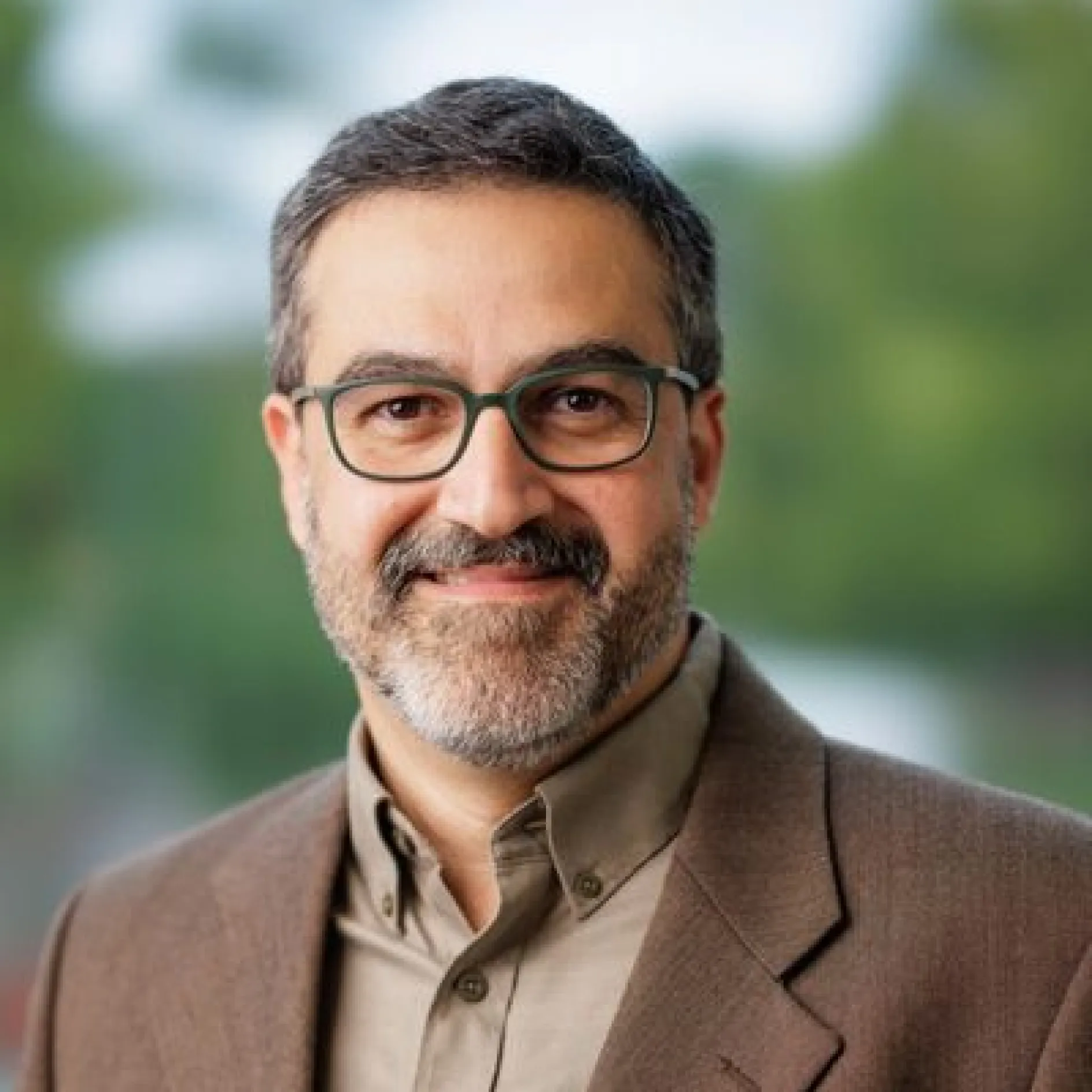

GhaneaBassiri comes to Washington University of St. Louis from Carleton College. Prior to Carleton, he was the Thomas Lamb Eliot Professor of Religion and Humanities at Reed College. Widely recognized for his pioneering work on the history of Islam in America, GhaneaBassiri’s scholarship bridges Islamic studies, American religious studies, and the politics of race and religion.
GhaneaBassiri’s A History of Islam in America (Cambridge University Press, 2010), for which he was awarded a Carnegie Scholar grant, was the first comprehensive study of the diverse presence and participation of Muslims in American history. His work on Islam in America began with Competing Visions of Islam in the United States (orig. Greenwood Press, 1997), which he composed as a doctor student at Harvard. It was the first book-length study of Muslims on the West Coast.
GhaneaBassiri’s subsequent scholarship has further explored the intersections of religion and politics, including numerous book chapters and articles on the impact of post-9/11 state scrutiny on Muslim philanthropy, on Muslim practices of citizenship, and on the historical structures underlying anti-Muslim sentiments as well as contemporary U.S. anxieties about Islam. Additionally, GhaneaBassiri has co-edited volumes on theory and method in the study of religion in general—All Religion Is Inter-Religion (Bloomsbury Academic, 2017)—and the study of the Qur’an and Islam in particular—Non Sola Scriptura (Routledge, 2022) and Material Islam (special issue of MAVCOR Journal, 2022). He is the founding co-editor of the book series Islam of the Global West published by Bloomsbury Academic.
Alongside his work on race, religion, and politics in America, GhaneaBassiri is philologically trained in Islamic studies. In his early publications, he sought to interrupt the general trend in Islamic studies to explain sectarianism as a byproduct of caliphal politics. By inquiring into the theological roots of a political ideal, he work laid a methodological foundation for taking religious differences seriously in early Islamic history.
The diverse threads of GhaneaBassiri’s scholarship converge in his current book project on The Mosque in Islamic History (under contract with Cambridge University Press). Supported by a Guggenheim Fellowship, this project aims to theorize the mosque not merely as an architectural object, but as a structuring institution of Islam through which Muslims have historically negotiated religious and cultural differences, including in the United States.
GhaneaBassiri has led numerous public scholarship initiatives. He directed the Portland Muslim History Project, now being archived at the Oregon Historical Society and is currently co-developing a virtual tour of America’s oldest mosque in Brooklyn, supported by a Luce-AAR grant. His public engagement also includes serving as a national scholar for the “American Stories” section of the NEH and American Library Association’s Muslim Journeys Bookshelf and authoring programing material for New York City Public Schools and advising PBS documentaries on American Muslim experiences.