Seven sophomores join the competitive humanities research fellowship
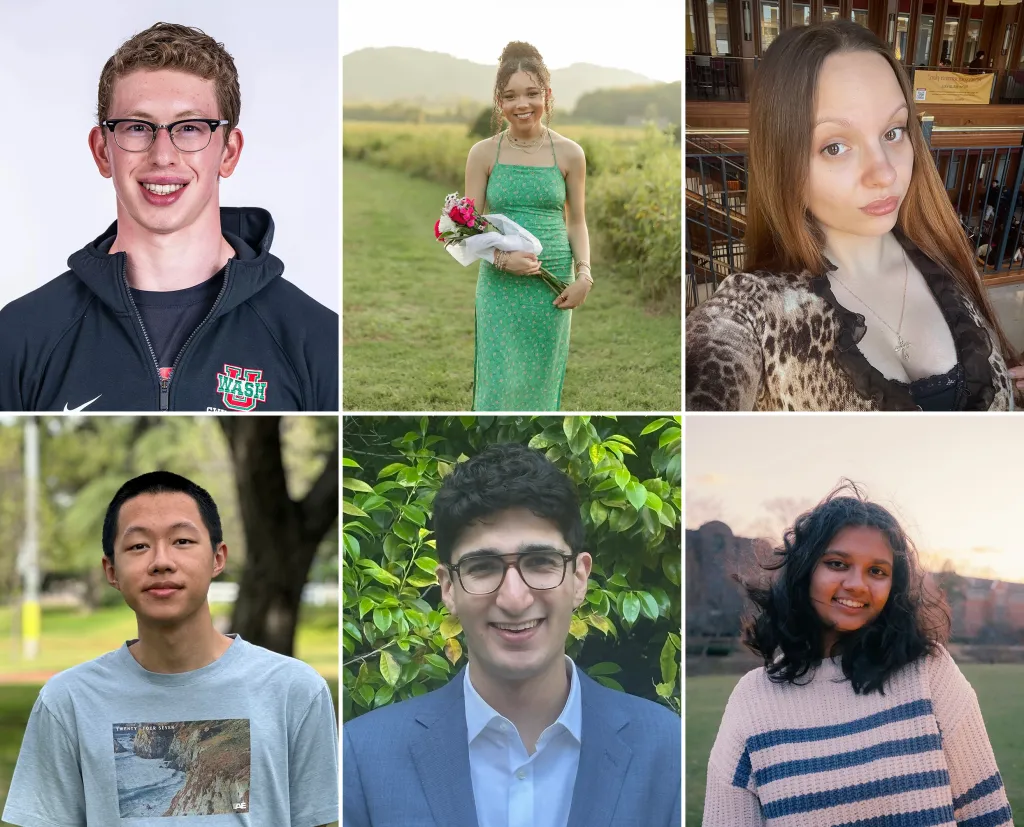
In May, the Center for the Humanities welcomed its 2026–28 Merle Kling Undergraduate Honors Fellowship cohort. Over the next two years, the six new fellows from the Washington University Class of 2028 will pursue their own independent research projects in the humanities or humanistic social sciences, explore the public dimensions of humanistic work and enrich the intellectual life of the Center for the Humanities. Students apply during the spring of their sophomore year and enroll in a two-year research seminar during their junior and senior years.
Learn more about this undergraduate research experience: The Kling fellowship and the luxury of time
The incoming Kling Fellows’ proposed projects range across (and between) numerous disciplines in Arts and Sciences, with topics of study including gender studies, film and literature and rhetoric.
Lucas Caswell
Political Science, Classics and Data Science in the Humanities
I want to understand how the biases of class and hierarchy in the classical world are carried forward into the writings and thoughts of the founding fathers. Particularly I want to see how they use case history to justify their choices politically and where they are adopting the trapping of the classics to set themselves apart from British intellectual culture in justifying their revolution.
Adrianne Gott
English Literature, Political Science and Data Science in the Humanities
I am interested in exploring why African American communities adopt plant-based diets at the highest rate among ethnic groups within the U.S and investigating how they have used veganism to define philosophies, aesthetics and strategies that challenge anti-Blackness. Ultimately, how do African American communities use veganism as a tool of anti-racist resistance that inspires a framework of collective action, wholistic health, and community care?
Natalija Grubisic
Philosophy, Environmental Studies and Legal Studies
During the height of the European Industrial Revolution, Karl Marx predicted that the proletariat’s inability to purchase commodities would inspire class revolution. While the growth of consumer capitalism in the Global North has subdued the working class and prevented revolutionary labor movements from occurring, will Marx’s prediction manifest in other regions of the world, where work and living conditions are substantially worse?
Wesley Huang
Environmental Analysis; Women, Gender and Sexuality Studies; and Ancient Studies
My project focuses on the status change of Athenian women during the Peloponnesian Wars, using Greek performances as evidence. Hence, I will explore how Greek playwrights use theatrical techniques to further gender politics discourses in Athenian art and politics. Whether it is Athena, Maenads, or Lysistrata, what could these characters reveal to us about gender and politics?
Jordan Lari
Global Studies and Art History and Archaeology
Jordan’s project examines how different displaced populations are portrayed in the media and how those portrayals shape public perceptions of which groups are considered “deserving” of citizenship or humanitarian protection in the United States. More specifically, the research explores how distinctions drawn between migrants and refugees, as well as perceptions of cultural proximity, influence the uneven ways humanitarian protection and belonging are extended across displaced communities.
Pranathi Murthy
Psychological and Brain Sciences; and Women, Gender and Sexuality Studies
India claims queer tolerance, but tolerance does not guarantee equality, even within the queer community. Using Bangalore, India, as a case study, with broader implications for other nationalist contexts, Pranathi will examine how majoritarian Hindu nationalist narratives in India shape the identity and mental health experiences of lower-caste and religious minority queer individuals, while asking whether current psychological interventions can meaningfully respond to the violence hidden inside narratives of inclusion.
Ryan Yin
Architecture, Human-Computer Interaction, Architectural History and Theory
Ryan’s project explores how small-scale civic architecture in contemporary Japanese prefectures experiencing rapid demographic decline sustains collective memory and public cultural life amid social contraction.