Holocaust Memorial Lecture

Holocaust Memorial Lecture

The annual Holocaust Memorial Lecture was inaugurated in 1989 by then-Chancellor William H. Danforth, who, at the request of both students and faculty, appointed a committee to establish a permanent lecture. Held on or near November 9, the anniversary of the Kristallnacht pogroms in Nazi Germany, the lecture aims not only to commemorate the Holocaust but also to address its broader implications for other instances of systematic persecution, mass murder and genocide. The lecture customarily alternates between speakers who concentrate specifically on aspects of the Holocaust and those who speak more generally about modern genocide, international conflict and humanitarian aid or concentrate specifically on particular instances of genocidal violence. Past speakers have included well-known public figures and leading scholars of both the Holocaust and other historical mass traumas. 

Each speaker is selected by the Holocaust Memorial Committee, which is composed of faculty, students and staff. The committee includes the following:

  • Erin McGlothlin, Chair, Vice Dean of Undergraduate Affairs, Gloria M. Goldstein Professor of Holocaust Studies, and Professor of German and Jewish Studies
  • David Cunningham, Professor of Sociology
  • Stephanie Kirk, Director of the Center for the Humanities, Professor of Spanish, of Comparative Literature, and of Women, Gender, and Sexuality Studies
  • Anne Schult, Assistant Professor of History
  • Carly Wayne, Assistant Professor of Political Science
  • Sophie Hawks, Graduate Student, Germanic Languages and Literatures
  • Molly Schneider, Graduate Student, Sociology
  • Sylvia Sukop, Graduate Student, Germanic Languages and Literatures
  • Gabe Herzlinger, Undergraduate Student, Math and Philosophy
  • Baylor McInturff, Undergraduate Student, Anthropology and Art History & Archaeology
  • Helen Turner, St. Louis Kaplan Feldman Holocaust Museum (ex officio)
  • Jackie Levey, Hillel at WashU (ex officio)

Sign up for our newsletter

Join our email list to receive information about the annual lecture series.

Subscribe

Current event

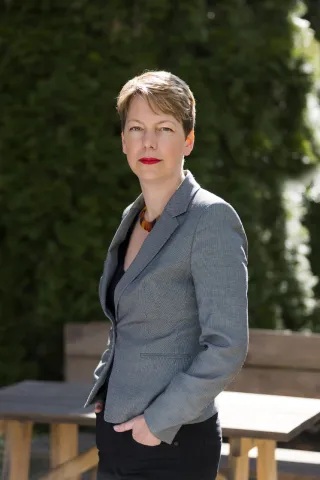
Anna Hájková

2026–27 Holocaust Memorial Lecture

Queer Romeo and Juliet of Wartime Prague: Same-Sex Love in the Holocaust

Anna Hájková, Reader of modern European continental history, University of Warwick

5 pm, November 9, 2026
Umrath Lounge in Umrath Hall


Between 1924 and 1942, for 18 years, Ludwig, a Jewish clerk from a Brno textile dynasty, and Paul, a Sudetengerman (an ethnic German living in Czech lands) lab assistant, lived together in Prague Vinohrady. It was a happy relationship, with mutual support, harmony and freedom from material worries. It all ended one early morning in March 1942, when the Prague police arrested the couple for a violation of Paragraph 175 of the German Criminal Code, which criminalized sexual acts between men. Three months later, both men were sentenced to long prison terms. Ludwig, as a Jew, was eventually deported to Auschwitz and murdered; Paul was set free half a year after the liberation, which did not apply to him as a gay man.

We will not find this story in the annals of the Holocaust of Czech Jewry, nor in the histories of wartime occupied Czechoslovakia. Queer Holocaust history has been systematically silenced as unworthy. In her talk, Anna Hájková explains how the silences on same-sex desire in the Shoah came to be and how they can help us understand history better — and more inclusively.

About the speaker

Anna Hájková is reader for modern European continental history at the University of Warwick, where she co-directs the Centre for Global Jewish Studies. Her first book, The Last Ghetto: An Everyday History of Theresienstadt, came out in 2020 with Oxford University Press. Her second book, People Without History are Dust: Queer Desire in the Holocaust (University of Toronto Press, 2025) was awarded the National Jewish Book Award 2026. 

EVENT PAGE

Past lectures

2025-26

Scott Straus
“‘Unimaginable Atrocities’: The Neglected Catastrophe in Sudan and the History of Genocide in the Region”

2024–25  

VIDEO
Caroline Sturdy Colls
“The Evolution of Mass Murder: Forensic Archeological Perspectives on Mass Violence at Treblinka Labor and Extermination Camps”
Why Treblinka, part of ‘the largest single murder campaign within the Holocaust,’ remains unknown to Americans, by Erin McGlothlin

2023–24  

Ari Joskowicz
“Roma, Jews, and the Holocaust”

2022–23  

Jeffrey Veidlinger
“The 1918-1921 Pogroms in Ukraine and the Onset of the Holocaust”
Ukraine and a forgotten chapter in Holocaust history, by Sylvia Sukop

2021–22  

VIDEO
Natalia Aleksiun
“Jewish Physicians and Their Patients: Rescue Strategies in Nazi-Occupied Poland”

2020–21  

Virtual Roundtable with Avril Alba, Zahava D. Doering and David Cunningham
“Legacies of Violence and Genocide: Can Memorials and Museums Help Us Build a Better Future?”
On Legacies of Violence, Genocide, and Implicated Subjects: Arts and Museums as Influence and Response, by Deniz Gündoğan İbrişim

2019–20  

Jason De León
“The Land of Open Graves: Understanding the Current Politics of Migrant Life and Death along the US/Mexico Border”
On Borders and Unnatural ‘Natural’ Deaths, by Tabea Linhard

2018–19  

Sue Vice
“The Holocaust in Literature and Film: Revisiting Claude Lanzmann’s Shoah”
Claude Lanzmann’s Shoah and Its Archive of Outtakes, by Erin McGlothlin

2017–18  

Crystal Feimster
“The Greatest Outrage of the Century: White Violence and Black Protest in in America”
‘A Time to Lift One’s Voice’: The East St. Louis Riot in a Migration Perspective, by Douglas Flowe

2016–17  

Doris Bergen
“Holocaust or Genocide: Uniqueness and Universality”
The Holocaust and the ‘Whew’ Effect, by Erin McGlothlin

2015–16  

Jay Winter
“The Holocaust and the Armenian Genocide”
Violence and Memory, with Anika Walke and Jay Winter

2014–15  

David Shneer
“Through Soviet Jewish Eyes: Photography, War and the Holocaust”

2013–14  

Sarah Wagner
“Srebrenica’s Legacies of Loss and Remembrance”

2012–13  

Aron Rodrigue
“Some Reflections on Sephardic Jewries and the Holocaust”

2011–12   

David Rosen
“The Moral Complexity of the Child Soldier ‘Problem’”

2010–11  

Marianne Hirsch
“Rites of Return: The Afterlife of the Holocaust in Jewish Memory”

2009–10  

Benedict Kiernan
“Blood and Soil: Genocide in World History”

2008–09  

Daniel Mendelsohn
“Finding ‘The Lost’: A Journey into the History, Family, and Judaism”

2006–07  

David Rieff

2005–06  

Christopher Browning
“Holocaust Denial in the Courtroom: The Historian as Expert Witness”

2004–05  

Peter Balakian
“The Armenian Genocide and America’s First International Human Rights Movement”

2003–04  

Adam Hochschild
“The Holocaust and the Congo: Then and Today”

2002–03  

Jan Gross
“Neighbors: The Destruction of the Jewish Community in Jedwabne, Poland”

2001–02  

James E. Young
“A Holocaust Memorial for Berlin?”

2000–01  

Philip Gourevitch
“The Rwandan Genocide”

1999–00  

Saul Friedländer
“The SHOAH: Memory, History and the Historian”

1998–99  

Louise Arbour
“Prosecutions before the International Criminal Court”

1997–98  

Michael Berenbaum
“The Holocaust and its Remembrance”

1996–97  

M. Cherif Bassiouni
“Stopping Impunity for International Crimes”

1995–96  

Steven Katz
“Holocaust and Mass Death: Variations and Differences”

1994–95  

Ernst Stein
“The Rise of Neo-Nazism in Germany”

1993–94  

Ian Hancock
“Gypsies, Germany and the Holocaust”

1992–93  

Elie Wiesel
“When the Unthinkable Happens”

1991–92  

William Shawcross
“Holocaust and Cambodia”

1990–91  

Robert Jay Lifton
“Beyond Genocide – Learning from the Nazi Doctors”

1989–90  

Arno Mayer
“Terror and Violence under Hitler and Stalin: Issues in Studying the Holocaust”