Interview with Faculty Fellow Anne Schult
How do you count a refugee? The question might seem straightforward, but the answer has consequences. The categories used to classify displaced people can shape how governments and international organizations understand their circumstances and decide what should happen to them. In her current book project, “Counting the Countless: Statistics, Demography, and the 20th-Century Refugee,” historian Anne Schult, a Faculty Fellow in the Center for the Humanities, traces the development of refugee statistics in the early 20th century, examining how ideas about population circulated among European governments, international institutions and networks extending into their colonies and overseas trade partners. She argues that the growing use of statistical methods did more than make refugee populations visible: It helped shape policies for managing and resettling displaced people. By uncovering this overlooked history, Schult offers a new perspective on how refugees became a population to be counted — and how those classifications shaped their fates.
What was happening in the early 20th century that made it increasingly important for governments and international organizations to count and classify refugees?
In the early 20th century, several overlapping upheavals pushed refugees from a private misfortune into a public administrative problem.
The first was the collapse of empires. The First World War and its aftermath dismantled the Russian, Ottoman, Austro-Hungarian and German empires, producing new nation-states with defined borders and defined citizenries. Millions of people suddenly found themselves on the wrong side of a line or unwelcome in the new order. The Russian Revolution and civil war alone displaced well over a million people, while the Greek-Turkish population exchange of 1923 and the Armenian genocide created further mass movements.
Second, the modern passport and border-control system took hold. Before 1914, crossing borders in Europe was relatively easy. Wartime security concerns made passports, visas and identity papers standard, so stateless people, whom their former governments had stripped of citizenship or who lacked documents, could not legally travel, work or settle anywhere.
Third, the newly founded League of Nations took on the question of displacement and disproportionately shaped the public narrative around refugees. It appointed Norwegian explorer Fridtjof Nansen as High Commissioner for Refugees in 1921 and later introduced the “Nansen passport,” an identity document for stateless refugees. Issuing such documents, funding relief and negotiating resettlement required clear definitions of who counted as a refugee, which led to a group-based definition of the refugee that was attached to particular nationalities, such as Russians or Armenians.
Finally, the rise of totalitarian regimes in the 1930s, especially Nazi Germany, created new mass movements, making systematic counting and classification essential for allocating responsibility for the persecuted among states. These pressures laid the groundwork for the 1951 Refugee Convention, which codified refugee status into international law.
During this period, statistical methods were increasingly being applied to new areas of social and political life. How did these broader developments influence the way officials counted and classified refugees?
The rise of statistical thinking gave officials both the tools and the mindset to treat refugees as a measurable population rather than a scattering of individual legal cases.
By the early 20th century, states had grown accustomed to censuses, vital statistics and social surveys as instruments of governance. Concepts like “population,” “rate” and “category” had become central to how administrators understood society. Applying these habits to displacement felt natural: If unemployment, public health and migration could be quantified, so could refugees. Numbers promised objectivity, and they allowed international civil servants to compare situations across countries and justify budgets to funders and member states.
Classification, however, was never neutral.
International bodies like the League of Nations and its International Labour Office helped standardize this approach. They gathered data through registration, consular reports and relief agencies, then compiled estimates to guide aid and resettlement. Nansen’s office, for example, relied on such tallies to negotiate with governments over who would receive whom.
Classification, however, was never neutral. Because statistical systems require clear categories, officials sorted refugees by nationality, ethnicity or country of origin, such as “Russian,” “Armenian” or later “German.” This group-based approach simplified counting but flattened individual stories and sometimes ignored people who fit no category. Figures were also often rough, owing to unreliable registration, double counting and political incentives to inflate or minimize totals.
Over time, these practices of categorization via numbers hardened into legal definitions. The need for comparable, countable categories shaped how refugee status was defined in later agreements, embedding statistical logic into the very concept of the modern refugee.
Can you share an example from your research that illustrates how refugee statistics were collected and used, and how they influenced policy decisions?
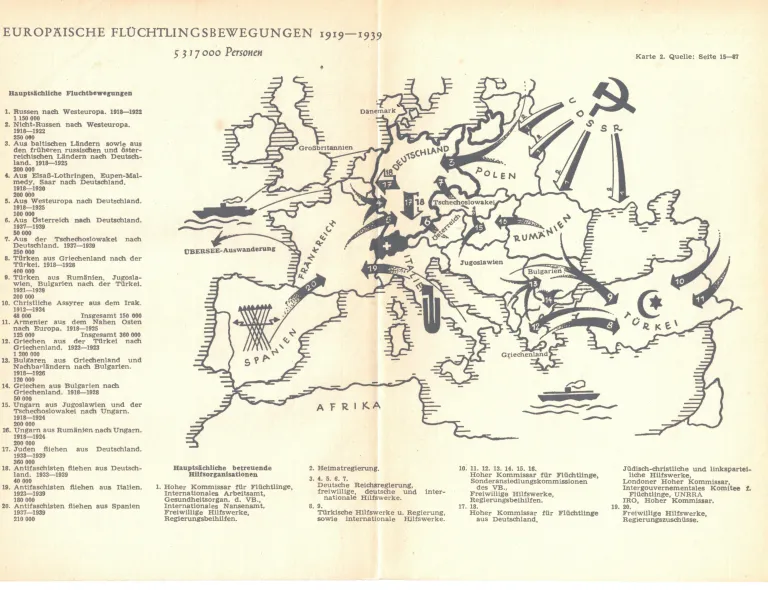
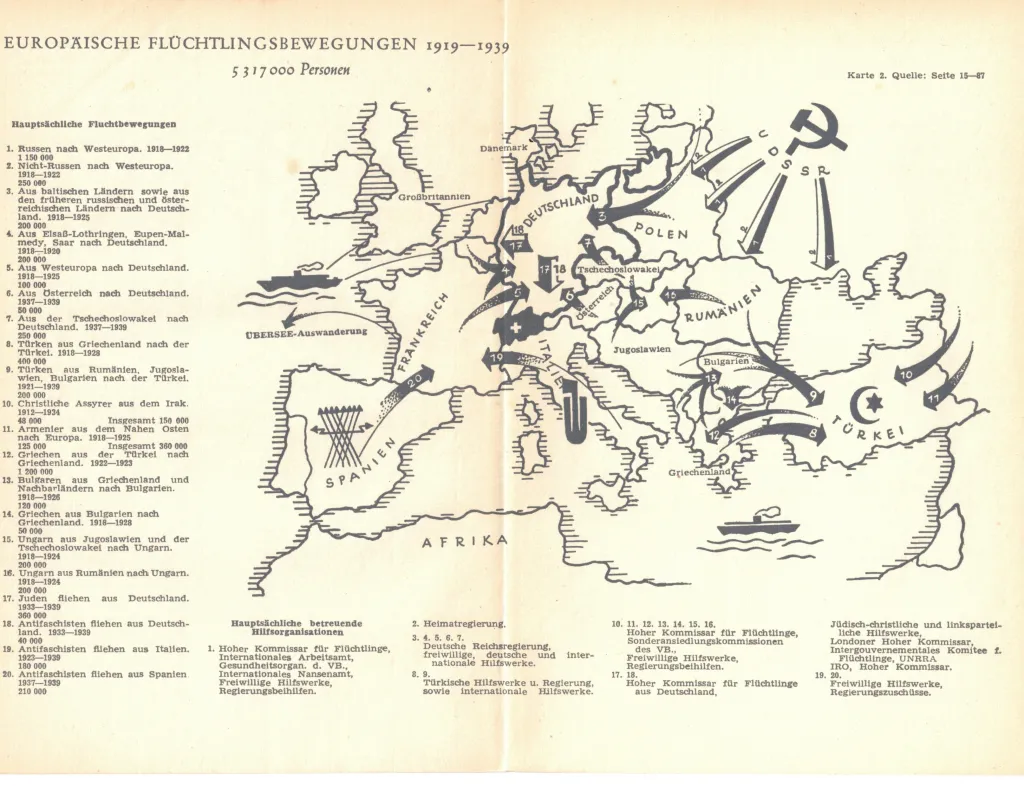
I like to highlight what many consider the world’s first international refugee survey: The Refugee Problem (1939), written by John Hope Simpson and published by the Royal Institute of International Affairs. It is a useful source to understand the stakes of enumerating refugees precisely because it sits at the point where interwar counting practices were being synthesized, just before the war transformed everything.
Hope Simpson was a former Indian Civil Service officer and vice-chairman of the Greek Refugee Settlement Commission, so he approached refugees as a practical administrator. The book surveys refugee populations across Europe and beyond, group by group (Russian, Armenian, Saar, German, Austrian, Czech, Spanish), pairing narrative with statistical estimates. It is a snapshot of how an informed, semi-official observer — not least one with training in colonial administration — understood displacement on the eve of war.
The survey makes visible how provisional the numbers were. Its figures draw on government returns, League of Nations reports and voluntary agencies, each with different definitions and incentives. The group-by-group structure also shows how nationality and origin categories had become the default way of organizing knowledge.
But it also highlights the political nature of an ostensibly scientific project. Drawing on population anxieties within British imperial governance at the time, Hope Simpson was preoccupied with settlement prospects and with the “absorptive capacity” of receiving countries, treating refugees largely as an economic and demographic question.
In my work, I argue that the survey is best read as both evidence and artifact: a source of estimates, and a document showing how experts of the time defined and sought to influence the politics of displacement.
How did the categories officials used to classify refugees — such as occupation, ethnic identification and income potential — influence policies for managing them? Were there competing ideas about how refugees should be understood or what should be done to help them?
Classification did not just describe refugees; it determined what happened to them.
Occupation and income potential were especially consequential. Officials at the League’s refugee office and the International Labour Office sorted people by skills and employability because resettlement depended on finding countries willing to absorb them. Governments in France, Latin America and elsewhere wanted agricultural laborers, miners and industrial workers, not the aristocrats, clerks and intellectuals who made up much of the Russian diaspora. Those labeled “productive” were prioritized for placement, while the elderly, sick or unskilled were seen as burdens and often left to private charities.
Ethnic and national identification shaped both protection and exclusion. Group-based categories meant that “Russian” or “Armenian” refugees received specific documents and arrangements, while those outside recognized groups, such as many Jewish refugees from Germany later on, faced gaps in coverage. Ethnicity also influenced destination: States often favored arrivals they considered easier to assimilate.
These practices reflected competing ideas about what refugees were. One view treated them as a temporary humanitarian emergency, calling for relief and eventual repatriation. Another saw them as a labor resource, to be matched efficiently with economic need. A third, promoted by figures like Nansen and many voluntary organizations, emphasized moral obligation and refugees’ dignity and legal protection. Meanwhile, nationalist governments often viewed them as security risks or threats to cultural homogeneity.
Tensions among these perspectives left policy fragmented, favoring economic usefulness over need and setting patterns that persisted into later refugee regimes.
Many histories of modern refugees emphasize the development of international legal protections after World War II. What becomes visible when we look instead at the earlier history of counting and classifying refugees, and what does that history help us understand about the role of statistics in shaping policy today?
Looking at the earlier history of counting reveals that the postwar legal framework did not appear out of nowhere. The 1951 Refugee Convention inherited tools, categories and assumptions that interwar officials had already built through registration, identity documents and statistical tallies. Legal protection and bureaucratic measurement developed together, and the definition of a “refugee” was shaped as much by administrative convenience as by moral principle.
This perspective also makes visible who was left out. Interwar systems protected groups that had been named and counted, while others — such as many non-Europeans and certainly those considered colonial subjects at the time — fell through the cracks. The interwar regime was geographically and juridically Eurocentric; its core premise was that a refugee had lost the protection of a state, which presumed a world of sovereign nation-states. But the numeric perspective shows, too, that economic usefulness often outweighed humanitarian need when states decided whom to admit, a pattern that was never fully abandoned.
Numbers on refugees ... depend on choices about who qualifies, how they are registered and what counts as displacement. Those choices carry consequences.
For today, this history suggests that statistics are not neutral mirrors of reality. Numbers on refugees, whether produced by UNHCR, national governments or researchers, depend on choices about who qualifies, how they are registered and what counts as displacement. Those choices carry consequences. Figures determine funding appeals, resettlement quotas and public perceptions of crisis, and they can be inflated, minimized or politicized to serve institutional goals.
Recognizing this does not mean discarding data, of course, which remains essential for planning aid. But it does entail reading figures critically, asking what categories produced them and remembering that people who do not fit official definitions in the present, such as internally displaced persons or climate migrants, may remain statistically invisible and therefore politically neglected.