Hoyon Mephokee, a PhD student in the Department of Art History and Archaeology, studies the colonial cultures and technologies of France and Francophone Asia in the late 19th and early 20th centuries, with a particular emphasis on cross-cultural contact between France and Siam.
Throughout January of 1894, circusgoers in Paris were treated to a rare sight at the Nouveau Cirque. Debuting the Boule de Siam (The Ball of Siam), the circus filled its stage with animals, trees and waterworks to transport audiences to the lush tropical landscape of the Siamese Kingdom (present-day Thailand). In this exotic place — which all Parisians had heard of, but most had never visited — audiences encountered a host of Siamese characters, a people whom many of them had never seen. Although the circus did not employ actual Siamese performers, it did make the fascinating decision to cast the Black clown Chocolat (born Rafael Padilla, 1868–1917) for the role of a Siamese nobleman. By collapsing Blackness with Orientalism, Chocolat’s performance in the Boule de Siam represented not mere entertainment, but a cultural site that inadvertently legitimized France’s expanding colonial ambitions in Southeast Asia.
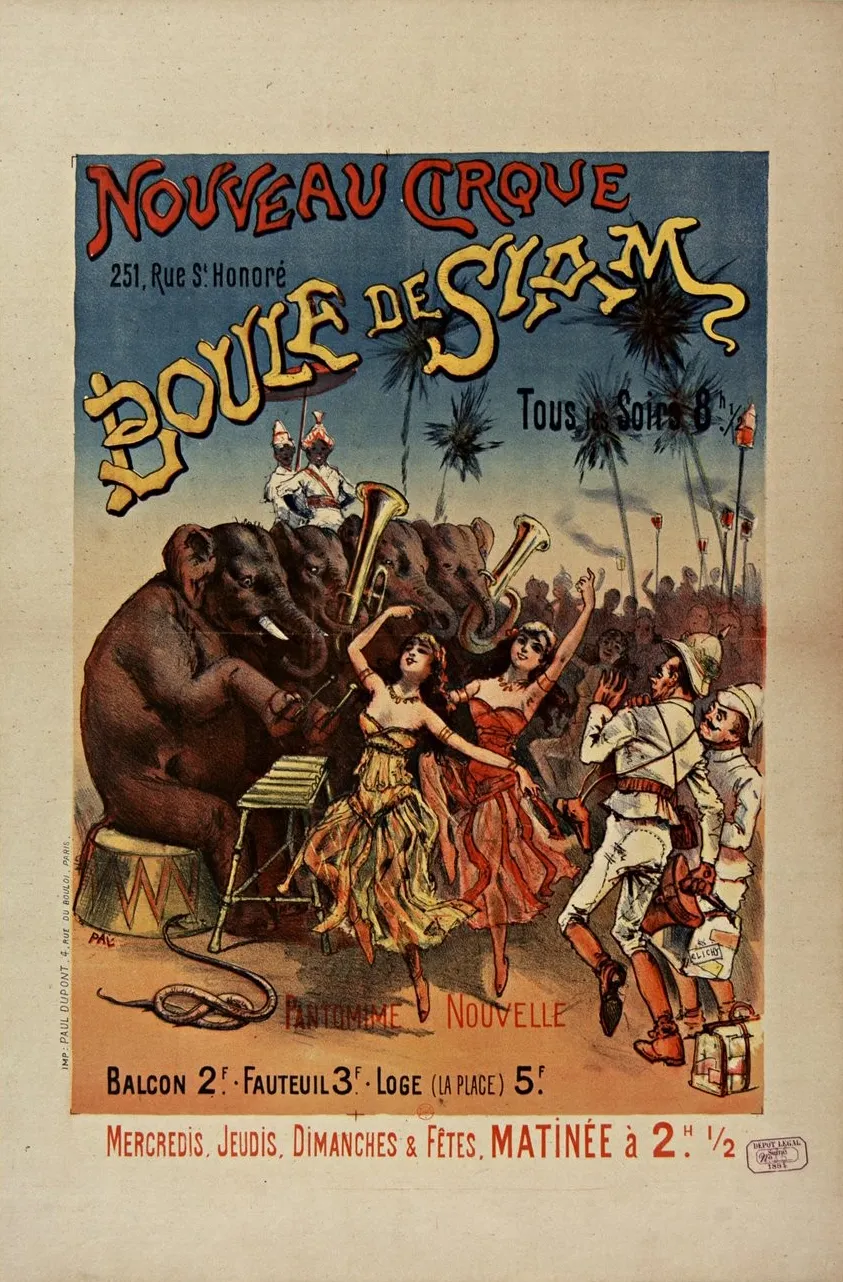
Within the narrative of the Boule de Siam, questions of race, power and desirability quickly come to the forefront. The show tells the story of a pair of French and English businessmen who travel to Siam in search of rice but quickly find themselves caught in a comical royal marriage plot. Indeed, although they are offered this crop by “Father Singapore, the Rajah of Pouloriz,” a powerful Siamese lord, the deal comes with a steep condition: that one of them wed his daughter. She is, however, secretly coveted by Œil-de-Perdrix, played by Chocolat, whose dark skin bars him from marrying her, since Father Singapore desires that she marry a Westerner. Although he attempts to scare the businessmen away, including by charming snakes to attack them, Œil-de-Perdrix eventually admits to them his love for the girl. Finding a solution to all their problems, the businessmen help Œil-de-Perdrix whiten his face so that he may assume the appearance of a Westerner and marry Father Singapore’s daughter.
While the Boule de Siam may appear, at first, as one of many trivializing caricatures of otherness, the Nouveau Cirque’s casting of a Black performer for the role of a Siamese character is significant not only for its conflation of two modes of exoticism but also because it did so in the immediate aftermath of the 1893 Franco-Siamese conflict. Only six months prior to the show’s opening, the Third French Republic subjugated Siam in a series of border skirmishes between the kingdom and the French Indochinese Union that had, until that point, comprised present-day Vietnam and Cambodia. France’s victory allowed it to seize Siam’s territories east of the Mekong River, out of which it created what we today know as Laos, and absorb them into its Asian colonial gem. For a Parisian audience, the Boule de Siam’s collision of various exoticisms in Chocolat’s performance inadvertently made them eager supporters and participants of the French Colonial Empire’s quest for Southeast Asia.
Significantly, Padilla’s Chocolat was an auguste, a clumsy, lazy, bumbling and poor type of clown whose role exaggerated the extant associations that the French consciousness had already formed with the Black body as different, lesser, subordinate, primitive and encoded with the history of slavery and colonial commodification. Starting in 1895, the year after the Boule de Siam, Padilla, as Chocolat, would collaborate with and act as a foil against George Foottit, an English clown. The two became famous for their acts, in which Foottit physically attacked and mocked Chocolat for his race and character to the audience’s great pleasure, further expressing and enhancing the racial tropes that had been attached to him.
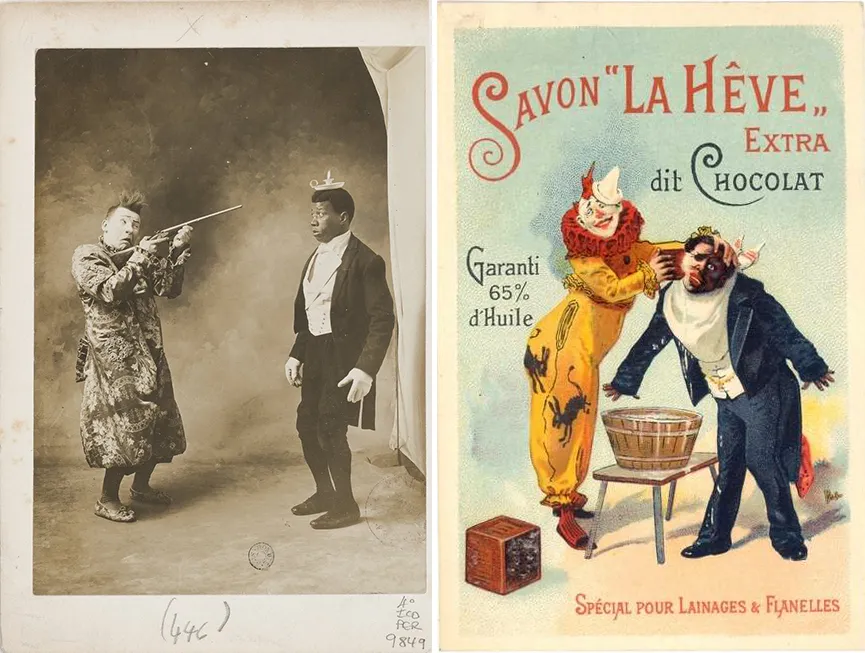
Right: Pal (illustrator), Savon “La Hêve” Extra, dit Chocolat; Garanti 65% d’Huile; Spécial pour Lainages & Flanelles, ca. 1896. Chromolithograph, 8 x 12 cm. Public Domain, via Wikimedia Commons.
As a known and even beloved figure, Padilla’s fame made him and his character a site of these associations and shaped how his body became exploited and interpreted by audiences outside the circus. A soap advertisement, for instance, shows Foottit gleefully scrubbing Chocolat’s face, “cleansing” him of his Blackness in a clear expression of the product’s power. Likewise, a Félix Potin chocolate advertisement shows Foottit riding on Chocolat’s back while brandishing and enjoying a chocolate bar, a gesture that echoes Europe’s reliance on forced Black labor in the cultivation and harvesting of the colonial crop used to make this delicacy. Rather than simply depicting a generic Black figure, images like these exploited the humor and violence that were associated with, encoded in and performed upon Chocolat’s body.
For an audience with limited knowledge of Siam or its people, the Boule de Siam was a rare opportunity to “see” an embodied Siamese person. Until that point, Parisians had defined Siam through vague and expected Orientalist tropes as a distant, tropical, exotic and perpetually primitive and ancient place in the Far East. Chocolat’s performance of Œil-de-Perdrix would have clarified and elaborated on those tropes by mapping onto them the universe of ideas associated with the Black body and Blackness. Moreover, with the 1893 Franco-Siamese conflict still fresh in the French consciousness, the performance of a bumbling, foolish and subservient Siamese character neutralizes the violence of colonial warfare and presents the French conquest of Southeast Asia as positive and inevitable, thereby implicating French audiences as participants and benefactors of this process. Indeed, with the aid of his new foreign friends, Œil-de-Perdrix’s “transformation” into a Westerner rather explicitly mirrors contemporaneous ideas on colonization as a civilizing process through which the lesser peoples of the world could become “Frenchified” (la françisation), willingly or otherwise. More than merely a reflection of colonial attitudes, the Boule de Siam actively shaped the French colonial consciousness in the aftermath of the 1893 Franco-Siamese conflict by exploiting the slapstick humor, participatory format and transportive powers of the circus spectacle.