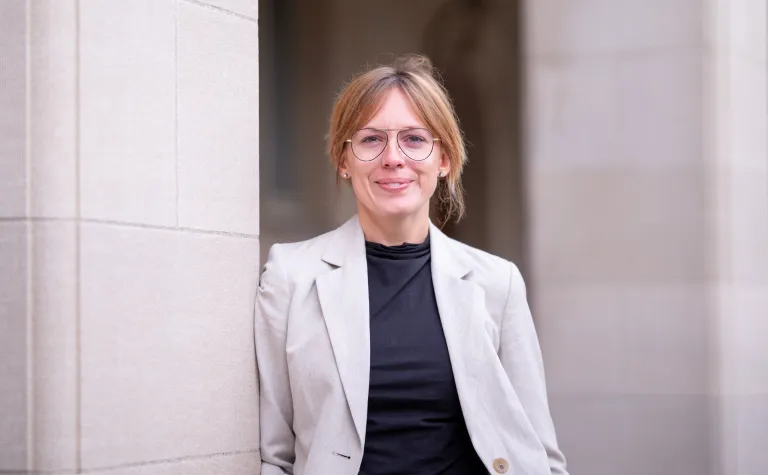
Kristin Emanuel is a poet, artist and PhD student in the Department of English researching visual poetry.
Before Yoko Ono entered the pop cultural limelight, she was an accomplished artist and a member of the experimental movement known as Fluxus. Her life changed in 1966 when she met John Lennon at the Indica Gallery in London. She undoubtedly made a striking first impression with her interactive art consisting of ladders, hammers and magnifying glasses. Also present at Indica was her participatory event known as Mend Piece, which promises to heal the world. In this piece, museumgoers are given broken ceramics and adhesives. A poem adorns the wall reading:
Mend with wisdom,
mend with love.
It will mend the earth
at the same time.
After encountering this poem, visitors must grapple with a resplendent contradiction: How do you accomplish something extraordinary using ordinary objects? While some critics scoff at the contradictory nature of Mend Piece, it grounds participants within a reparative present. In lieu of doomsaying, Ono incentivizes actionable change, community and connection. In 2026, exactly 60 years after its debut, I visit Mend Piece at the Museum of Contemporary Art (MCA) in Chicago so I can experience its transformative power for myself.
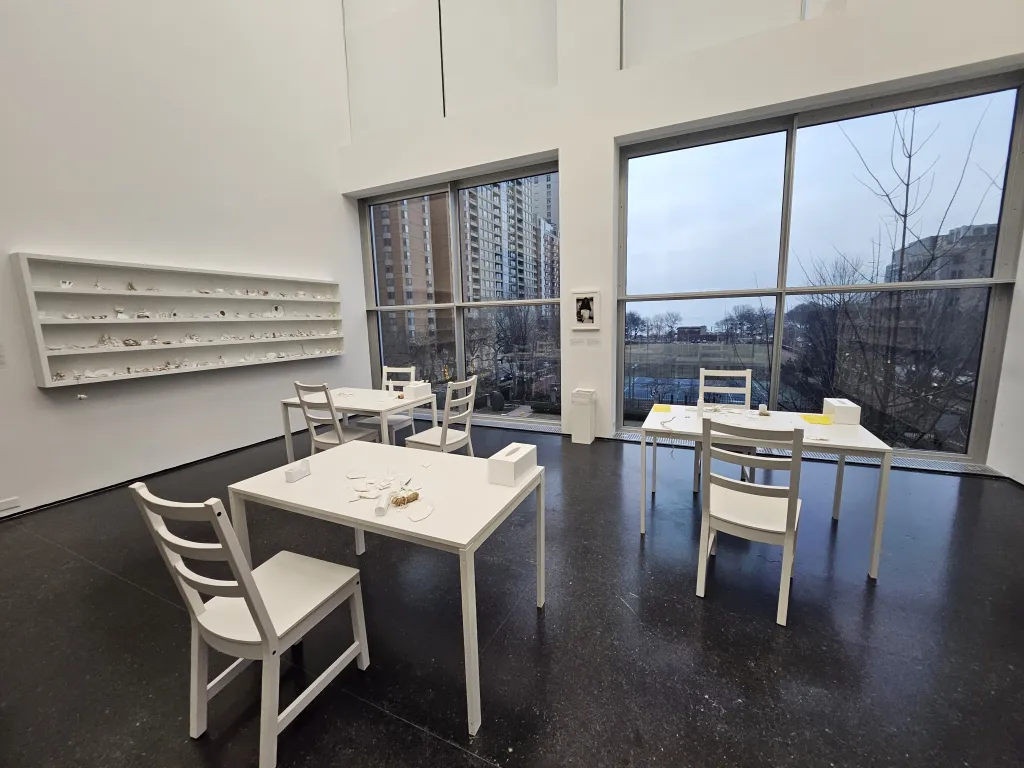
The installation is in a blank white gallery. Parsons tables are strewn across this space with shattered ceramics, scissors, twine, tape and glue. Shelves line either side of the gallery, decorated with sculptures created by museumgoers. When I enter, the tables are mostly empty. An older woman dutifully braids twine around shards of ceramic, creating a shape that resembles a windchime. I sit across from her and begin crafting my own clumsy sculpture. It is hard to map the text of the poem onto the experience of mending. Bits of twine flake onto the table and glue stickies my fingertips.
Critics express understandable skepticism about Ono’s instructions. Museumgoers are meant to take the concrete process of mending and imagine it as an abstract universal. This feels like a daunting task during a moment marked by political unrest, war and environmental catastrophe. How do gluey fingers change anything?
In 2016, art critic Ken Johnson penned a scathing review of Ono’s exhibition The Riverbed, which featured a version of Mend Piece, claiming, “as a conceptual artist, Yoko Ono practices a vapid kind of spiritual therapy.” He describes participatory events like Mend Piece as “enervating exercises in wishful thinking.” Critic Jerry Saltz characterizes Ono’s work as “merely poetic, treacly wishing-minimalism spiced with a little language,” but in the same breath, he acknowledges how materiality anchors language to experience. It is hard to worry about cataclysms when you are braiding twine into an elaborate fishtail and eavesdropping on a nearby conversation. Saltz acknowledges this phenomenon, admitting that Ono’s art demonstrates more than just a “wishing-minimalism” but “a healing minimalism.”
Mend Piece is healing, in a modest sense. Over the course of 30 or so minutes, I arrange ceramic pieces into a frail rosette, pretending its sharp and snaggled edges belong to our broken world instead of belonging to a broken teacup. Ono’s instructions remain impossible, yet impossibility creates aspirational depth. Mend Piece is just as relevant today as it was during the Vietnam War. Ono describes her work as part of the “Peace Industry.” Derived from the “War Industry,” this term aims to popularize peace as an attitude, an artistic practice and a form of cultural currency. Even the word Ono uses for her work (“piece”) puns on peace. She did away with this pun altogether during her 1969 Bed-Ins for Peace, which you can learn more about in the publicly available documentary Bed Peace.
What makes Ono’s work special is precisely what critics detest: its subversive and playful simplicity. Her participatory installations channel childlike wisdom alongside darker adult struggles, asking viewers to become contributors in the making of a better world. Frustrated and disempowered by news of violence beyond the scope of our control, it is easy to turn to despair; instead, Ono asks us to repair the mess we inherited. Change is attitudinal. Acting on behalf of a better future only happens when we realize that the old can be made new. The present is ours to shape.
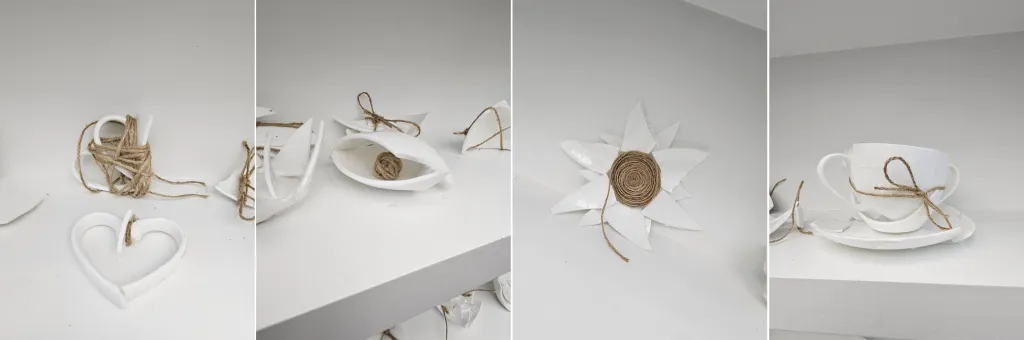
At the MCA, I finish mending my ceramic sculpture. I place it on the shelf next to other creations: an elephant, a dog, a clamshell cradling a pearl of twine. Nobody in this gallery has mended the earth, but we have reassembled broken teacups and saucers into ragtag sculptures that brim with optimism and sincerity. Mend Piece is about catalyzing imaginative change and refocusing on immediate acts of community and care. It is about sitting across from a stranger in an art museum, smiling at her, and nodding as she exclaims: “Look! I’m mending!”
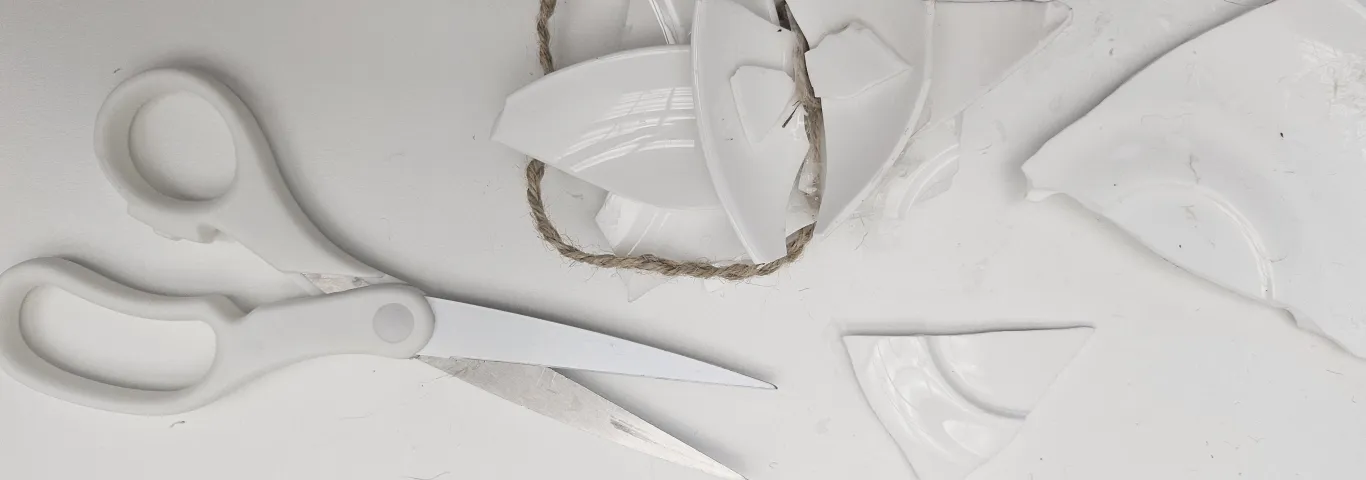
Headline image: A close-up of the materials provided for the interactive Mend Piece exhibit at the Museum of Contemporary Art in Chicago, 2026. Photo courtesy Kristin Emanuel.