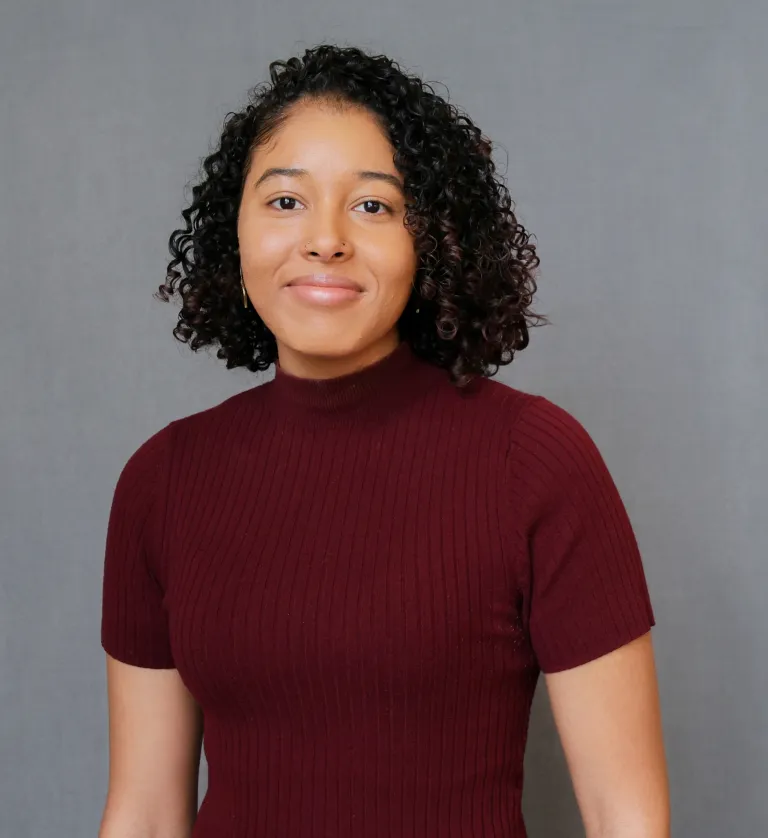
Alex Keith joined the WashU community as the Mellon Sawyer Seminar Postdoctoral Fellow at the Center for the Humanities and the Department of African and African American Studies. Keith is an interdisciplinary scholar, educator and public historian with a doctorate in history from Northwestern University. Her research explores the intersections of race, gender, sexuality, diaspora and performance in the U.S. and the U.K. Her current project focuses on the administrative and cultural histories of two of the first Black-women-founded theater groups in London and Chicago.
Below, Keith shares with us her academic interests, an unexpected outcome of a public-facing project and her postdoctoral plans.
Tell us a bit about your academic journey. What has been the trajectory of your academic interests? Did you meander and finally make a major shift to your current interests, or has it been these interests since day one?
My academic interests have been consistent. When I was in high school, one of my good friends was a spoken word artist, so we spent most of our free time attending spoken word competitions. It was inspiring to see young artists performing poetry on race, gender, class and sexuality. Since then, I have been especially interested in how Black artists use art as a medium for social change, advocating for a cause greater than themselves. Growing up, it mattered that the spoken word pieces were also about the public education system in Philadelphia, and what that system meant for those of us in public schools.
In college, most of my interests roved around the Black Arts Movement, how Black artists, particularly women artists, used poetry and art as a medium for social change in the 1960s. I eventually ended up writing my senior thesis on the artist Errol Hill — a Trinidadian playwright and actor who spent some time in England and became the first faculty member of African descent at Dartmouth College. I studied his academic trajectory and works, especially how he imagined art in the U.S., in the Caribbean and in Britain. My interests have been a through line, cutting across Black arts geographically and temporally. In graduate school, I became interested in how Black women’s theater arts institutions use art as a form of social commentary. My dissertation focused on Black women’s theater activism, which I am working on turning into a book.
In 2024, you co-authored a coloring book with Shorefront Press, celebrating Evanston, Illinois’ local Black history figures. What led to this project, and what has been the most rewarding or challenging aspect of taking on this public-facing project?
As part of my graduate training, I worked with Shorefront Legacy Center, which is a Black community archival center in Evanston, Illinois, the same suburb as Northwestern, where I went to graduate school. I helped build a locator guide, finding aids and more. One of the projects involved creating a coloring book for kids in kindergarten through third grade. I got to help the artist and by doing research for it. In addition, I went with Laurice Bell — executive director of Shorefront Legacy Center and co-author of the coloring book — into kindergarten classrooms where we showed kids sketches of community-leading figures.
The book has 20 Black leaders from the community, including a man named Hecky Powell, who owned a barbecue restaurant. As part of engaging its little kid-readers, the text asks them about their favorite food. My favorite moment was talking to about 40 kindergarteners while showing them a picture of Hecky and telling them what inspired the book, but all they did was shout out their favorite food. They really liked French fries and were so excited to share that with me.
We later went to the Foster Senior Club, a Black seniors club in Evanston, to donate copies of the coloring book. Unlike the kids who were excited about French fries, these 60- and 70-year-olds were most excited about being able to recognize the local Black figures in the coloring book. Since the book was initially aimed at engaging little kids, I was not expecting them to be that excited. But they embraced and appreciated it as a symbol of Black representation, recognized sketched figures and immediately started sharing stories about them. It was lovely to be part of a project that memorializes local Black history. It is the most impactful community-focused project I have undertaken.
You joined WashU as a Mellon Sawyer Seminar Postdoctoral Fellow at the Center for the Humanities and Department of African and African American Studies, tell us more about that. What are you working on and what are you most looking forward to?
As a postdoctoral fellow, I get to join an exciting project — the Sawyer Seminar Series, a gathering that brings to the WashU campus various speakers examining Black studies, academic freedom and the future of the American university. We task speakers to help us think through how Black studies gives praxis to academic freedom and, more importantly, share about the role of the university and community, especially in a moment where humanities, and higher education more broadly, are being scrutinized nationally and to think of its implications both locally and internationally.
I am also co-teaching a graduate seminar on “Topics in Global Black Studies: Black Intellectual Traditions, Democracy, and the American University” with Professor Kia Caldwell, where we undertake readings and reflect on key points raised during the Sawyer Seminar Series. The most exciting part is getting to work with students and learning how these series of talks might influence my students. There is so much happening right now in relation to higher education, immigration and race as well as diversity, equity and inclusion that I expect students will come with their own lived experiences, knowledge and perspectives, and I am hoping the class becomes a safe space where we can all share ideas.
I am excited to be part of a project that centers Black studies and highlights it as having a liberatory quality — a quality that helps us reframe and imagine different possibilities for the university and the community at large.
About the author
Grace Mensah-Fosu is a PhD student in English and comparative literature and a McDonnell Academy International Scholar. She is completing a mentored professional experience (MPE) at the Center for the Humanities in fall 2026.