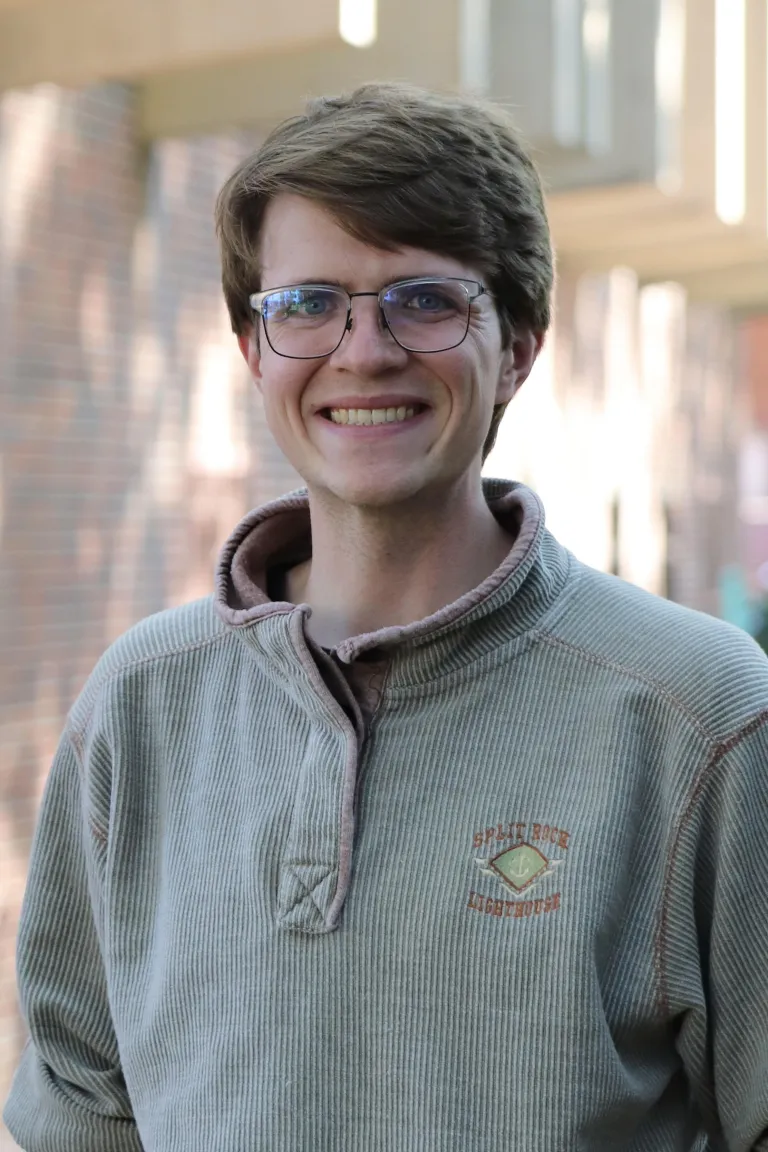
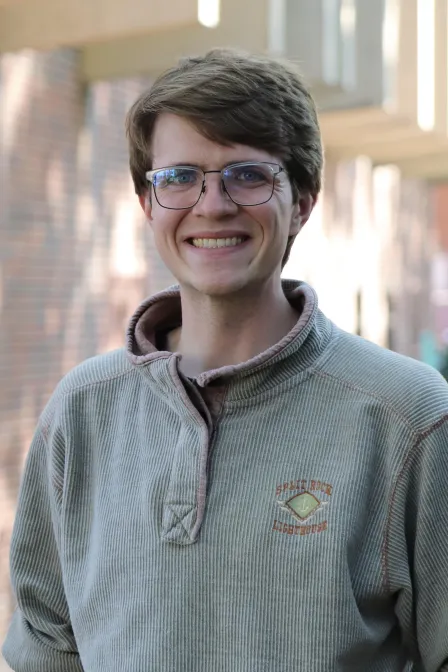
Karl Nycklemoe is an interdisciplinary historian of the environment, law, science and technology in North America. He earned a PhD in history from Stony Brook University and has now joined the WashU community as a Modeling Interdisciplinary Inquiry Postdoctoral Fellow. Nycklemoe’s current research project focuses on Indigenous and U.S. law regarding waterways in the Upper Mississippi watershed from the 17th through 19th centuries.
Below, we asked Nycklemoe about his research, his public writing for Minnesota Historical Society and his postdoctoral plans.
Walk us through a typical conversation with a friend or colleague. What kind of topics keep you going for hours without end?
Conversations with my colleagues are often history-related, touching on the relationship between the environment, the law, science and technology. How these connect in unexpected ways but when pondered in hindsight, seem so obvious. For instance, thinking about how fountains are situated in places like St. Louis, which laws or policies guide where and how fountains are pumped, among others. People often think of law as divorced from the material world. Yet, in my research, I ask how laws meant to regulate the economy, infrastructure and social relations reshape the environment in the Upper Mississippi.
Tell us a bit about your academic journey. What has been the trajectory of your academic interests? Did you meander and finally make a major shift to your current interests, or has it been these interests since day one?
Both. Ever since applying to graduate programs in history, water — history related to water and waterways — has always been my central focus, but the specifics and method have changed along the way. For instance, in 2019 when I applied to Stony Brook University, I proposed to work on 20th-century wetland policy, particularly related to estuaries and the Atlantic Coast. But due to COVID, my first year of coursework was remote, so instead of pursuing work in the National Archives, I decided to work on the 19th-century Upper Mississippi. The Minnesota Historical Society had a digitization scheme where I could request digitized and photocopied materials for the project. I have since maintained an interest in that region and later in Indigenous and Native history. All of which were also encouraged by graduate courses in gender and sexuality studies, as well as mentorship from faculty in history and Hispanic languages and literature. From then the project expanded to focus on U.S. navigational rights, mostly trying to understand how Native Indigenous peoples governed these spaces before and amidst the U.S. colonial project. I am curious to see how that will change while I am here at WashU.
You have been contributing to MNopedia since 2020. What led to this project? What is it about, and what has been the most rewarding or challenging part since taking on this public-facing project?
MNopedia is an online only, free encyclopedia for the Minnesota Historical Society that draws from community members and historians — both working in the universities and beyond — to write short pieces about Minnesotan history, with emphasis on labor, Indigenous and environmental histories that bolster their numerous projects.
During COVID, I was working at the Minnesota Historical Society as a reference assistant. When I got furloughed in March, my work pivoted from working in the library to writing an article for MNopedia. I ended up writing pieces on [writer and environmentalist] Sigurd F. Olson, Voyageurs National Park and Superior National Park, which were later republished by MinnPost. Later pieces included Fort Ridgley, a former military port in Minnesota, and Quatrefoil Library, a volunteer-run, non-profit LGBTQIA+ lending library and community center. The most rewarding part for me was getting to write these public-facing articles that are generally tied to people’s interest in and love for history.
You joined WashU as a Mellon Postdoctoral Fellow in Modeling Interdisciplinary Inquiry at the Center for the Humanities. Tell us more about that. What are you working on and what are you most looking forward to?
This semester I am focused on conducting interdisciplinary research without the obligation of teaching. WashU has many [other] research centers — like the Center for the Environment that are related to my interest — so I am learning about them and other on-campus resources. I also intend to transform my dissertation into a book, as well as edit one of the chapters into a research article for publication, hopefully in a month or two.
The larger project I am working on charts how Upper Mississippi Indigenous nations — particularly the Dakota, Ojibwe, Menominee and Ho-Chunk nations — governed waterways before and during U.S./European imperialism and colonialism from the 17th through the 19th centuries. I trace its first contacts, which occurred when the French began to move through the Upper Mississippi in the 1650s, and how those interactions were mediated by gift-giving protocols and notions of kinship that were already rooted in Indigenous law and legality.
American colonists and Indigenous peoples both considered settler expansion to be a very notable historical event for different reasons. So, I get to ask questions like, how does free navigation work, where one is not beholden to give gifts or pay tolls to anyone to travel on a river? How did it then become the norm, particularly when the U.S. first extended military offices and ports in the region in early 19th century?
I also examine issues of narrative and science whereby 19th-century scientists and boosters produced a certain history of the region that made Indigenous law an unthinkable concept to settlers. By charting these histories, we learn about how U.S. colonialism on waterways was slow and steady, with colonists initially beholden to Indigenous people before eventually subverting them.
I am very excited to be at WashU, meeting and working in this lovely atmosphere with the wonderful people at the Center for the Humanities.
About the author
Grace Mensah-Fosu is a PhD student in English and Comparative Literature and a McDonnell Academy International Scholar. She is completing a mentored professional experience at the Center for the Humanities in fall 2026.