Sylvia Sukop is a PhD candidate in the Department of Comparative Literature and Thought, in the Germanic Languages and Literatures program and the International Writers Track. A fall 2026 Graduate Student Fellow in the Center for the Humanities, she researches the commemoration of difficult histories including the Holocaust and U.S. slavery.
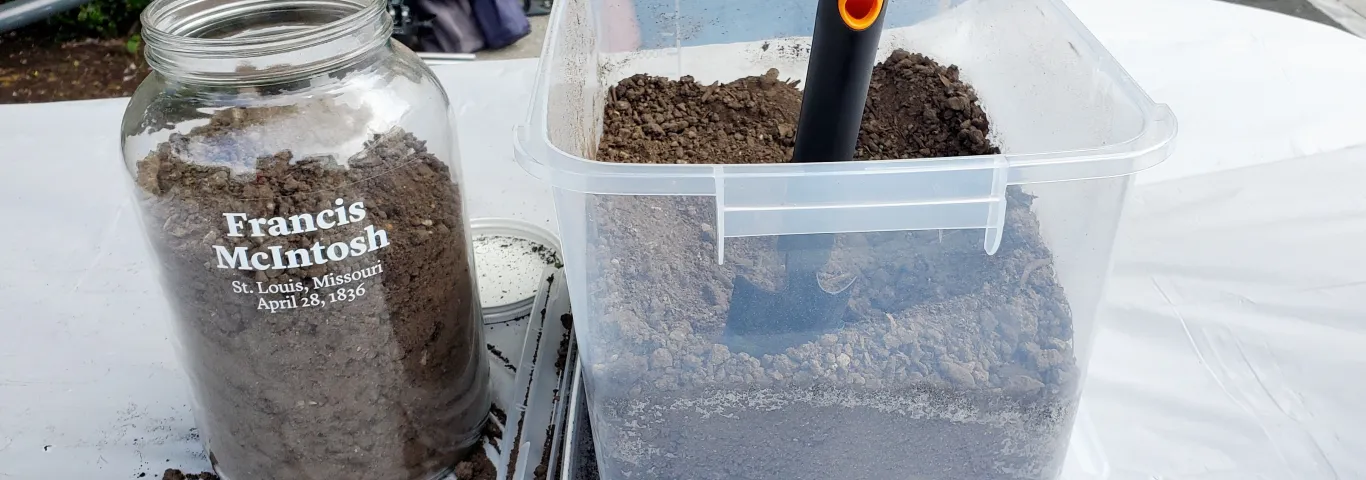
Holding the small garden trowel in my right hand, I pause. I have been waiting in line and now it is my turn. On the table before me is a plastic bin containing dry soil, and next to it an oversized glass jar, partially filled with that soil. Our task is to transfer soil from the bin to the jar, a single scoop, then hand the trowel off to the next person in line. On this bright spring morning, had you in passing glimpsed our tableau vivant, you might have mistaken it for a gardening workshop.
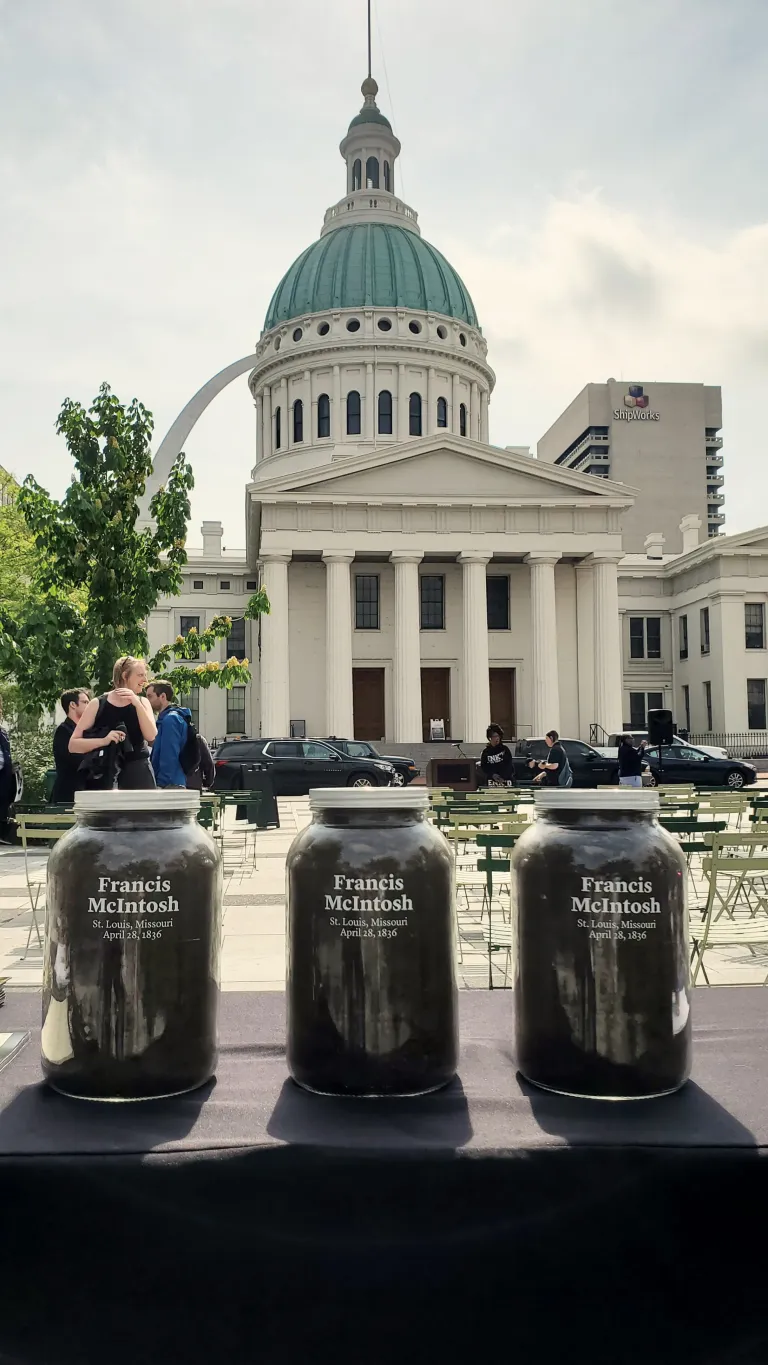
I pause — at first to ground myself in what is in fact a ritual of collective remembrance. We are gathered here on April 30, 2022, in Kiener Plaza in downtown St. Louis, near the site of the 1863 vigilante mob lynching of Francis McIntosh. Earlier, community members collected soil on the street corner where McIntosh, a free Black man from Pennsylvania, was murdered. He had been working as a porter and cook on a steamboat docked in St. Louis when he was caught up in an altercation with two St. Louis policemen that left one of the officers dead, landing McIntosh in jail. According to the Reparative Justice Coalition of St. Louis, co-organizer of today’s event: “The case is well-documented, in part for its incredible brutality. … A white mob abducted McIntosh from the jail, tied him to a nearby tree, and burned him alive as a crowd looked on. Historian Walter Johnson writes in The Broken Heart of America, ‘the burned tree [was] left standing on the corner of Seventh and Chestnut for years afterward, an attraction for whites traveling west and a grim warning for Blacks passing by,’ illustrating one of the ways the lynching would continue to haunt the region, perpetuating racial terror, and corrupting the rule of law.”
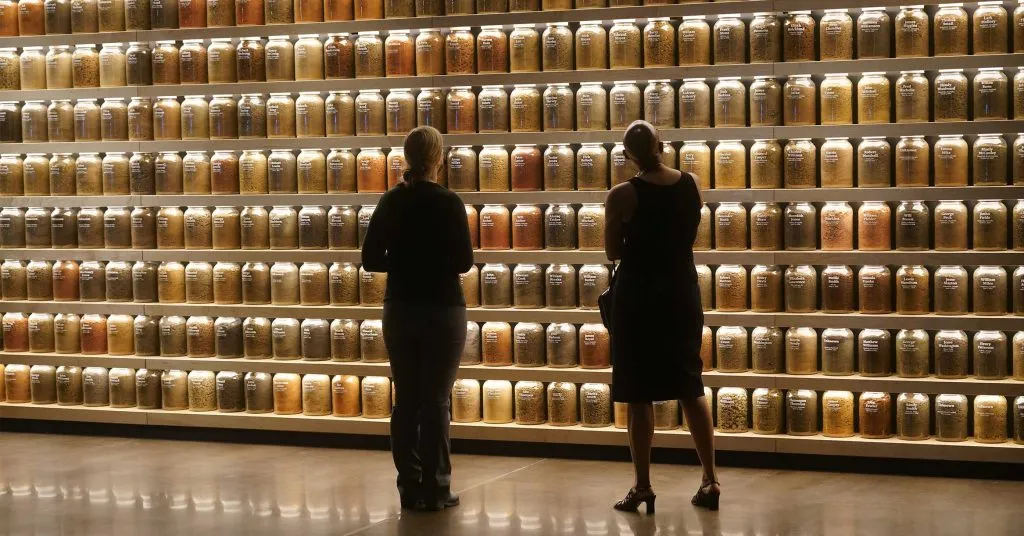
Here on the plaza we’ve just heard remarks from St. Louis officials including Mayor Tishaura Jones, along with community elders and activists, offering ancestral blessings and honoring McIntosh’s memory while calling attention to present-day systemic inequality and violence. The event is part of the Equal Justice Initiative (EJI) Community Soil Collection Project. Around the country, volunteers, sometimes including a victim’s direct descendants, gather soil from documented sites where lynchings were perpetrated. The ritual continues as participants place the soil in two (sometimes three) identical jars bearing the person’s name, place of lynching and the date, if known. At least one jar remains in the local community, and one is preserved and displayed at the EJI’s Legacy Museum in Montgomery, Alabama.
Having read with horror the story of McIntosh’s lynching, I am prepared for this to be a heavy ceremony. But now I find myself pausing for another reason, one that takes me by surprise: flashbacks to a different ritual I have participated in over the years, that of Jewish burial. Gathered at the gravesite, mourners are invited to shovel dirt onto the casket once it’s been lowered into the ground. I had done this for friends and for people I did not know well, and each time, performing this physical action brought me closer to the human life lived and lost. Vanzetta Penn McPherson, who participated in a Soil Collection in Alabama, recalls a similar feeling: “It is a confrontation … with truth,” she says in an EJI video. “Digging on that dirt was a poignant way to connect to the time, the event and, most importantly, the man.”
As in so much Jewish ritual, there are multiple variations on the shoveling tradition. While the sensible way to hold a shovel in ordinary life is with the cupped side turned up, to maximize the amount of dirt you pick up in each scoop, an alternative tradition calls for holding the shovel the “wrong” way, on purpose. Shoveling with the cupped side facing down expresses your reluctance at having to perform this socially necessary yet painful, regrettable task. You deliberately make the task more difficult.
Trowel in hand, I now read the simple epitaph on the jar before me: “Francis McIntosh, St. Louis, Missouri, April 28, 1836.” And with intention, I slip my wrong-way trowel cupped side down into the mound of soil in the box on the table. When I lift it back up, most of the dirt slides off and lands back in the box. With each of my attempts, I am able to transfer only a few bits of soil into the jar. It’s just not how a trowel is designed to work. Though people are watching, I do not explain my strange use of the tool — like everyone else, I perform my turn in respectful silence and pass the trowel to the next person in line.
* * *
The disparate traditions, memories and emotions that converged in this moment on Kiener Plaza attest to one aspect of what cultural theorist Michael Rothberg calls “multidirectional memory.” In his 2009 book by that title, he writes, “Pursuing memory’s multidirectionality encourages us to think of the public sphere as a malleable discursive space in which groups do not simply articulate established positions but actually come into being through their dialogical interactions with others.” Multidirectional memory affords space for unexpected connection and solidarity as people from different groups don’t merely participate alongside one another (or even in competition with each other for memorial recognition) but break from separate established positionalities and “come into being” together.
These kinds of embodied experiences have inspired and guided my dissertation research and writing, focused on commemorative practices surrounding slavery and its legacies in the U.S. and the Holocaust in Europe. From rituals like the Soil Collection Project, to historical reenactments and memorials involving performance, I prioritize firsthand observation and, when possible, I participate in commemorations myself. The difficult histories being remembered don’t belong to any single community but are inextricably woven into our collective local, national and transnational past. I always appreciate shared opportunities for such remembrance, in part because I am interested in embodied cultural practices as a way of knowing — the body as “cognitive agent” — an idea explored by Bill Bissell and Linda Caruso Haviland in their co-edited volume, The Sentient Archive: Bodies, Performance, and Memory. Many of the contributing writers come from performance, especially dance, but their insights also speak to commemorative practices.
In her essay “Touching History” in The Sentient Archive, Ann Cooper Albright poses the question, “How is one touched by history? The verb is chosen with care. I am not asking how one is affected by history. Nor am I asking what one learns from history. Instead I want to think about how one is touched by history. … Reaching out to touch something or someone insists on its own reciprocity, for it is impossible to touch in a way that does not also implicate one’s own body.” She continues, articulating a pillar of my own research methodology: “I try to find ways to use my physical intelligence to help understand what is at stake while researching a particular historical moment, choreographer, or movement form. I think of this engagement as creating an embodied archive that parallels the written or visual archive, helping me to locate more than mere facts.”
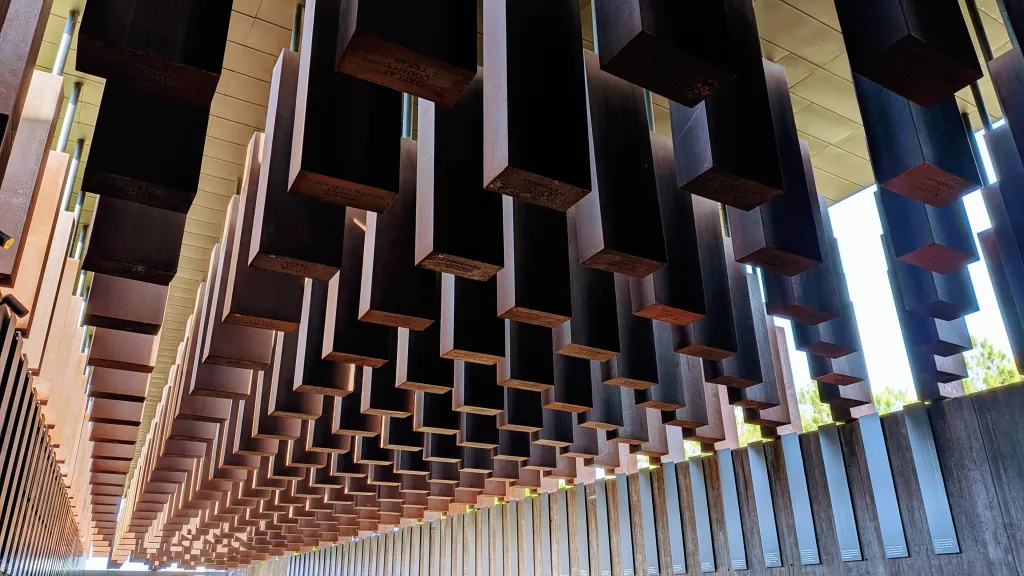
In late April 2026, four years after the Francis McIntosh memorial event in St. Louis, I travel to Montgomery for my first-ever visit to the National Memorial for Peace and Justice, where 4,400 Black people killed in racial terror lynchings between 1877 and 1950 are commemorated. Looming on a hilltop, the central monument consists of 805 suspended stelae, each representing a U.S. county where a lynching has been documented.
Walking through this dense, inanimate forest of rusting, vertical slabs, each six feet tall and initially at eye level, I want to take my time, even as high schoolers who arrive by the busload rush past me. I want to read the names of each person and place etched into the steel, though their sheer number makes this impossible. The ground begins to drop off sharply and soon I’m standing at the lowest point, the stelae hovering high above me. I feel dizzy, engulfed by the scale of the monument and the atrocities it recalls. The sound of flowing water draws my eye to the inscription on the stone wall beneath a shimmering wet veil of symbolic tears, the all-caps text outstretched in a single unbroken line: “Thousands of African Americans are unknown victims of racial terror lynching, whose deaths cannot be documented, whose names will never be known. They are all honored here.” The text’s insistent horizontality feels like a protest, an unwavering march forward and out of the crowded, stark verticality of the monument’s main design elements.
I spend the next day immersed in the nearby Legacy Museum, another EJI site, a museum tracing the history of systemic racialized violence from the transatlantic and domestic slave trade, through Jim Crow and racial terror lynchings, to mass incarceration. Partway through dozens of profoundly moving, information-packed, multimedia exhibits, I encounter an immense wall of shelves holding hundreds of jars from the Soil Collection Project. The display is surprisingly colorful owing to the many different regions the soils come from, but the shelves are so tall that it’s hard to read the names on the upper level. The jars are not arranged in alphabetical order, and I feel overwhelmed searching for Francis McIntosh; while looking for just one name, you have to read them all. Finally, I find the jar we had filled in St. Louis, its “twins” preserved back in Missouri, one at the Griot Museum of Black History in St. Louis, and one at the Black Archives of MidAmerica in Kansas City. And I remember, when my brother died at 19, and years later my father, we divided their cremains among several different resting places, because their lives mattered in those places. My brother’s and father’s deaths were both due to natural causes and can in no way be compared to the thousands of lives lost at the hands of violent mobs. But this effort to memorialize through a material like soil (to “matter” Black lives and memory), coupled with my personal connection to such attempts in my own (white European immigrant) family, makes this memorial hit with added force.
Rather than a final act of farewell, dirt shoveled onto a coffin to bury it, the Soil Collection Project helps excavate forgotten or erased histories. It invites us into an embodied ritual of shared grief and remembrance, and it reminds us of our human kinship. It creates a lasting, visible memorial to the individuals whose lives were taken, honoring their “involuntary sacrifice,” as Penn McPherson, the woman who commented on her participation in the EJI video, pointedly put it. The project’s mnemonic power, I now know, resides not in the soil alone, but in the many people whose embodied acts of care, and of touch, make manifest a refusal to forget and a call to continue fighting for justice.
Read more
To learn about WashU’s historical connection to the lynching of Francis McIntosh, see the article co-authored by Geoff Ward, professor of African and African American studies, and Kelly Schmidt, reparative public historian and lecturer, “Remembering John O’Fallon.” O’Fallon, an anti-abolitionist who later became a founding trustee and primary benefactor of the university, was committed to the defense of chattel slavery and white racial dominance. He is reported to have served as foreman of the grand jury that declined to indict the racist mob responsible for the 1836 lynching of Francis McIntosh.
Headline image: A 2022 ceremony memorialized Francis McIntosh, who was lynched in downtown St. Louis in 1863. Photo courtesy Sylvia Sukop.