Interview with Faculty Fellow Marjan Wardaki
In her forthcoming book, Marjan Wardaki, assistant professor of history and Faculty Fellow in the Center for the Humanities, follows Afghan and Indian scientists who traveled to Germany between the world wars, where they forged intellectual and professional networks that crossed imperial boundaries. Their experiences and engagement with German technology reveal how technical knowledge moved between Europe and South Asia, and how scientists drew on diverse intellectual traditions to pursue new possibilities beyond British control. At the center of this story is Afghanistan, which emerged in the early 20th century as an unlikely hub of international collaboration and anticolonial ambition. By recovering this largely overlooked history, Wardaki’s book challenges familiar narratives of Afghanistan as a perpetual site of conflict and offers a fresh perspective on the relationship between science, technology and the struggle for political independence.
What is your project about?
I am currently writing my first book, a colonial and postcolonial history of science in the South Asian subcontinent. It uncovers the history of the scientific diaspora of Afghan and Indian scientists who traveled to interwar Germany to reshape the landscape of modern science outside the reach of the British empire.
The book shows that migrants transformed both European and South Asian sciences by combining their German training in technology with Indo-Persian, Islamicate and artisanal traditions. In doing so, they generated alternative epistemologies that challenged imperial science and contributed to the making of national institutions. Foregrounding Afghanistan as a critical hub in the history of South Asia reframes the geography of empire and science in the early 20th century. I hope the book also provides a new vocabulary by which we can describe Afghanistan, away from the contemporary categories of religious fanaticism, perennial war zones and the graveyard of empires, which I show are all inherited colonial terms.

What brought the South Asian scientists to Germany?
The First World War did not end on the battlefield. Its aftermath pulled science into the service of empire, as chemists, physicians and engineers came under military control. Rivalries moved from politics to laboratories, turning institutions into a battleground for knowledge and power. In colonial India, science was both a tool of domination and a crucible of resistance. Think of this in terms of cultural, institutional, national and indeed physical resistance.
At the same time, interwar Germany was just stripped of its colonies and was now looking to forge a counter-hegemonic scientific language that could attract trainees and experts from across the colonial and postcolonial states. The historical moment was ripe, because as most of the Islamicate world entered a European-controlled mandate system, Afghanistan broke free from British grip in 1919 and engaged with the German state and its engineers. This unlikely partnership opened new pathways for both Afghan and Indian experts in emerging fields, who traveled to interwar Germany to train in technology. The book shows how these migratory movements impacted the transformation of Afghanistan became more than a nation-state: It became a laboratory of anticolonial ambition, where decolonial science took root and empire itself was unsettled.
Your project positions Afghanistan as a critical hub in the history of South Asia and science. Tell us about this history.
Over the course of the long 19th century and early 20th century, a series of three Anglo-Afghan Wars were fought (1839-1842, 1878-1880, 1919). My book discusses how each of these conflicts were carried out with the goal of turning Afghanistan into a “scientific frontier,” a term that denoted not only a border between British India and Afghanistan, but also to organize a military infrastructure by which British India could be protected from Imperial Russia.
For example, as the British troops pressed forward along three invasion routes, military engineers, or “sappers,” traveled behind the army to erect telegraph stations that connected Delhi with Kabul. Yet, each time poles were built up, using, of course, local timber found in the foothills of Afghanistan, local tribes cut these wires as a form of protest and as a way of destabilizing imperial communication. As the German state became involved in Afghanistan, these counterhegemonic practices became much more sophisticated.
Why study the history of science in Afghanistan?
We don’t always think of Afghanistan as a site of innovative projects in science and industry. Yet, as I show in this book, by looking at the history of science in Afghanistan, we learn two lessons. Firstly, the creation of sovereign industries along with a new foreign policy brought the country in dialogue and collaboration with engineers, intellectuals and diplomats from Germany, Japan, India and many others. Given how unique Afghanistan’s decolonial moment was — at a time when majority Muslim states were still colonized or still under British suzerainty, a series of international actors had vested interest in securing and maintaining a free Afghanistan. This historical moment brought many of these anti-colonial projects to Afghanistan. For example, very few know that through one of these alliances via Berlin and Tokyo, it was in Kabul that India’s first independent “government in exile” was founded.
The second lesson is that we often think of science and technology as a linear advancement designed to make all our lives easier and better, but my book exposes vulnerabilities as well as the different ways in which technology become operational. For example, on the one hand, the meaning and implementation of technology manifested through positivists or empiricist definitions that justified imperial and military expansion on a global scale. At the top state level, it served nationalist formulations, driven in some cases by ethno-religious ideas or by towering figures like King Aman Allah (in Afghanistan) or Jawaharlal Nehru (in India). But in the book, technology is explained through its diasporic platform, encompassing social and intellectual spaces in interwar Germany where the convergence and collaboration among a broad spectrum of migrant scientists from the Global South temporarily dissolved their differences and aligned them for anti-colonial reasons.
I hope that by the end of the book, readers can ask new questions, including why is it beneficial to maintain an impoverished and undemocratic Afghan state? Who benefits most from this arrangement? Also, why did the United States, claiming to spread democracy, bring the Taliban back to Afghanistan?
What are your sources for this history?
Researching places like Afghanistan comes with certain challenges that require scholars to become creative. For one, decades of warfare and waves of humanitarian crisis have made the safeguarding of historical artifacts difficult to sustain. Despite this, Kabul University has maintained an incredibly rich database for both digital and in-person access. I have benefited from this archive, collecting many Persian-language journals and newspapers. The Library of Congress also features a rich manuscript collection, including military-technological pamphlets and lithographs that were lost during the Second Anglo-Afghan War. The surveilled nature of these migrant scientists means that we can find meticulous documents at the British Library, where I have spent many years. Then there are diasporic collections held all over the world. I will always be indebted to Paul Bucherer’s rich and multifaceted library in Liestal (Switzerland), as well as the private archive of the prolific and foundational scholar of Afghanistan, May Schinasi, in Nice (France). This is the historian’s version of a candy store: smelling dusty books by day and exploring these beautiful cities by night.
Because the migrant scientists I study were responsible for the founding of many important institutions, I have had the privilege of visiting the World Health Organization and the League of Nations in Geneva; the Brechna Archive in Karlsruhe (Germany); university and technical school archives in Leipzig, Berlin, Dresden and Bonn/Cologne; the Charitè archive in Berlin; the University of Edinburgh archive and many more. I am also looking forward to traveling to India and Japan next year, where I will visit the Cipla archive in Mumbai, the Alkazi Foundation for the Arts in Delhi and the several botanical research institutions in Tokyo and Kyoto that collected seeds from Afghanistan for my second book project.
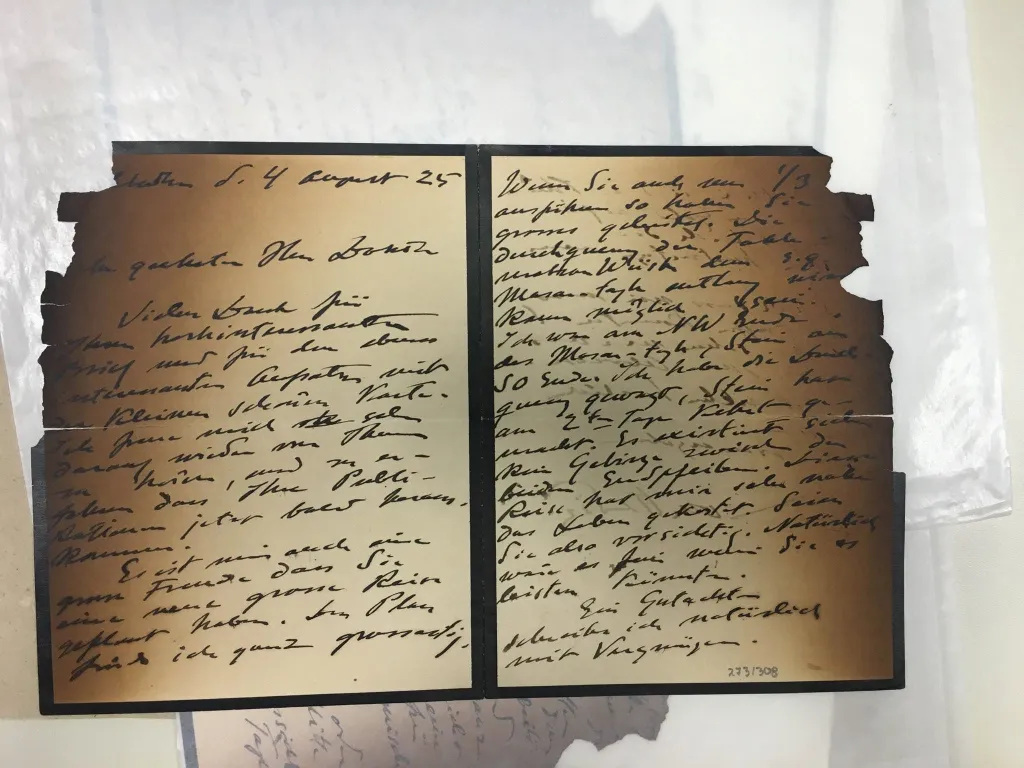
There are many more to list, including Zentrum Moderne Orient, the German Foreign Office and so many more. Being in the archive is one of the most fulfilling experiences because not only are you taken back to an era, but you get to see the image history of the object itself. Like in this picture (above), this is a document from the early 1900s, but we can see remnants of a fire and the war after 1945.
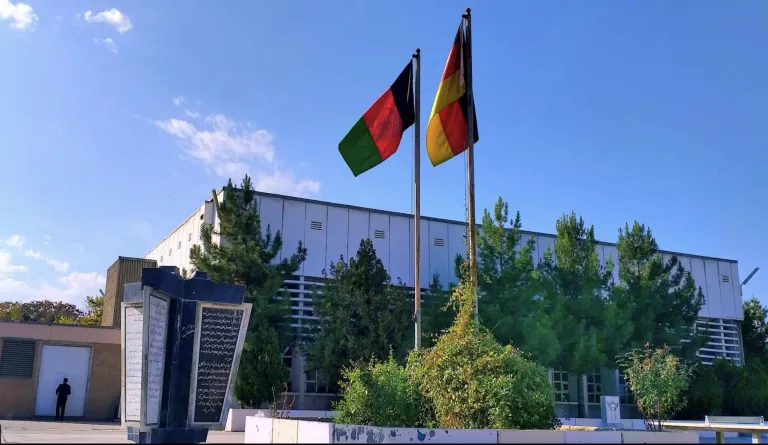
Headline photo: The flags of Afghanistan and Germany fly outside Amani High School, a school founded in 1924 in Kabul with German backing. For much of its history, German teachers and German-trained Afghans who returned taught core mathematical, scientific and technical classes directly in the German language.