G. Ridout is a PhD student in the Department of English, co-editor-in-chief of WashU’s literary magazine, The Spectacle, and a fellow in the McDonnell International Scholars Academy.
Hailed as “a daring, daunting, and dazzling writer” by cultural theorist Bill Brown, and called “one of the greats” by York University’s Jean-Thomas Tremblay, Grace Lavery is professor of English at the University of California, Berkeley. Her recent academic monograph, Personal Demons: Possession Narratives of Late Liberalism, takes on a wide array of texts, ranging from productive and provocative (David Lynch’s Twin Peaks, Jordan Peele’s Get Out) to tawdry and pernicious (L. Ron Hubbard’s Dianetics, J.K. Rowling’s Harry Potter). Engaging these unlikely voices, Lavery contests neoliberal notions of soul and body, sex and desire, offering a brilliant new theory of embodied living through the end of liberalism.
On her visit to WashU, Lavery spoke with PhD student G. Ridout over lunch at a St. Louis favorite, The Stellar Hog. They discussed Personal Demons, the fifth anniversary of Lavery’s memoir, Please Miss, the realities of fame and life as a trans woman in academia.
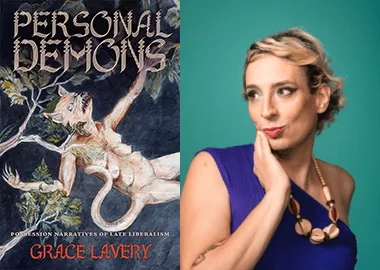
Let’s start with Personal Demons. The book’s archive consists of demonic possession narratives that you've characterized mostly as dreck. What attracted you to this motley crew of dreckish texts?
Somebody referred to them as pop culture curiosities, which is also true, in the sense that none of the texts that I talk about — even those of David Lynch — really exemplifies very much. I was hunting for fissures, gaps in the ways in which we understand the world. The dreck in question is useful, not because it's interchangeable with other dreck, but because it isn't, because it’s unique. Thinking about Scientology as a literary object, for example, teaches us something about freedom and necessity. In general, and particularly in this book, I’ve been thinking about the gaps in the ways that we build ourselves.
Personal Demons invites us to consider the relation between demonology and transsexuality. What's at stake for you in that project?
My interest in that convergence came about from noticing that trans people are often described as people who have been demonically possessed. It's fairly common in evangelical and fundamentalist Christian environments. What’s at stake for me is that so much transition rhetoric, trans studies and trans discourse takes an essentially defensive position, and I think we can take a dialectical position. So, instead of saying, “We’re not demons,” we could say, “We are demons, but so are you.” That’s the sort of political gesture I’m making in this book and maybe elsewhere in my work, which is, your system depends upon some kind of abject figure, but you’re no different to them.
Do you see this work putting anything at risk for you?
I’ve had some pretty shitty things happen to me as a result of my writing. I talk about some of them in the introduction. I get scared, but it’s also not obvious, exactly, what I could do to diffuse that fear, and I never want to seem self-pitying because I’ve had enormous good fortune and institutional privilege. At the same time, visibility can be a trap. One thing I’m worried about is whether people will seize on this book as “Prominent trans professor admits demonic possession narrative.” My work will very likely attract bad faith, predatory readers trying to find this or that sentence to discredit me. And then I’m worried that some contingency of trans people will feel betrayed or annoyed or irritated. That’s probably likely. There’s a contingency of online trans people who think everything trans is self-evident. But if I thought [transness] were self-evident, I wouldn’t have written this book.
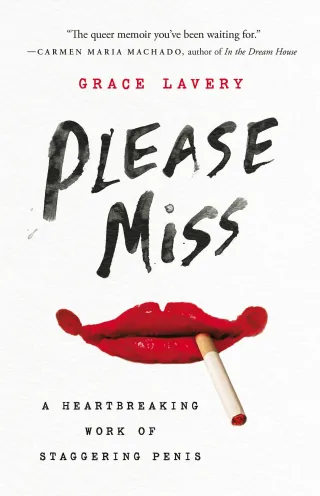
I’ve heard you say that you write on your phone sometimes. I’m thinking of your memoir, Please Miss: A Heartbreaking Work of Staggering Penis. What occasions your writing these days? Where did Personal Demons happen?
Personal Demons happened on a laptop; I don’t think I wrote any of it on my phone. I hadn’t put that together, but it’s true. I wrote the previous book almost entirely on my phone, and the book before that, too. There’s an interlude in Personal Demons where I talk about how I wrote the middle part of the book when my baby woke up in the middle of the night. I was fascinated by my baby’s experience of waking up. Maybe he was excited, or sad, or traumatized to wake up. It’s hard to tell. That triggered broader questions: Why do we think about waking up so much? Why are so many political narratives these days about waking up? Is there any version of living that doesn’t depend on the existence of a “red pill”? That question is central to the book. I also wrote during the late stages of my partner’s pregnancy, and what fascinated me at that point was this reading of the movie Ghost that I’ve had kicking around, which I’m very proud of. It became a claim about neoliberalism, which was unexpected.
Please Miss will celebrate its fifth anniversary in February 2027. How has your world changed since then? Could we you ever see a follow-up, Ghostbusters II style?
That’s so funny. Of course, Ghostbusters is referred to in the book, where I propose the Stay Puft Marshmallow Man anti-hero prequel. I don’t think a sequel is impossible. I didn’t know who I was writing for when I made Please Miss. I didn’t know if the book had an audience; I hoped that it did, but I didn’t take it for granted. On the other hand, I was thinking, you know what? Maybe this is gonna be adapted into a fucking HBO show somehow, but I don’t know where that idea could possibly have come from, because the book is completely unadaptable. Obviously.
In a hypothetical world where the memoir is adaptable… If you’re the casting director at HBO, who’s your pick to play Grace in the limited series Please Miss?
The politically correct answer would be some unknown trans actress trying to make a name for herself and needs a big break. But you know, if Kathryn Hahn would take it, she could have it.
In the talk you gave at WashU, “Oscar Wilde After Cultural Studies,” you started with that famous quote from De Profundis: “I was a man who stood in symbolic relation to my age.” How do you stand in relation to your age?
I am often credited far too much for the standard thing: trans woman comes out, “oh my god, you’re so brave,” or “you’re so courageous.” It’s annoying for so many reasons. I get this, especially as — I think? — the first transsexual to go through tenure in an English department in the U.S. The goodwill, the valor, is completely stolen because I didn’t come out until I had a book contract with Princeton. I delayed it for that reason. Until that point, I had been on the most ludicrous glide path where my whiteness, my maleness, my privilege, my accent, were all money in the bank. Rather than difficulty only being experienced in terms of trauma or in terms of social struggle — both of which are fucking important, by the way — I want it to be okay for there to be intellectual difficulty in existence. Intellectual struggle. That’s something we don’t always know how to talk about.
To read more about Personal Demons and Grace Lavery’s other work, visit gracelavery.org.
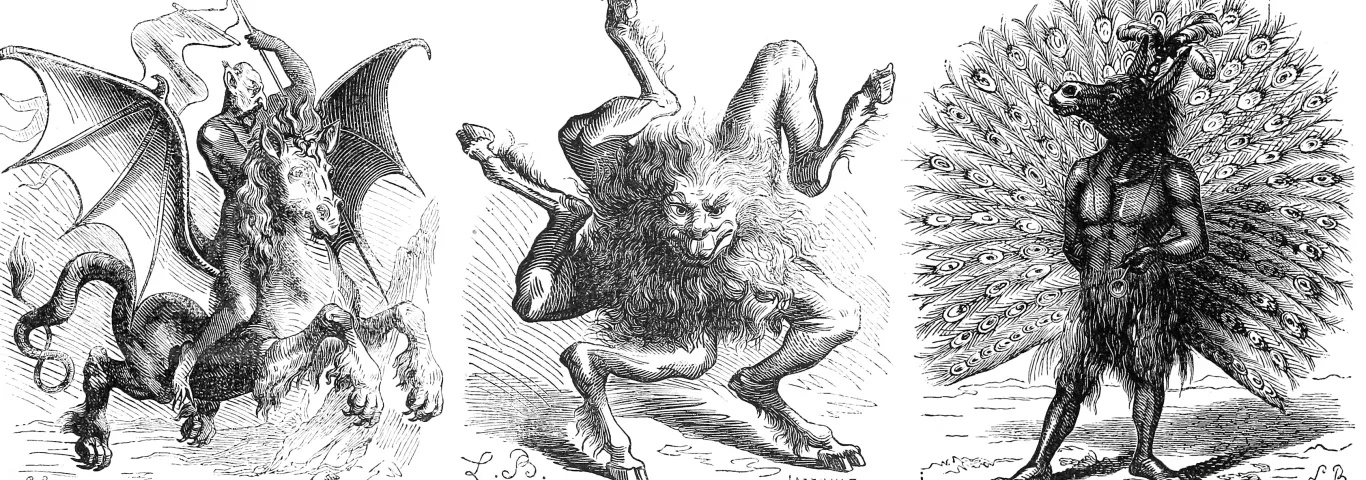
Headline image: Drawings of demons from Dictionnaire Infernal, a 19th century reference book on demons and demonology. Wikimedia Commons.