Liza Michelle Monter Arauz is a PhD student in Hispanic studies. Her current dissertation examines the role of women translators in the circulation of Latin American literature in the Anglophone world.
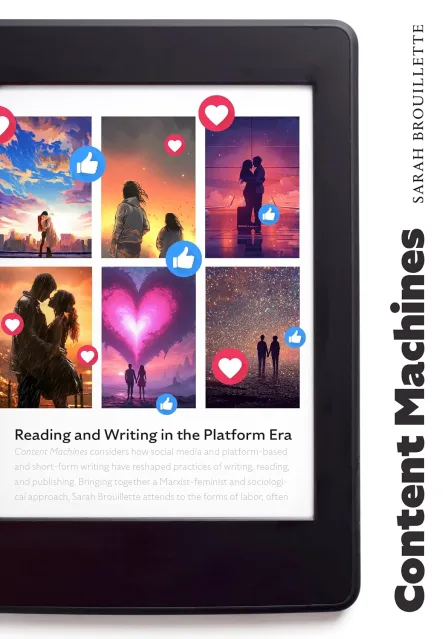
Sarah Brouillette is a professor of English at Carleton University. Her most recent book, Content Machines: Reading and Writing in the Platform Era (Duke University Press, 2026), examines how social media platforms are reshaping contemporary practices of reading and writing. She recently visited WashU to give the lecture “Platform Fiction” and the workshop “The Tradwife as a Problem for Research,” both part of the Global Comparative Humanities Working Group’s lecture series.
This interview has been edited for length and clarity.
In your lecture “Platform Fiction,” you identified romantasy as a leading genre, especially on Wattpad. Would you call it the genre of the long crisis? Is it a symptom or a device?
This is the Fredric Jameson coming out of me: the idea of culture as a symbolic resolution to problems which can never actually be resolved in the real world, at least not until we have a different world. That is the function of a lot of mass culture — to provide people a way to just survive what’s very difficult to otherwise survive. I’m always thinking about fantastical outlets for unanswered longings.
I'm ultimately interested in how these things do only symbolically what we should be doing socially. If you had a different social organization, then you would have a completely different kind of culture. In our culture there are different longings, perhaps maybe different fantasies, but it does tell you a lot about unmet needs if you look at fantastical registers in popular culture. Romantasy is a good case right now and so is the tradwife from different political angles.
How do you think about the affective dimension of your research? Where do you locate the emotions that these tropes produce or that produce them?
In the case of the tradwife, the content is obviously poking at the failed promises of feminism. The idea that you could have it all, a loving equalitarian partnership and a fulfilling career. Then you have young women looking at a future where neither of those might materialize, who may see that as unfair and then feel like they want to blame someone. And it’s easy to blame feminists and to think that it’s because we were sold a false bill of goods and actually we shouldn’t be trying to be fulfilled, authentic individuals, that that’s a liberal feminist myth of modernity and that we just need to retreat into a social role where we’re doing for others, for our children, for our husband, whatever he’s like it doesn’t matter as long as he has enough money to support you being at home.
That is why I say fantasy because it has the capacity to — we use the term activate — get you out of that dissociative scroll where you are just slumped and you are barely paying attention, and it is because it touches something. If it did not do that, it would not work as content. It wouldn’t be as successful as it is. It is important that it is activating an affective structure and obviously part of it is rage bait. Some people are just getting mad at it, but a lot of it is just longing. That is what will make people watch these images over and over again, these images of the traditional housewife, because it is beyond what anyone can actually imagine happening in their lives. It is often just an image of having enough money to be secure.
What are your thoughts on Substack, particularly the idea anyone who wants to be a writer or a recognized author must have one?
I don’t think it’s great for academics. Who wants to publish stuff that hasn’t been looked at? It’s unedited. Then again, a lot of people are also working with editors, hiring people to help them with their Substack. Though the platform says you are an independent business, you own your content, your account, in fact people are working with others to help them produce content because you have to meet the content baseline, which is a lot of content. Most academics I know don’t work that fast, and they don’t want to share their rough drafts like that on the internet.
It is kind of sold as an alternative to social media, as if Substack is more like the public sphere, more calm and more rational, a place where we will all have a calm debate. But in effect, that’s not really how it functions. Its major venture funders are like some of the worst people you can imagine. What’s in it for them? It’s starting to work more with Polymarket to make more money. A lot of creative writers don’t like it because they don’t want to be producing every week. They want to go away and just think and do their work in private and silence, but people don’t want to pay for that.
In the North American context, it certainly has become a worker’s inquiry for creative industries people. If you want to learn about people’s experiences in contemporary publishing you can find out so much and just read people telling their stories — everyone’s so aggrieved about what’s happening in the creative economy and in publishing industry, which is totally fair. They should be.
I think in literary Substack, they’re fixated on how things used to be, when we had intelligent, great novelists like David Foster Wallace and Jonathan Franzen — both white men, coincidence? — when people liked complex books and now, we’re in the era of the women-run where everything’s trash. So, there’s a lot of that kind of conversation, about how everything is therapy, and everything is romance and dumb stuff that only dumb people like.
Literary Substack sees itself as some kind of a safe haven and implies that commercialization of publishing just happened recently, that there was a great high point of culture and that we’ve lost all that. I’m obviously generalizing, but that’s how Substack functions. It’s an outlet for people. There is a lot of complexity, but the narrative is fixating on a symptom, which is women’s dominance in the industry.
But the underlying issues are how the institutions of cultural production have changed, and people are forced to try to work in these horrible ways, like on Substack. I’m kind of toying with the idea of seeing Substack as a place where you can go and feel validated because it helps explain why you have failed. Then, it becomes dignifying because it’s like you’re too good because you refuse to do what these successful writers will do. It’s a sign of election to be on the outside of success. But it is not invalid or completely untrue that men, young white men, especially straight men, are not a priority for publishers right now. But who’s reading and what audiences do they know they can sell a lot of books to?