Sylvia Sukop is a PhD candidate in the Department of Comparative Literature and Thought, in the Germanic Languages and Literatures program and the International Writers Track. A fall 2026 Graduate Student Fellow in the Center for the Humanities, she researches the commemoration of difficult histories including the Holocaust and U.S. slavery.
5 pm, Monday, November 9, 2026
Washington University, Umrath Hall, Umrath Lounge or Virtual
Register to attend
Czech and British historian and award-winning author Anna Hájková, based in London, is a faculty member at University of Warwick, where she currently directs the Warwick Centre for Global Jewish Studies. A pioneer of queer Holocaust history, she will deliver WashU’s 2026 Holocaust Memorial Lecture on Monday, November 9, centered on the story of two men, one Jewish, one an ethnic German living in Czech lands, whose story she uncovered in her research, likening it to the tragedy of Romeo and Juliet.
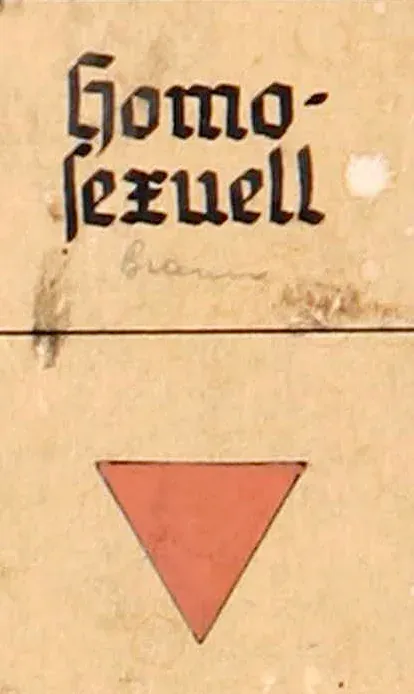
Ludwig and Paul lived as a couple in Prague for 18 years until they were arrested in 1942, during the German occupation, for violating the infamous Paragraph 175, criminalizing sexual acts between men. Their lives and their fates (Ludwig died at Auschwitz) would have been forgotten if not for Hájková’s persistent efforts to tell a more inclusive history by challenging systematic silence on same-sex desire and relationships in the Shoah. In her research, Hájková found that the couple self-identified as a Liebespaar (lovers, romantic partners) and, against all obstacles, they found ways to stay together, even at times when they had to live separately to deflect the attention of neighbors and the authorities. Ultimately, theirs is not just a story of oppression and persecution but also embodies moments of domesticity and kinship, connection and solidarity.
I spoke with Dr. Hájková over Zoom about how she came to a research focus on queer Holocaust history, the challenge of histories that are hidden or survive only in fragments, how even documents produced by perpetrators may contain authentic traces of victims’ lives and voices, and what Anne Frank’s diary suggests about desire versus identity as an analytical lens.
Sylvia Sukop: Although the field is changing, queerness remains a stigmatized and overlooked aspect of Holocaust history. Many people still don’t have a comfort level with it, even in 2026. As a historian, how did you first come to this subject matter?
Anna Hájková: My PhD was on Theresienstadt, and I have a long-standing interest in gender. My mentors encouraged me to pursue history of sexuality. Nancy Wingfield invited me to a workshop on sexuality in Central Europe and suggested that I write a paper about sexual barter in Theresienstadt. As I was writing the paper, I realized how stigmatized prostitution among the Holocaust victims is, and I started thinking more systematically: What are other modes of behavior that are so absolutely marginalized? Same-sex is similarly marginalized, or parents who gave up a child at selection [the process of sorting prisoners into those to be executed immediately and those temporarily spared to perform forced labor].
Sukop: In other words, these are the big taboos.
Hájková: Inspired by queer history, I knew the point is not to reiterate the stigma, but to analyze it. So, having written an article about prostitution in the Holocaust that won a prize, I thought, okay, maybe I will sit down and write a paper or a lecture about same-sex desire. At the time, Insa Eschebach, who was then the director of Ravensbrück Memorial, edited a collection of essays about homophobia in the camps. And as you know, German memorial culture is very fraught, and I thought, if Insa can pull it off, then it can be done. In spring 2016 I gave a talk at the Schwules Museum on queer desire in the Holocaust, and that was the rabbit hole into which I fell in 2015. Now I have emerged, you know, triumphantly! [Laughs]
Sukop: [Laughs]
Hájková: Like a very aged Alice with my book in my teeth. [Grinning]
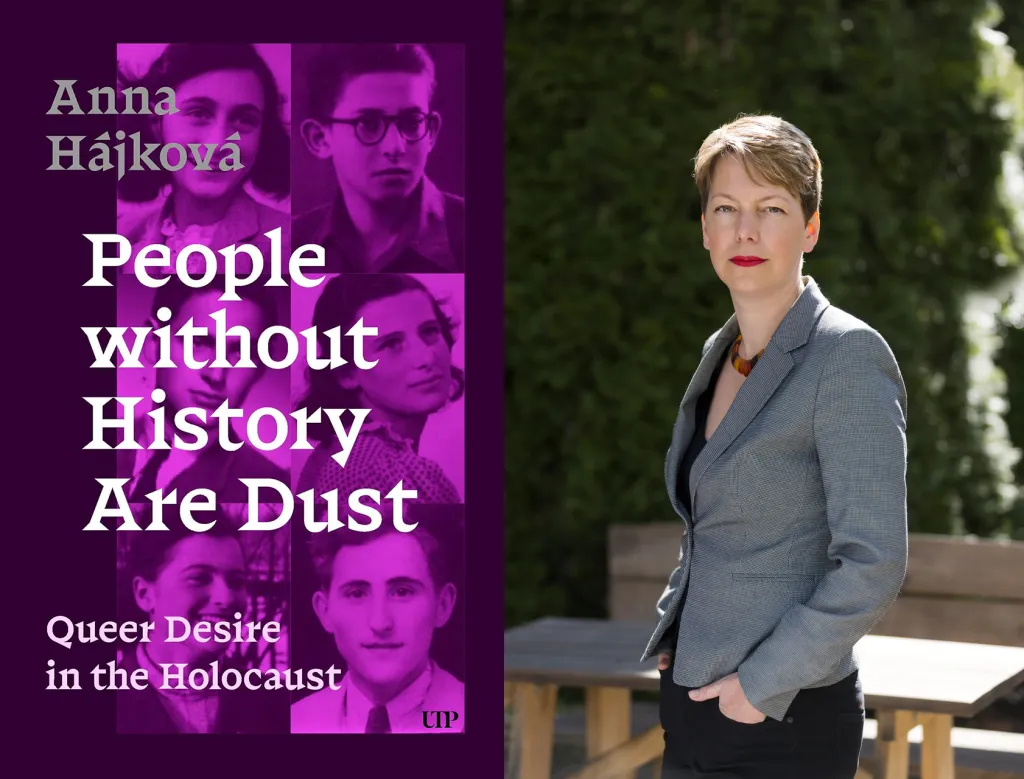
Sukop: Your book, People Without History Are Dust: Queer Desire in the Holocaust, has garnered great attention, including winning a Jewish National Book Award for 2025. You are now reaching an audience beyond academia.
Hájková: I did not want to be a historian’s historian. I want people to engage with my work also because it’s politically important. And, sadly, it becomes more relevant by the day. Which is also why I’m glad that I’m invited to the U.S. Though, when I think some of the decisions I have done about my work, I have also done not knowing what I’m getting myself into.
Sukop: Yes. You have taken leaps into the unknown, with unknown consequences.
Hájková: I guess it’s the only way.
SS: Over time, you uncovered a lot of new information, though it’s not always easy to make meaning from what you find, to know how much it can tell you. The nature of your sources is fragmentary, yet you marshal an incredible amount of detail through this kind of excavation. You describe how you were going through a file looking for one thing when you stumbled on the story of Ludwig, who was Jewish, and his partner, Paul, a Sudeten German. What did that moment of discovery feel like?
Hájková: Writing on a marginalized topic means that you have very few sources. But I have some sources, and I love researching. I try to focus my research on areas and languages with which I am familiar, so I know where to look. Specifically for the Prague couple, I knew I could look up the police registration files. I was able to find not only the sentencing records, which were in the Arolsen Archives, but also the trial. I just try to figure out where can I do research, and what can I unearth. Sometimes you spend a lot of time on chasing a trace, and it doesn’t go anywhere, or you find out something, but it just doesn’t add to the story. But you get a sense of where there are sources, and who were these people.
Sukop: For 20 years they lived together in an upscale neighborhood in Prague. They spoke the same first language, German, but they came from very different backgrounds in terms of hometowns, religion, occupation, class—they also had a notable age difference.
Hájková: I try to show them as people, people who have this loving relationship but also go to the baths and have sex with other men.
Sukop: Reading their story, I was struck by how modern, how contemporary the life that they were living feels. You mentioned the class difference of the two men, and there was also a racial difference. What did it mean in this period to be a “mixed race” couple?
Hájková: The emergence and construction of ethnic and racial differences is a given in any society. So, we really need to use race as category of analysis rather than a hard given thing. The meaning of being Jewish, being German, being Czech, shifts from ethnicity to race with the emergence of modern antisemitism and definitely the Nazi occupation.
What it meant to our couple? We will not be able to establish that. I think the fact that they were both German speakers was much more salient to them. Like many other mixed couples, even when they moved apart they continued their relationship. However—and this is where we need to bring in queerness into the history of mixed marriages—had they been a heterosexual couple, they could have married, and Ludwig would have never been deported or only in the last few months of the war. What is so meaningful for the Czech police and for the German police and for the Gestapo (that is, race) is not so relevant for the couple, because they are two men in love. So, this is another reminder that race means different things to different people.
Sukop: You write about the challenges that come with using primary materials that are documents produced by the perpetrators. For Ludwig and Paul, there are no personal diaries or letters, only police and trial records. This is where your narrative skill comes in, trying to create an authentic sense of their lived relationship, even without such personal documents. In your research, in your writing, how you attempt to do that?
Hájková: That is a good question, and this is not the first time that I think about it. When you look at the classical German school of history, they will say that the self-testimony needs to be freely chosen and cannot be given under duress. I think that misses much of the reality. Also, it raises uncomfortable questions about ethics and from whose perspective do we write.
Here, we have interrogations under duress, maybe under torture, where the two men say quite striking things. When they are asked, “Why did you have sex with that man?”—“Because I love him.” And I think that is remarkable and worth dwelling on. I know that other colleagues will say that these statements are under duress and we should not look for subjectivity in them. I disagree and I explain why. I don’t say that everything that we find in those interrogations is material that we can work with, but I explain why, rather than saying there is nothing, that there is something to work with.
I did not want to be a historian’s historian. I want people to engage with my work also because it’s politically important. And, sadly, it becomes more relevant by the day.
Sukop: Anne Frank is an important figure in your most recent book, People Without History Are Dust, which won the Jewish National Book Award. I think she’s foundational to your challenge to the “establishment,” if you will, of Holocaust memory scholarship. You write, “Anne Frank’s diary illustrates the importance of queerness, not so much as an identifying attribute as it is an analytical method.” Can you talk about that?
Hájková: Generally, to this date, operating with identity as a concept of analysis doesn’t help us understand what’s happening with sexuality. It’s not about saying Anne Frank was bisexual, or lesbian, or homosexual, or queer. It is about saying that the diary has traces of queer desire. But if she would have acted on that, had she survived, what she would have become and whatnot, that is not the point here. The point here is that as a historian of sexualities, I can say there are traces of queer desire. And in writing about queerness in the Holocaust, this is a relevant source.
Sukop: My last question is about the current political moment. Is the landscape of acceptance or even affirmation of queer historical research improving, or do you see backsliding?
Hájková: I think I this is a key question. There are so many things happening that are contradictory, which is thrilling to analyze but rather tiring to live through. You have two steps forward, three steps backward. What has been happening in the U.S., I would definitely see twofold. I would say that the public is more polarized than ever, and I have written in my book about Moms for Liberty and the library bans. But in terms of gender studies and queer studies and Jewish studies in the U.S., it’s more progressive than ever.