During summer, WashU graduate students get the chance to translate their academic skills to nonacademic career environments and learn some new ones through the Humanities@Work initiative.
The Center for the Humanities invites graduate students to get creative in exploring diverse career opportunities as part of their graduate training at WashU. Through Humanities@Work, a summer internship initiative launched in 2024, humanities PhD students gain hands-on experience with local nonprofit organizations while exploring new ways to put their research, writing and analytical skills to work.
All PhD students in the humanities and the humanistic social sciences are eligible to apply. Applications to the program will open in the spring term and will be accepted on a rolling basis until February 15. Students selected for the program receive a stipend of $3,000 for an eight-week summer internship. Internship organizations are subject to change.
More information
“We strongly believe that grad students can start to weigh a variety of career options early on in their training,” says Meredith Kelling, PhD, the humanities center’s assistant director for student research and engagement. “Doing so can help expand your understanding — as you train to become a scholar — of what scholarship can do in the world outside of academia.”
According to the American Academy of Arts & Sciences’ annual Survey of Earned Doctorates (SED), 30% of humanities PhDs nationally go into careers such as business, government and public policy, nonprofit administration and arts and cultural organizations. With those statistics in mind, WashU graduate students are seizing the opportunity to apply their academic expertise in new and exciting non-academic career pathways, thanks in part to Humanities@Work. In the two years since then, interns have reported experiences rarely found in graduate curricula, from employee onboarding to lesson planning and website development, that build practical skills and open up new possibilities for their careers.
Humanities@Work — spearheaded by Stephanie Kirk, PhD, director of the Center for the Humanities, professor of Spanish, comparative literature, and women, gender, and sexuality studies; and her humanities center colleagues Laura Perry, PhD, assistant director of research and public engagement; and Kelling — is designed to assist humanities PhD students in exploring career opportunities beyond the traditional tenure track, providing essential support and resources for those looking to navigate the evolving job market. “Community-based internships are a vital part of our humanities’ graduate student training,” Kirk says. “These opportunities allow them to enhance their skills and connect their research and knowledge to public-facing and community-engaged contexts. These experiences help prepare students for a variety of career pathways both within and beyond the university.”
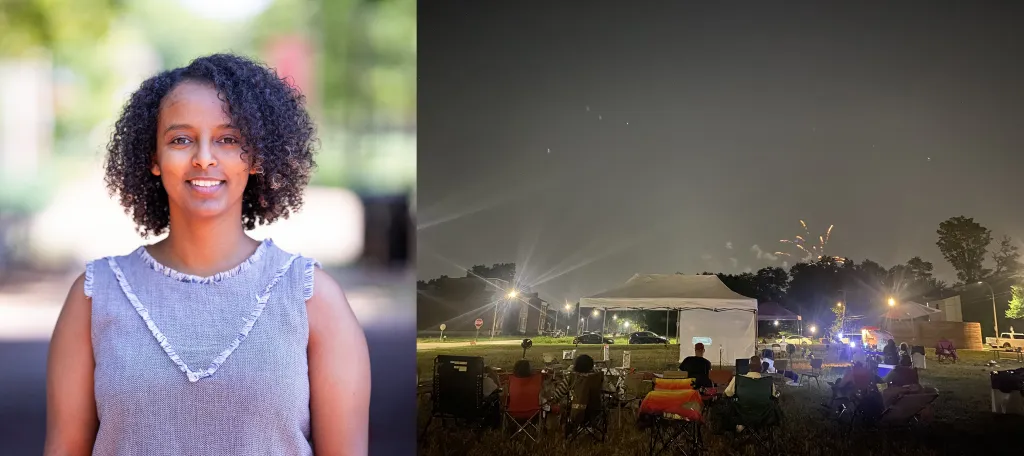
Initially supported with a $142,800 award from the National Endowment for the Humanities (NEH), the project was forced to pivot to university funding after the current U.S. administration’s mass termination of over 1,400 NEH grants. In a significant turn of events, however, a favorable U.S. district court ruling reinstated the various NEH grants late last spring. With renewed energy, Humanities@Work program will continue at least next three summers, with the aim of fostering diverse career paths for humanities graduate students.
Last summer, Humanities@Work collaborated with four community organizations — 4theVille, Missouri Historical Society, Forest ReLeaf of Missouri and The Griot Museum of Black History — that contribute to a thriving St. Louis region through missions focused on youth education, historic preservation, environmental health and cultural heritage. The internships foster a relationship that not only benefits the interns but also supports St. Louis community organizations.
But first, participants in the program receive comprehensive coaching and mentorship throughout the spring from the Center for the Humanities staff, in collaboration with the Center for Career Engagement. “We have students develop cover letters and resumes, which are very different from academic CVs, as a means of learning how to articulate their candidacy for a variety of work contexts. All of this builds on the rhetorical strategizing they learn how to do in coursework,” says Kelling. From there, students are required to conduct interview sessions with staff from the Center for Career Engagement. “Preparing for a job interview is a really important step that they’d miss if our program merely matched them with an organization. Being able to articulate what they bring to the table and training them to ask good questions about the work involved are crucial skills they’ll need later in any job search context.” This training culminates in job interviews with partner organizations in April.
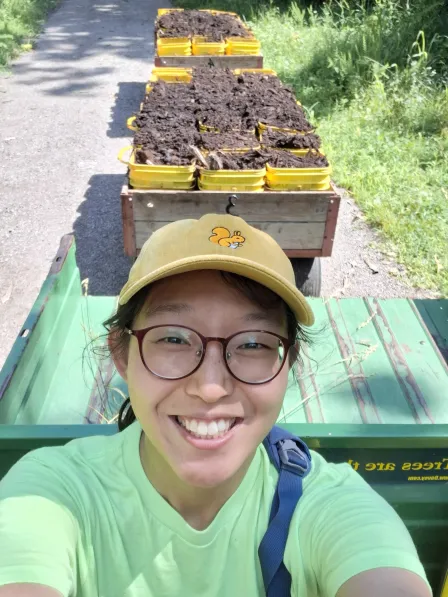
“We normally don’t get to hear so concretely about how to transition your CV to a resume in the humanities,” says Naomi Kim-Yu, a PhD candidate in English and American literature who interned this past summer with Forest ReLeaf of Missouri. “I also thought the mock interview was a really good experience,” she says.
John Ibembe, a graduate student in sociocultural anthropology, spent his summer with 4theVille, a community-based tourism and arts organization that aims to restore pride in the legacy of St. Louis’ historic African American neighborhood, The Ville. He emphasized how useful it was to undergo an American workplace orientation, noting that it was his first experience working within an American nonprofit culture.
Ibembe also noted how his anthropological research skills came in handy during the internship. “I specifically worked on a storytelling project,” says Ibembe, “that aims to capture the community memories of senior residents who have lived in The Ville for most of their lives. I was impressed by the depth of archival and historical research that 4theVille conducts in relation to their work on cultural heritage.” Placing students in community organization internships can help them see the skills acquired as scholars during their graduate studies in a new light. At the same time, the program’s intentional reciprocity is key to its success. “I think it’s really powerful that someone like John was able to use his developing ethnographic research skills to support this amazing community project,” Kelling says.
Internship experiences also allowed participants to extend their scholarly investigations toward more concrete applications, says Nia Sampson, an English graduate student who interned at The Griot Museum of Black History, an institution dedicated to sharing the city’s Black history, heritage and culture. “The most surprising thing for me was learning how to develop a lesson plan for K-12 students, which was not what I initially expected to do but, it turned out well since my PhD research focuses on childhood and girlhood studies.”
Interns also noted the opportunity to develop practical skills unrelated to their dissertation projects. In her role as Forest ReLeaf’s Humanities@Work intern last summer, Kim-Yu conducted field interviews and wrote and edited stories that highlighted the impact of its work in supporting a resilient tree canopy across the state. That’s when she saw an opportunity for Forest ReLeaf to publicize these stories more strategically via a dedicated WordPress webpage. “This was a task I started on largely because we realized there wasn’t a great ‘home’ for the impact stories online, so we wanted to set up a blog page. I had no idea that WordPress was so challenging! It was gratifying to get a grasp on the features I needed so that I could really have a final ‘product’ at the end in the form of the impact stories blog page.” These impact stories are essential for developing promotional materials and writing the grants that keep the projects going. For smaller organizations that might not have a full-time communications staff member, interns are an essential piece of the effort to document projects, which can help organizations refine their programming and strategize for the future. “Naomi’s work, to me, is a clear example of how humanists can be part of concrete change in the world,” says Kelling.
These opportunities allow them to enhance their skills and connect their research and knowledge to public-facing and community-engaged contexts. These experiences help prepare students for a variety of career pathways both within and beyond the university.
As the Humanities@Work program returns for summer 2027 — made possible by the reinstatement of the NEH grant — it promises a transformative opportunity for graduate students, equipping them with skills and experience needed to explore diverse career paths beyond academia. The Center for the Humanities, through the Humanities@Work program, strongly encourages eligible graduate students in the humanities and humanistic sciences to take advantage of this unique opportunity to expand their career horizons by exploring new pathways for their graduate training and expertise.
About the author
Grace Mensah-Fosu is a PhD student in English and Comparative Literature and a McDonnell Academy International Scholar. She is completing a mentored professional experience at the Center for the Humanities in fall 2026.